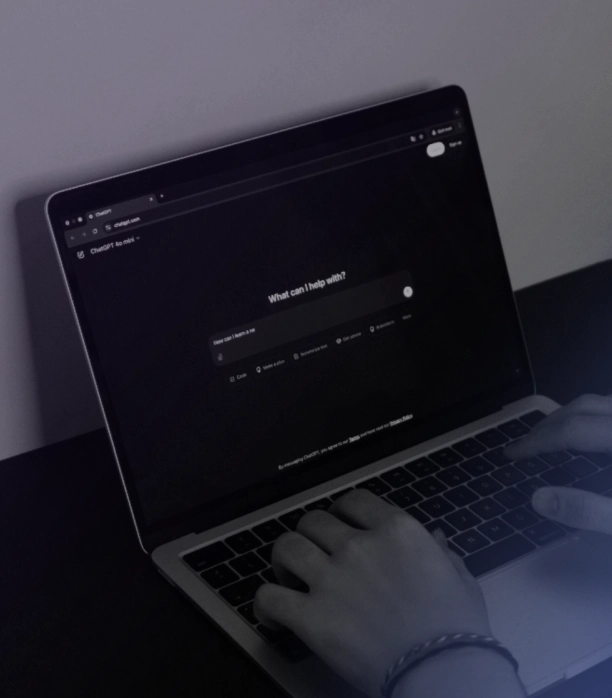



Most pastors are already using AI tools in their day-to-day work. Recent research from Barna Group shows that half of all pastors rely on AI to brainstorm ideas, 41% use it for Bible study preparation, and sermon preparation assistance has nearly doubled since 2024 (12% to 24%.) Only 13% of pastors say they do not use AI tools at all.
The defining question for church leaders in 2026 is no longer if you should use these platforms, but which tools deserve your trust and which ones create unnecessary risk for your congregation.
So, what’s worth adopting and what’s worth skipping? Let’s take a look!
Which AI tools for pastors are worth adopting?
Beyond sermon prep and weekly brainstorming, 37% of church leaders use AI for graphic design and 36% use it to research complex biblical or theological context. Most of this work happens behind the scenes during administrative hours via bulletin outlines, drafting routine emails, or generating promotional visuals.
When evaluating what AI platforms are worth adopting in 2026, it’s important to use tools that free up your calendar for personal ministry without compromising data security or replacing your unique theological voice.
Here are a few essential AI tools to use to save hours of work, free up more time for ministry, prepare sermons, and better understand your church congregation!

1. AI for church admin & executive support
Utilizing AI is a great timesaver to replace or supplement administrative and executive support. That’s because administration is the hidden tax on pastoral ministry: the relentless stream of inbox triage, calendar tetris, and creating content that lands.
Fortunately, there are powerful AI tools that help save hours of work every week. For example, Subsplash Workflows turns multi-step follow-up processes into clear visual plans that ensure every task is completed on time. Instead of letting paper connect cards gather dust on a desk, Workflows automatically assigns tasks to team members so new visitors, prayer requests, and volunteer sign-ups never fall through the cracks.
By combining custom forms with automated emails, your team can guide congregants through their next steps without managing tedious spreadsheets. To make building these processes even simpler, the platform features an AI workflow generator that builds complete follow-up sequences from simple prompts. You state your ministry goal in plain language, and the tool builds the necessary steps, forms, and triggers in moments—giving your staff back valuable hours every week.
2. AI tools for multiplying your sermon’s impact
Today, sermons don’t end on Sunday afternoons. In fact, for many churches, that’s just when the sermon begins its weeklong journey! Many churches and pastors today spend hours each week on the time-consuming process of recording sermons, downloading and uploading sermons onto different platforms, manually looking for great social media clips, splicing and editing, posting their sermons on YouTube, and sharing all of this out in a timely manner. Whew! That’s a lot of work.
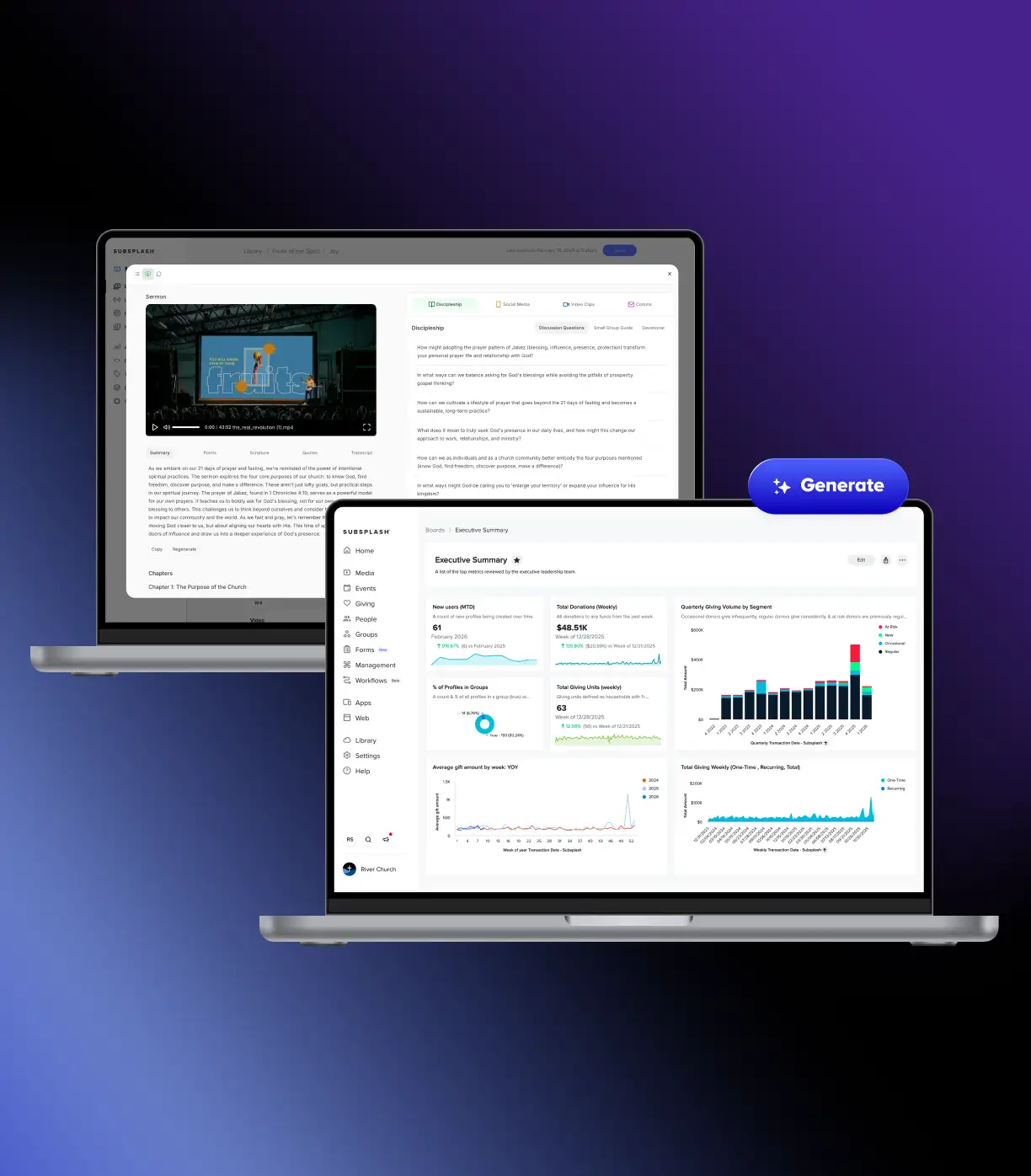
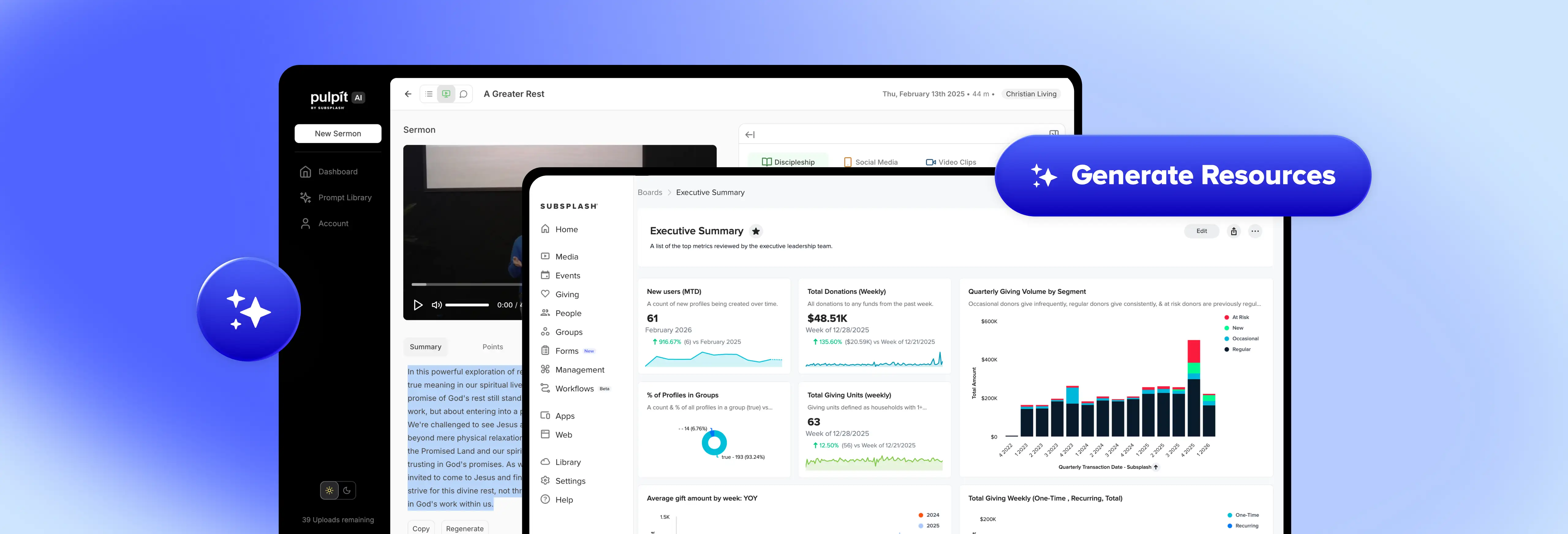
Thankfully, there are powerful tools built specifically for this exact process—like Pulpit AI. Pulpit AI analyzes your recorded sermon to generate over twenty pieces of sermon content in just a few clicks, including weekly devotionals, small group discussion guides, and short video clips. This ensures all downstream content carries your original pastoral tone and theological alignment.
On top of that, Pulpit AI helps directly with the sermon prep itself. Pastors can chat with their sermon, generate clean transcripts from videos, uncover supporting scripture and context, spark fresh illustrations, and so much more.
There is, however, a fundamental and ethical difference between asking an AI to write a sermon from scratch and using AI to multiply a message you have already preached that’s derived entirely from your voice and sermon. Pulpit AI is absolutely designed for the latter, helping pastors and preachers easily engage with their sermon, save eight to ten hours each week, create shareable content in minutes, and skip the heavy lifting of creating post-sermon content.
3. Built-in AI data & trend analysis
Data doesn’t have to feel like a cold, corporate spreadsheet. When it’s done right, it acts like a high-definition X-ray of your church’s relational health. Instead of guessing whether the summer slump is hitting early or wondering why second-time visitors aren’t plugging into small groups, modern AI surfaces those story-behind-the-numbers moments in seconds.
However, this analysis should only occur within secured environments where your data already lives. There are many places where guardrails matter: your church’s financial records, home addresses, and member details should never be uploaded into external, unvetted AI tools just to quickly build a report.
Built-in tools like Trends AI keep all that intelligence directly inside your primary Subsplash platform. Trends AI keeps your church financial and member records secure inside your primary platform, eliminating the need to export private spreadsheets to outside websites. You get powerful, actionable insights on demand, while your congregation’s private data stays completely locked down—no spreadsheet exports or third-party risks required.
Which AI tools are worth skipping?
AI for creating & writing sermons
Sermon preparation is where the tension between technological efficiency and pastoral calling is most acute. Sunday arrives with relentless predictability, but when Saturday night rolls around, the temptation to let an AI prompt handle the heavy lifting of preaching is understandable.
A sermon is a sacred responsibility birthed out of personal prayer, study, and intimate discernment for a specific local congregation, not from efficient AI tools.
While nearly a quarter of pastors edit or draft sermons with AI assistance, 51% express deep concern about plagiarism and losing integrity during message preparation. When AI writes the message itself, the core purpose of preaching collapses. Authenticity and spiritual authority do not come from clever phrasing; they flow from a pastor’s personal wrestling with Scripture.
AI works exceptionally well as a digital commentary or research assistant, but the final message must always be birthed out of your own prayer, study, and authentic voice.
Skip using generic AI tools for sermon prep that aren’t theologically trustworthy or sourced in biblical truths. Additionally, avoid using AI tools in such a way that compromises your sermon’s originality, inspiration, and integrity.

AI for pastoral care & spiritual counsel
Spiritual guidance requires real human presence, empathy, and holy discernment. While technology can optimize workflow, it can never mourn with those who mourn, sit quietly in a hospital room, or exercise spiritual authority.
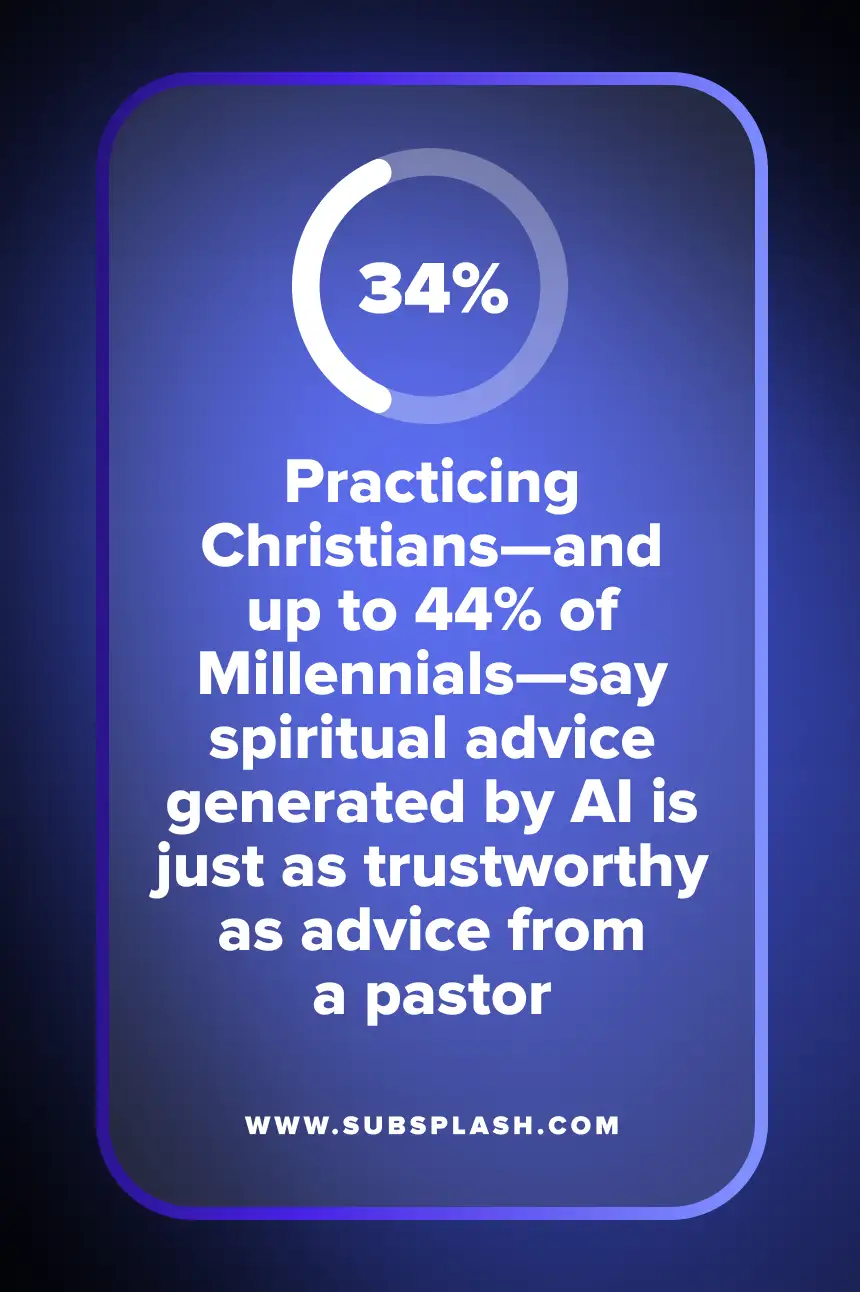
Another study from Barna Group reveals a concerning trend: 34% of practicing Christians—and up to 44% of Millennials—say spiritual advice generated by AI is just as trustworthy as advice from a pastor. Nearly half (48%) of practicing Christians report openness to trusting AI with their own spiritual growth.
This data exposes a quiet shift in how people seek direction. Late at night, when struggling with doubt, marriage friction, or grief, congregants are increasingly turning to chatbots before ever reaching out to a pastor. While an algorithm can quickly retrieve Bible verses or summarize theological concepts, it lacks a soul, cannot experience the Holy Spirit, and carries zero relational accountability.
Pastors must actively guide their churches into healthy technological boundaries. Remind your leadership team and congregation that while an AI platform can serve as a helpful concordance, it will never be a Spirit-filled shepherd.
As automated interactions proliferate across daily life, authentic human connections become a primary ministry differentiator. The answer to rising digital trust is not banning technology altogether, but doubling down on what software can never replicate: a pastor’s ability to embody presence, holy listening, direct mentorship, and deep community belonging.
Member data privacy & protection
Over 83% of church leaders report data privacy concerns regarding AI, and that caution is entirely justified. Unverified third-party software often lacks necessary encryption, leaving your church vulnerable to data leak and privacy concerns.
Congregations trust churches with some of the most vulnerable details of their lives—from personal giving histories and home addresses to confidential prayer requests and pastoral care notes. However, when staff or volunteers paste sensitive member data into public AI platforms, those private details can enter public algorithms, creating serious privacy and legal liabilities.
The bottom line is that your church needs guardrails around member data, privacy, and protection. Skip utilizing any AI tools in such a way that it will put any of your congregants or church at risk.
Establishing a church AI policy
Despite widespread weekly use among church staff, fewer than 1 in 10 churches have a formal AI policy in place. Engagement with Artificial Intelligence has gone up significantly since its release to the public in 2022, which means your congregants are engaging with AI more than ever. From students asking about life’s meaning to staff drafting emails, AI is officially part of your church’s daily life. However, many organizations lack clear guardrails.
When we think about technology guidelines, we often treat them as technical tasks for an IT department. However, establishing a church policy on AI is fundamentally an act of pastoral care. The tools your staff uses directly affect the spiritual formation and trust of the people you shepherd. If you do not actively shape how your church interacts with technology, the surrounding culture will do it for you.
To help you get started with a church AI policy, Subsplash offers an abundance of free resources to support your church. From an AI policy webinar to a e-book to our many blogs, use as many resources as you need and easily get started on your church AI policy today.
A simple filter for 2026
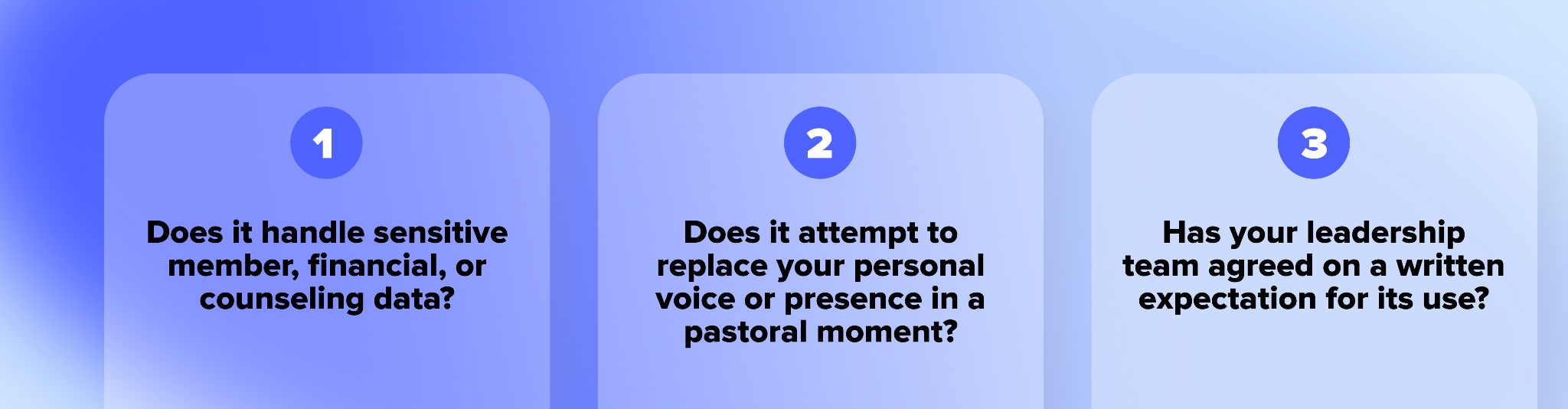
Before introducing any new AI tool to your church, run it through these three basic questions:
- Does it handle sensitive member, financial, or counseling data?
- Does it attempt to replace your personal voice or presence in a pastoral moment?
- Has your leadership team agreed on a written expectation for its use?
If a tool compromises private records or replaces human relational care, treat it as a high-risk liability and step back.
The path forward: stewardship over all
At its core, adopting artificial intelligence in 2026 is about wise stewardship, clear boundaries, and protecting what matters most. When used intentionally, AI offloads the administrative tax of running a church, giving you back precious hours to spend in personal prayer, pastoral counseling, and face-to-face discipleship.
By keeping sensitive member data locked inside secure, native environments like Subsplash, protecting the sacred responsibility of preaching. The tools will continue to evolve, but your calling to shepherd your local congregation remains irreplaceable.
Ready to build a safe, grounded AI strategy for your staff? Download our free Church AI Policy Guide to set practical guidelines, or explore how Pulpit AI turns a single sermon into a week of discipleship resources while preserving your authentic theological voice.
If you’d like to learn more about how Subsplash’s AI tools can assist your ministry this year, [.blog-contact-cta]let’s chat![.blog-contact-cta]
.webp)
.webp)