

According to recent studies, 91% of church leaders support AI use in ministry—yet only 7% have established a formal church artificial intelligence policy. That gap is where things go sideways.
Imagine it’s a typical Monday morning when a staff member casually mentions she used ChatGPT to write this week’s pastoral care follow-up emails. She didn’t think anything of it because nobody ever said not to. But now you’re thinking about the counseling notes she may have referenced, the member names she may have dropped into a public tool, and the congregation that trusts your team with their most vulnerable moments.
This scenario plays out in churches across the country every week. Your team is almost certainly already using AI. The only question is whether you've given them a framework to use it well. A church AI policy template doesn’t have to be complex—it can be a single page, built in one staff meeting. Here's how to do it.
Why your team needs an AI policy today
When we think about technology guidelines, we often treat them as technical tasks for an IT department. However, establishing a church policy on AI is fundamentally an act of pastoral care. The tools your staff uses directly affect the spiritual formation and trust of the people you shepherd. If you do not actively shape how your church interacts with technology, the surrounding culture will do it for you.
Here are three reasons why creating a church artificial intelligence policy matters today:
- Your congregation’s trust is at stake. Your church members share their deepest hurts, financial struggles, and private prayer requests with your team. Without clear boundaries, well-meaning staff members might drop counseling notes or family details into public AI engines to generate response letters. When this happens, sensitive information enters public databases. A clear policy ensures your team treats personal data with the highest level of confidentiality.
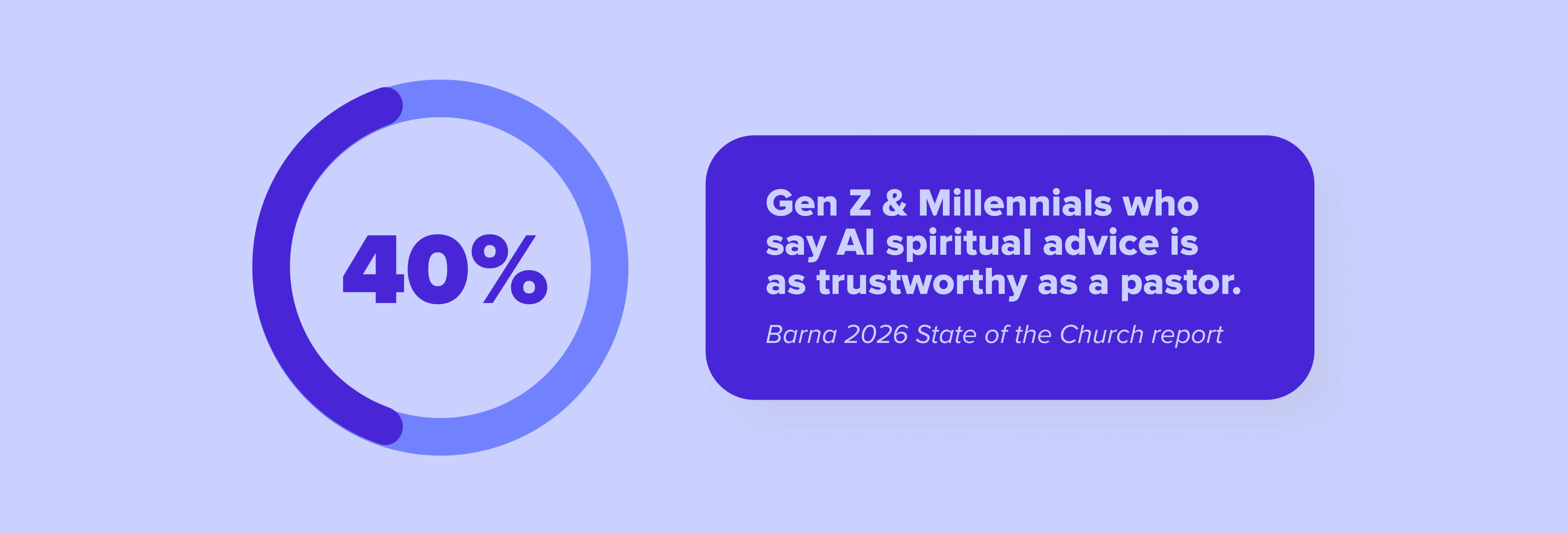
- Pastoral authority is under pressure. Data from the Barna 2026 State of the Church report shows that 40% of Gen Z and Millennials say AI spiritual advice is as trustworthy as a pastor. If younger generations can’t distinguish between an algorithm and a shepherd, your leadership must act. Ministry expert Carey Nieuwhof warns against a passive slide into discipleship by algorithm, which fragments deep spiritual formation. True pastoral care requires human presence—a computer cannot walk with someone through grief.
- The creative mandate applies to technology. God created humans in His image and gave us a mandate to steward creation, which includes the tools we build. Technology is never neutral; it reflects the values of the people who create and use it. As Michael Whittle, VP of AI at Subsplash, shared during a recent industry panel: “Our technology is always downstream from our theology.” Your team needs to define those theological convictions before they choose their tools.
5 things your AI policy must cover
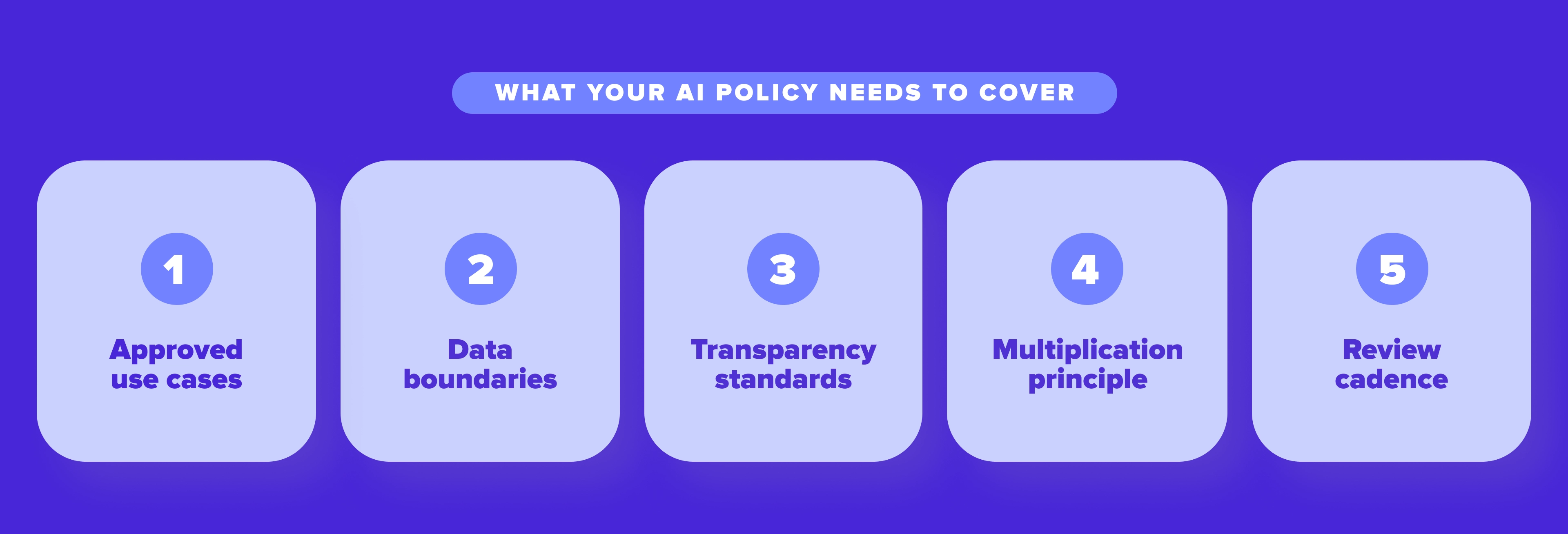
A practical church AI policy is a one-page guide for your weekly workflows. When thinking through how to write a church AI policy, start with these five areas:
1. Approved use cases
At your church, where is AI welcome? Communications, sermon research, social content, event promos, and newsletters are all fair territory.
Where is it off-limits? Your policy should prohibit AI from writing sermons, generating pastoral care correspondence, or handling sensitive counseling responses. Keeping those boundaries between administrative work and pastoral care well defined protects the relational heart of your ministry.
2. Data boundaries
What is never allowed to be uploaded to a public AI tool? Think through items like prayer requests, counseling notes, giving records, and membership data. From there, establish a strict rule—never upload personal, identifiable information into public text generators. This includes member names, specific financial contributions, addresses, or private prayer requests. If a piece of data contains real human vulnerability, it must stay entirely inside your secure church systems. Protecting private data honors the individuals who trust your leadership.
3. Transparency standards
Transparency is a core Christian value, and it works on two levels.
Internally, your church staff AI guidelines should define when staff members need to flag AI-assisted content to a supervisor before it goes out. An automated outline for a weekly bulletin probably doesn't need a review note. A community group guide that was substantially drafted by AI should be flagged and reviewed before distribution.
Externally, your congregation will form an opinion about your AI use whether you address it or not. A simple line in your bulletin, on your website, or in a ministry newsletter—something like "Our team uses AI tools to assist with content creation; all ministry communications are reviewed and approved by a staff member before distribution"—goes a long way toward building trust before questions become concerns.
4. The multiplication principle
Your policy should prioritize multiplication over generation. That means that AI should extract and amplify what the pastor has already created, not generate new theological content from scratch. Software should only extract, summarize, or amplify content that your pastoral team has already prayerfully created.
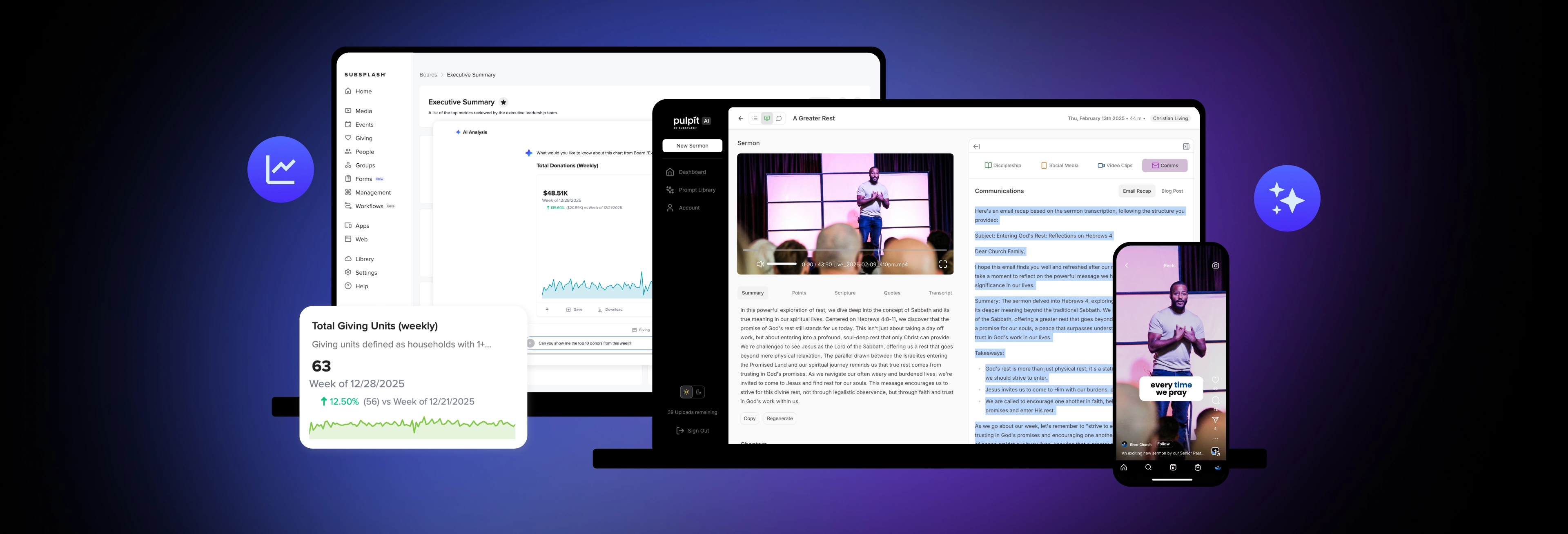
In practice, that means using a tool like Pulpit AI to turn your Sunday sermon into mid-week study questions, devotionals, and social clips — all in the pastor's voice. The sermon is the source. The AI extends its reach. This approach ensures your specific theological voice remains the foundation of everything that goes out under your church’s name.
5. Review cadence
AI guidelines for churches that work today may need adjustment by next year. Commit to reviewing your AI policy once a year, or when a major new tool is adopted. This doesn’t have to be a formal process—one leadership team conversation is enough. Regular check-ins keep your team aligned and prepared for new cultural shifts.
How to build your church AI policy in one staff meeting
You don’t need a month’s-long committee to write a strong policy. In fact, you can create a solid framework in a single 60-minute staff meeting. Use this practical agenda to move from abstract ideas to a finalized, working document!
Phase 1 — Start with values, not rules (15 minutes)
When discussing church AI ethics, focus on your core ministry values. What does your church believe about technology? About human dignity? About pastoral authority? Write two or three sentences together that explain why you are setting these boundaries. That’s your policy preamble, grounding your rules in scripture.
Phase 2 — Audit current usage (15 minutes)
Ask every person in the room: what AI tools do you use, and for what? You may be surprised at how much AI is already being used by your church staff. List them without judgment. Your team should feel comfortable being completely honest.
List every application, from newsletter drafting to graphic design assistance, on a whiteboard. Understanding your team’s current habits shows you exactly where you need clear boundaries.
Phase 3 — Agree on 3 non-negotiables (15 minutes)
Based on your shared values, decide on three absolute rules for your ministry. What will you never do with AI? Usually this includes: no member data in public AI, no AI-authored sermons, and always human review before anything goes to the congregation. Writing down these distinct boundaries eliminates confusion for your team.
Phase 4 — Write the one-pager (15 minutes)
Take your preamble, your approved use cases, and your three non-negotiables and put them into a single document. Not sure what to write? Here’s what a basic policy might look like:
"Staff may use AI tools for social media drafts, event summaries, newsletter outlines, and sermon research. Staff may not input member names, prayer requests, giving records, or counseling notes into any public AI platform. All AI-assisted content must be reviewed and approved by a staff member before distribution to the congregation. Sermons and pastoral care correspondence must originate with the pastor. AI may assist with research and formatting only."
Use the free Subsplash AI Policy Toolkit to turn this draft into a finished document. It includes a fill-in-the-blank church AI policy template built around exactly these five areas — so you’re not starting from scratch. Print the final page, hand it to your team, and store it with your official church staff AI guidelines.
Staying the shepherd in a digital age
Establishing a clear policy is not about restricting helpful technology. It is about ensuring that you, the pastor, remain the shepherd of your community.
Your congregation returns week after week because they want an authentic, human connection and an unmediated encounter with the Gospel. AI cannot pray, repent, or replace the physical presence of a faithful pastor. A clear framework ensures your digital tools support human relationships rather than replace them.
If you are ready to build clear AI guidelines for your staff, we wrote a free Ebook to help your church team easily get started! Download your free copy of Digital Stewardship: A Church AI Policy Toolkit today, which includes a fill-in-the-blank church AI policy template, conversation starters, and discussion questions.
And, don’t forget to explore more AI insights by watching our webinar, "The AI Equipped Church", to equip your ministry for ethical AI stewardship and intentional AI use in ministry. Get started today!
.webp)