


Artificial Intelligence is changing the way we work, communicate, and create altogether. And for the Church, that raises some big questions.
What happens when AI enters the creative process? Can it help pastors prepare sermons without replacing the work of preaching? Where should church leaders draw the line? And in a world increasingly shaped by technology, what makes the local church uniquely important?
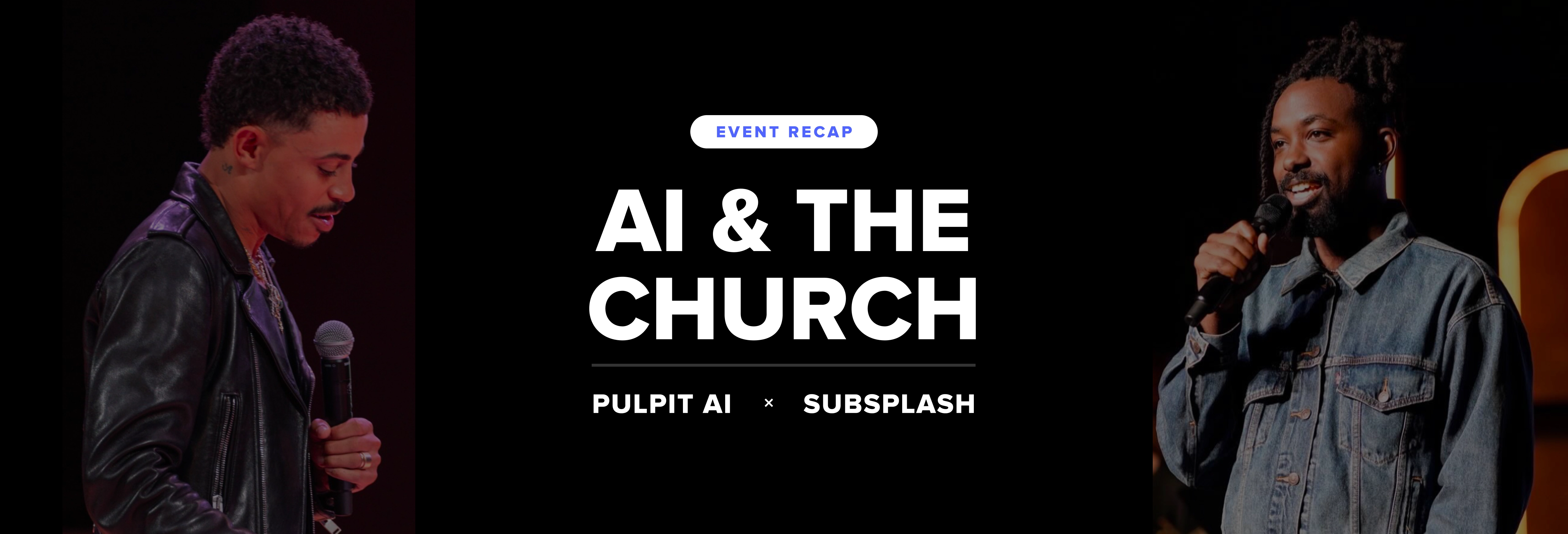
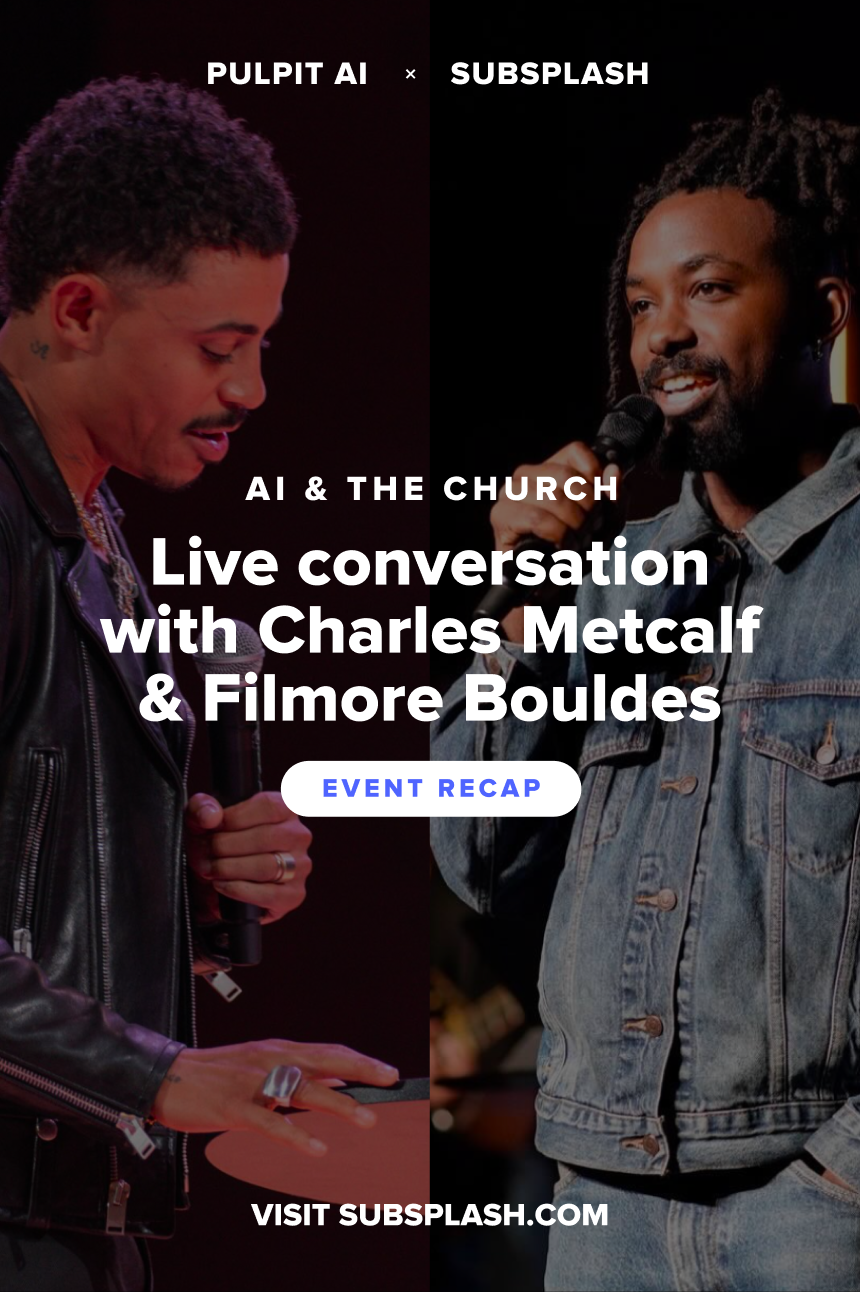
These questions—and many more—were at the heart of a conversation hosted by Subsplash featuring Pastor Charles Metcalf of Transformation Church in Tulsa, Oklahoma, and Pastor Filmore Bouldes of onechurch in Seattle, Washington.
Both pastors are passionate about creativity, preaching, and building the local church. Their conversation with the VP of AI at Subsplash, Michael Whittle, offered a thoughtful perspective on how church leaders can embrace AI without losing sight of what makes ministry and creativity deeply human.
Here are some of the biggest takeaways from their compelling conversation. Check it out!
4 Important takeaways about AI, the Church & creativity
1. Use AI to assist creativity, not replace it
In the Garden of Eden, God gave humanity the responsibility to steward creation. God creates; humans create alongside Him. And if we’re created in the image of God, then creativity is part of who we are.
That distinction matters when we start talking about AI. AI can be incredibly useful for workflows, administration, research, and other practical tasks. But when it comes to beauty and human expression, both pastors emphasized the importance of preserving the human element.
There’s a distinction between art and efficiency. If your primary goal is simply to communicate information, AI may be an incredibly helpful tool. But if your goal is to create awe, beauty, or something that connects deeply with another person, human creativity still matters. As Pastor Fillmore put it, “I would say we use [AI] for assisting creativity. We don’t outsource our creativity to AI.”
2. Let your values determine your boundaries
There may not be one universal set of AI rules for every church. Different churches value different things. And that’s okay.
One church leader might use AI to recreate a graphic without thinking twice about it. But that’s not to say it’s right to present AI-generated work as original. Another church leader might use AI to compose emails, while another may prefer a uniquely human touch every time. Or, because the Church places high value on people, leaders can choose to invest in a creative director rather than simply replacing that role with AI.
As you can see, there are many different approaches to AI, the church, and creativity. The point isn’t that every church operates the same, but that every church decides what they value before they decide how they will use AI.
That means asking deeper questions like:
- What parts of our ministry should always remain deeply human?
- Where can AI make our teams more efficient?
- What kinds of AI-generated content are we comfortable using?
- Where do we need human oversight?
- What would it look like for AI to serve our mission rather than shape it?
Ultimately, it’s crucial to determine your values and then stand on them. To help your team turn these values into clear guidelines, we created a practical resource to walk you through the process. Download our free ebook on how to build a church AI policy to create a thoughtful roadmap for your staff today.
3. Automate tasks, not relationships
For churches, one of the greatest opportunities AI presents is efficiency. But efficiency isn’t the ultimate goal of ministry.
People are!
Pastor Charles described a principle his team uses at Transformation Church: automate tasks, but don’t automate relationships and personal connection. That’s an important distinction.
Technology can help a church send a follow-up email, organize information, manage a workflow, or personalize communication at scale. Those are things that can free up valuable time for ministry teams. But automation shouldn’t eliminate the human touch.
For example, a church might use a workflow to follow up with a first-time guest while still having a pastor or volunteer personally call that person. The system handles the repetitive pieces, while a real person handles the relationship.
That’s where AI can become a multiplier rather than a replacement. The goal isn’t to use technology so that we can spend less time with people. The goal is to use technology so that church leaders can spend more meaningful time with people.
4. Use AI as a sermon research assistant
Perhaps nowhere is the AI conversation more sensitive for pastors than sermon preparation. After all, preaching isn’t simply another task to make more efficient. It’s deeply personal.
Many pastors use AI much like they would use a research assistant. They begin with the biblical text, do their own observation and study, consider the original audience, and develop their own ideas before bringing AI into the process. AI can then help with research, identify potential illustrations, or consider thoughtful questions.
But AI shouldn’t be writing the sermon. And that’s an important distinction.
The key principle? Use AI to accelerate research—not outsource thinking. AI can give you information. It can’t do the spiritual work of wrestling with the text, understanding your people, or discerning what God is asking you to communicate. And because AI isn’t committed to telling you the truth, both pastors emphasized the importance of fact-checking, knowing your sources, and bringing critical thinking into the process.
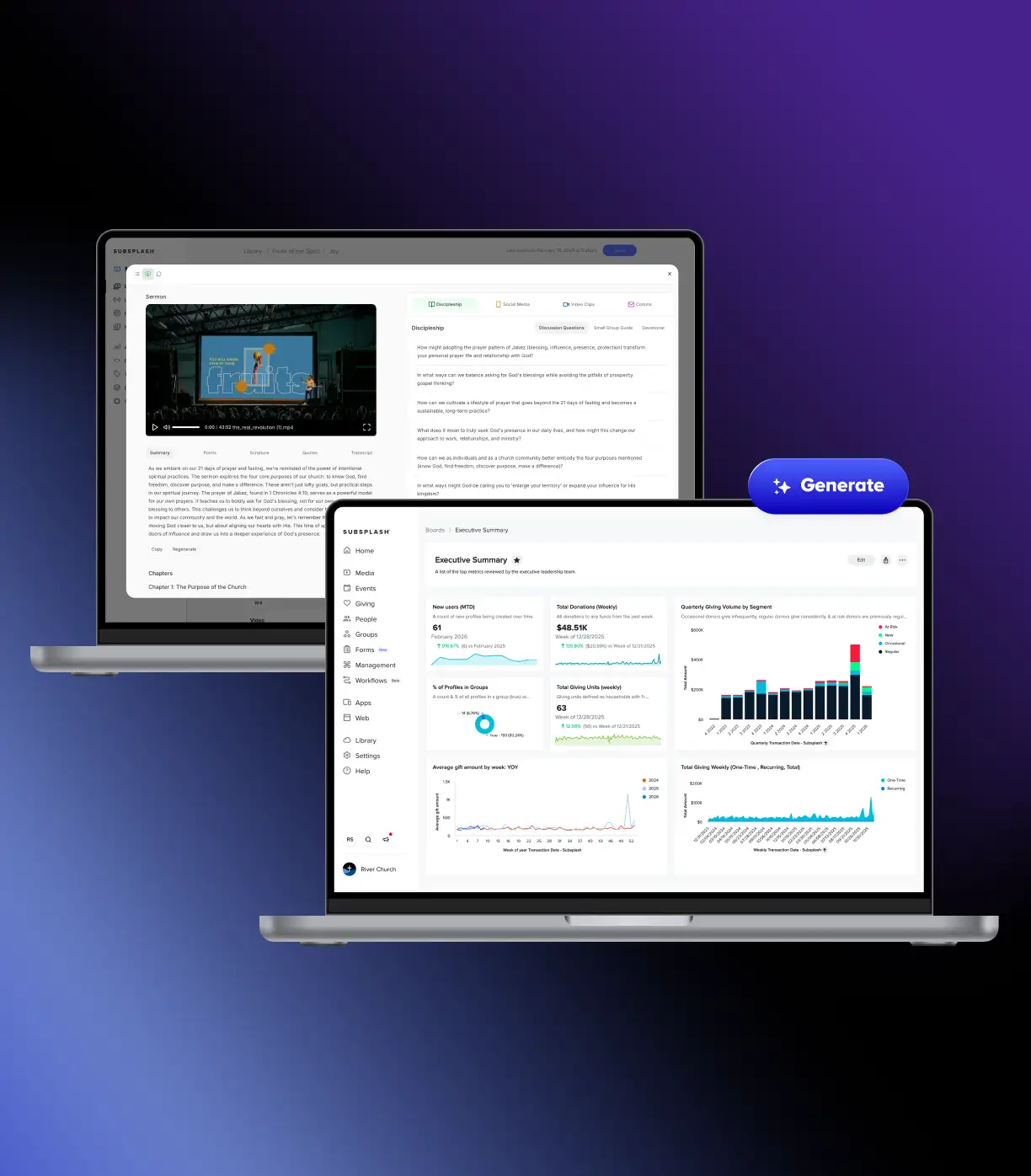
To utilize AI sermon tools within a safe and trusted environment, turn to AI sermon tools built for churches like Pulpit AI. Rather than generating generic outlines from scratch, Pulpit AI works directly with the message you have already prayerfully prepared and preached. Once you upload your sermon recording, it translates your message into over 20 tailored discipleship resources—including daily devotionals, small group guides, newsletters, and social media clips.
AI is a tool. The Church is the mission.
The conversation around AI isn’t going away. And church leaders don’t need to have every answer today. But we do need to start asking better questions.
What do we value? What should remain human? Where can technology help our teams? How can AI give pastors and creatives more time to do the things only people can do? Most importantly, how can we use these tools without allowing them to replace the people, relationships, creativity, and spiritual formation at the heart of the local church?
AI can help us work faster, research, create, and be more efficient in general. But the goal is always to make more room for more in-person ministry.
Ready to explore AI for your church?
The full conversation with Pastor Charles Metcalf and Pastor Fillmore Bolds is packed with practical insights for pastors, creatives, and church leaders navigating this rapidly changing technological landscape.
See how AI can help your church multiply the reach of your message while keeping your voice, your theology, and your ministry at the center.
To explore how a unified platform can simplify your weekly workflow, book a demo or start your free trial of Pulpit AI.
.webp)
.webp)