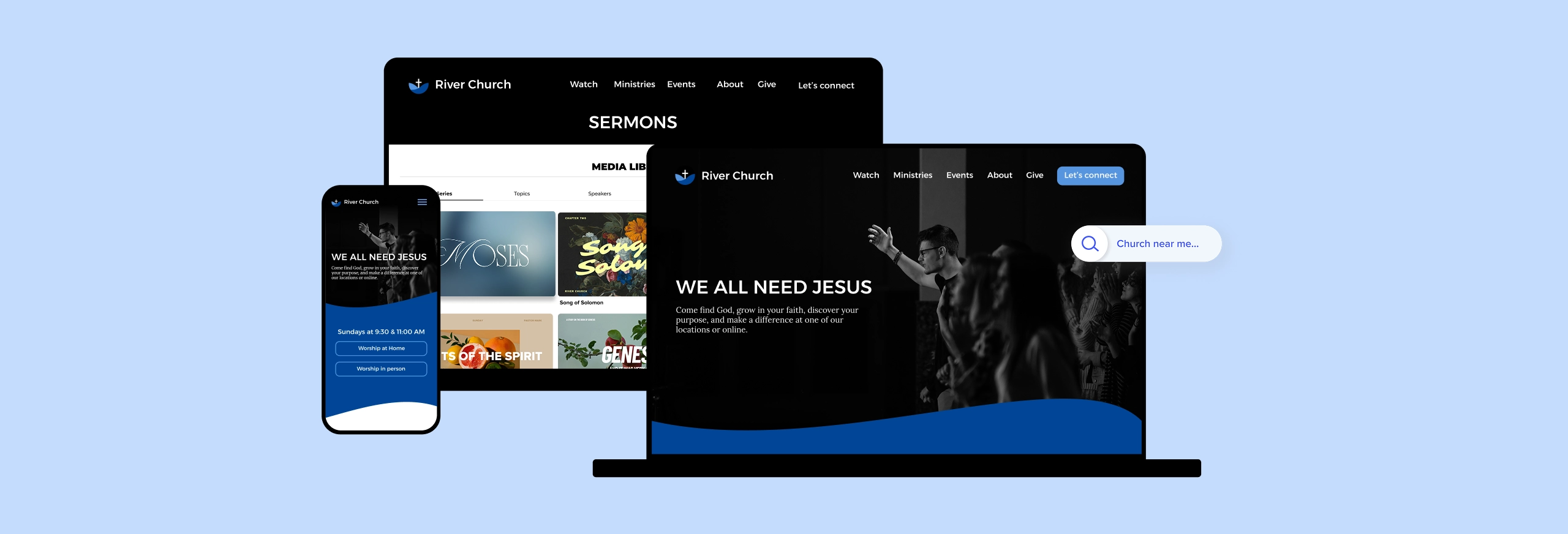



Have you heard the good news? Recent data shows a historic reversal in attendance trends, with Gen Z and Millennials now tracking as the most regular weekend churchgoers. Today, over two-thirds of modern Bible users interact with Scripture directly on a device. Because of this cultural shift, your website functions as the front door to your community. Securing reliable church website hosting ensures that your online home remains open, safe, and welcoming every single day of the week.
Your digital front door is often the first place seekers encounter your ministry. In fact, research shows that a majority of churchgoers will check out a church digitally before they step through your doors.
Choosing a reliable church website hosting provider is a key step in building your digital presence. When your web presence works smoothly with your app and church giving, online seekers can find your location, watch sermons, give, and connect with your team without friction. Your staff can focus on ministry instead of technical troubleshooting. But picking the right platform requires a clear understanding of your team's everyday needs.
Let's explore why infrastructure matters, look at the challenges of fragmented tools, and evaluate the top options available for your church today.
What to look for in a church website hosting provider
Evaluating a church website builder and hosting platform involves more than just looking at the monthly price. For ministries, software integrations directly impact real-world success. They dictate how smoothly child check-in runs on Sundays, whether families can find sermon archives on Mondays, how easily congregants fill out prayer requests midweek, and if someone can give easily online without any friction.
Unfortunately, many church leaders fall into a trap of managing a fragmented stack of disconnected tech tools. When you patch together separate software companies for your website, video files, text messaging, and mobile apps, your staff pays a high complexity tax in lost hours, dozens of passwords, confusing text chains, and disjointed technology that erodes trust rather than builds it.
When selecting a website hosting provider for a church, it's crucial to evaluate key features and pricing plans. Next, look closely at site speed and uptime guarantees. Slow loading times can discourage online visitors and hurt your search engine rankings. Security is equally vital, especially when protecting sensitive congregational data or handling digital financial transactions.
Let's take a look at a few key features and why these issues matter when evaluating and comparing website hosting for churches.
Site accessibility & uptime
Web hosting services store your website’s files on servers that are connected to the internet 24/7. Reliable web hosting providers offer high uptime guarantees, minimizing the risk of downtime and ensuring that your website is available when users need it. This constant accessibility is crucial for maintaining the credibility and reputation of your church’s website.
Site speed
The site performance and speed of your website is heavily influenced by your hosting provider. Web hosting providers with solid infrastructure and optimized servers ensure that your website loads quickly, which is crucial for keeping visitors engaged, better SEO results, and lower bounce rates.
Site security
Web hosting providers implement various security measures to protect your website from potential threats such as malware, denial-of-service (DDoS) attacks, and unauthorized access. They also provide tools for regular backups, ensuring that your website’s data can be restored in case of any issues. This level of security is crucial for protecting sensitive information, especially if you collect donations on your website.
Scalability
As your congregation grows, your website should be able to adapt to your needs. A good web hosting provider offers scalability. This flexibility ensures that your website can continue to perform well and meet the needs of your audience, regardless of its size or complexity.
Technical support
Top-notch web hosting providers offer technical support and resources to assist you in managing and maintaining your website. Whether it’s helping with server configurations, troubleshooting issues, or providing guidance on best practices, the support from your hosting provider is a crucial resource.
Budget
Budget is a significant consideration for churches, as funds are often allocated to various essential community services and activities. Finding a hosting provider that offers competitive pricing is vital. Look for providers that offer transparent pricing without hidden fees and provide good value for the services they offer. Some hosting providers also offer discounts for non-profit organizations, so it’s worth inquiring about any special pricing available for churches.
Top 5 church website hosting providers
1. Subsplash
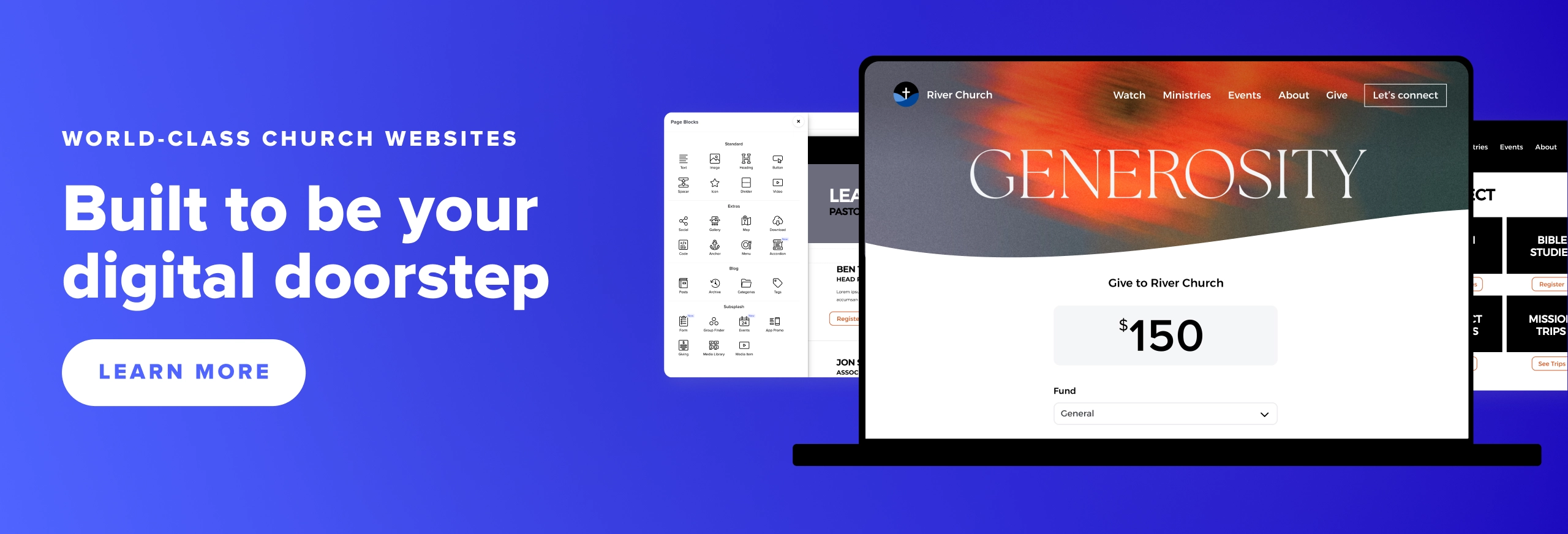
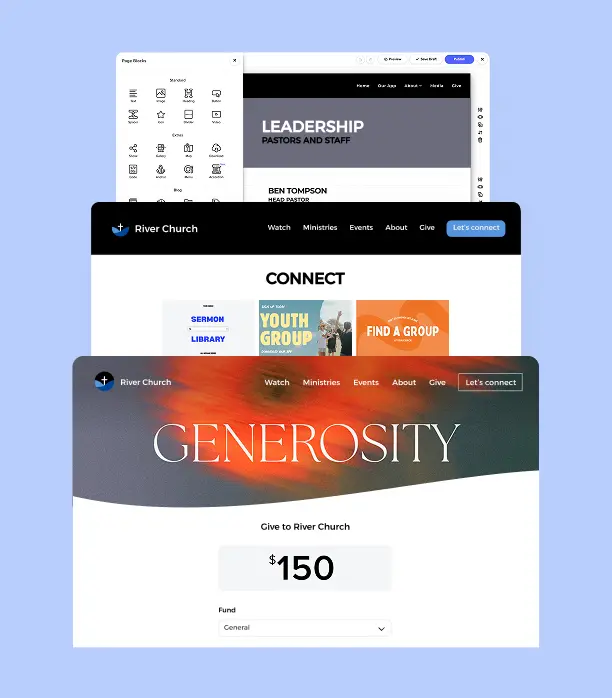
Subsplash’s custom church website builder and hosting software features an easy drag-and-drop template, allowing anyone on your team to build a beautiful site without writing code!
The Subsplash Platform serves as an interactive hub that connects your web presence directly with your custom mobile app, church management software (ChMS), and church giving. And because the media player is fully native, you can stream your services ad-free without relying on corporate video platforms that display distracting content.
Pros
- Ease of use. The intuitive drag-and-drop interface ensures that anyone, regardless of technical expertise, can add content, images, and other elements to their church’s website.
- Built for churches. Subsplash offers church-focused templates that come with everything a church needs for their website. Extra features like integrations with event calendars, sermon notes, and media hosting & delivery make sure your church’s website makes the biggest impact possible.
- Built-in church giving. Subsplash Giving lets you accept donations safely online. And with modern giving solutions like Subsplash Tap, you can offer tap-to-give options on Sunday mornings and look for weekly data giving patterns the following Monday!
- Optimized for mobile. With a mobile-friendly design, Subsplash guarantees that your website provides a consistent and user-friendly experience across various devices.
- Good for SEO. SEO tools and integration with Subsplash Media boost your website's search engine ranking so more people in the community can find you online.
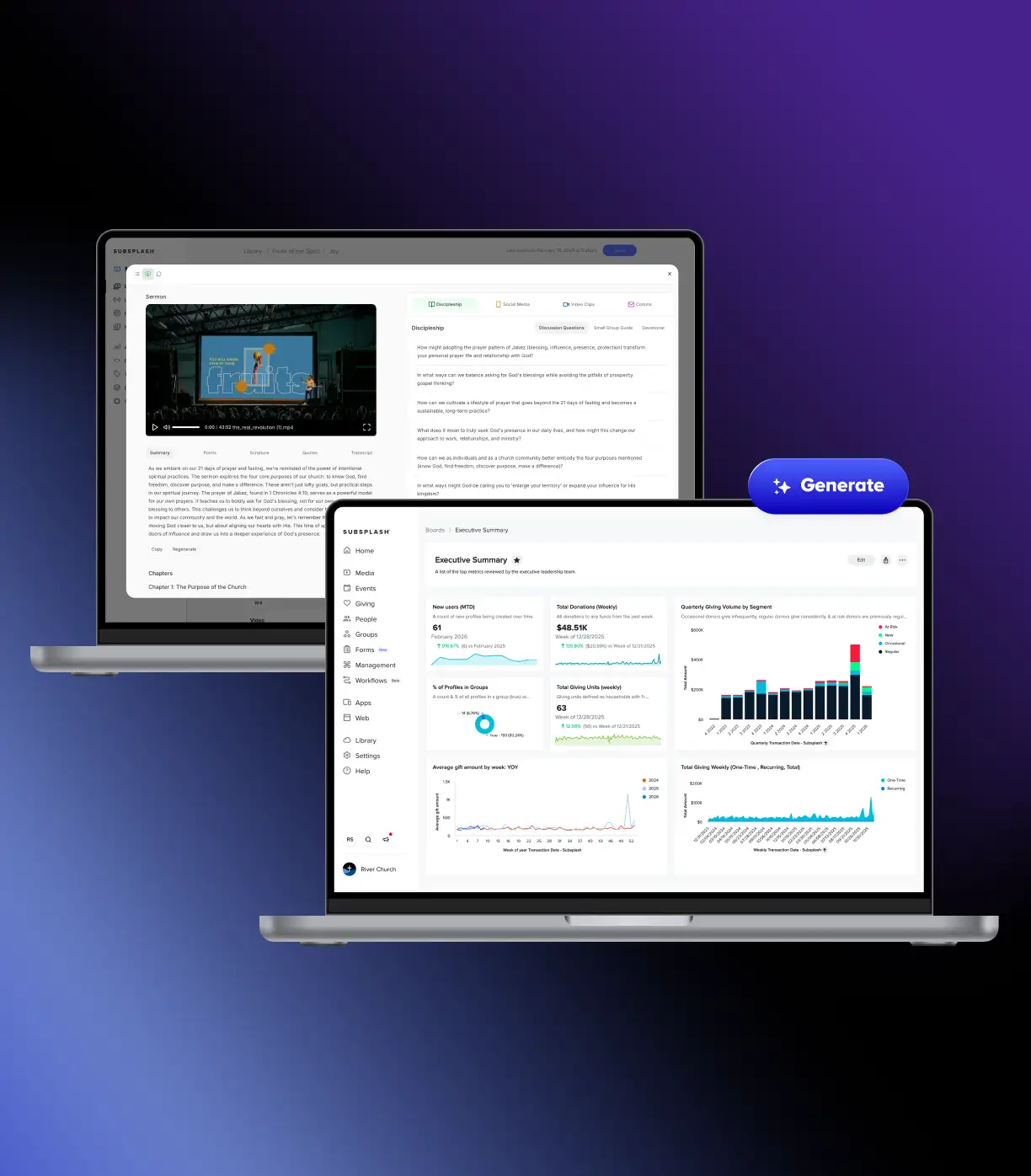
- AI optimization. Our direct integration with Pulpit AI turns a single sermon recording into over 20 distinct pieces of discipleship material with one click. You can instantly generate daily devotionals, sermon summaries, newsletter text, and small group discussion guides drawn directly from your teaching.
- Rich media integration. Incorporate videos, podcasts, images, and live streams to enrich your website’s content and engage your audience.
- Churchgoer growth path. Our visual tracking tool called Workflows allows your team to map out next steps for congregants, ensuring new visitors move smoothly from filling out a connection card to joining a small group—and that no visitor gets overlooked.
- Remove the guesswork. With the add-on Trends AI, this advanced intelligence hub gathers your giving, attendance, and small group numbers into daily dashboards. You can ask direct questions to get clear charts without using messy formulas or spreadsheets–saving your staff hours of manual labor, week after week, year after year!
- One-click cross-platform publishing. When you publish your weekly sermon, the file updates on your website, custom church app, and TV apps for Roku and Apple TV simultaneously!
Cons
- Moving your existing media libraries can require initial onboarding time, though our dedicated support team walks with you through the process.
Pricing
Subsplash offers a wide range of digital tools with multiple pricing options to meet any church's budget. [.blog-contact-cta]Schedule a free demo [.blog-contact-cta]with a member of our team to get started with Subsplash Websites.
2. Bluehost
Bluehost is a well-known shared server provider that focuses heavily on basic WordPress websites. It remains a common starting point for small organizations seeking an economical entry-level layout. With its user-friendly, simple interface, Bluehost is particularly well-suited for beginners.
Pros
- Beginner-friendly. The platform is designed with simplicity in mind. Bluehost has a straightforward setup with one-click installations for standard WordPress files. So, you don’t need to have a tech background to use this hosting provider.
- Seamless WordPress integration. As a hosting provider recommended by WordPress, Bluehost offers one-click installations.
- 24/7 support. The platform provides 24/7 support through chat and phone channels.
- Low cost. Low introductory promo pricing for your first contract term.
Cons
- Higher costs upon renewal. Users should be mindful of the renewal rates, as they can be significantly higher than the initial sign-up cost.
- Aggressive upselling. Some users on review sites find the company's upselling tactics post-signup to be too aggressive.
- Not great for non-WordPress sites. Bluehost is designed for WordPress websites. If you are using a less well-known CMS, you may find the interface hard to navigate.
- Many plugins necessary. If you try to use this generic type of website hosting for churches, you must find, purchase, and configure third-party plugins to handle basic church functions like sermon tagging, child check-in, or group messaging.
Pricing
Bluehost currently advertises plans beginning around $3.99/month depending on term length, with renewal rates increasing at the end of the contract.
3. HostGator
Backed by a 99.9% uptime guarantee, HostGator is one of the most versatile web hosting providers. It handles standard website traffic and provides simple control panels.
Pros
- Beginner rates. Introductory shared hosting plans are often available for a few dollars per month, with significantly higher renewal rates
- Consistent uptime & performance. With a 99.9% uptime guarantee, HostGator ensures that your website remains accessible and loads quickly.
- Intuitive control panel. The platform features a user-friendly control panel. Managing and maintaining your website is simple even for those who don't have a technical background.
Cons
- Inconsistent customer support. Some users on review sites say they experience inconsistencies in the quality of customer support received.
- Aggressive upselling. Some users also mention pushy sales tactics upon signup and renewal.
- Complexity. Building out specific ministry features, such as a searchable small group finder or live streaming host, requires complex web development or unstable generic add-ons.
Pricing
HostGator’s pricing page can be daunting to navigate. They have many different plans and product offerings. However, the cheapest, shared hosting plans start around $16 per month.
4. SiteGround
SiteGround has established itself as a leader in the web hosting industry. It stands out among generic hosting companies for its speed optimizations and being well-suited for organizations running standard web databases. SiteGround is known across the industry for its exceptional customer service and high-performance hosting solutions.
Pros
- Outstanding customer support. SiteGround is widely recognized for its responsive and knowledgeable customer support team. Their support is available 24/7 via live chat, phone, and email.
- Fast site speeds. With SSD storage and data centers strategically located around the world, SiteGround guarantees fast loading times, contributing to a seamless user experience.
- Robust security measures. The platform provides advanced security features, including daily backups, SSL certificates, and DDoS protection.
Cons
- Expensive. SiteGround's pricing is on the higher end compared to some of its competitors.
- Limited storage on cheaper plans. The lower-tier hosting plans come with limited storage space, which might necessitate an upgrade as your website grows. This is particularly important to remember if you do any live-streaming or have a large video library of sermon recordings.
Pricing
SiteGround’s introductory pricing is often discounted, while standard renewal pricing is significantly higher.
5. AWS (Amazon Web Services)
Known for its scalability, reliability, and widespread adoption by some of the world's largest websites and corporations, AWS operates on a unique pay-as-you-go pricing model.
Pros
- Scalability. AWS provides an environment that adapts to varying traffic volumes. You don't have to worry about your website crashing if you get a big spike in visitors.
- Global reach. With a network of data centers spread across the globe, AWS guarantees low latency and high-performance access for a worldwide audience.
- Diverse range of services. From computing power and database storage to content delivery, AWS's comprehensive suite of services caters to a myriad of website needs and functionalities.
Cons
- Complex pricing structure. Navigating AWS’s pricing can be daunting. Unexpected costs can occur if services are not carefully configured and monitored.
- Steep learning curve. Beginners may find AWS's extensive range of tools and services overwhelming.
- Built for developers. If you don't have a web development team or a CTO at your church, you may struggle with getting set up and dealing with routine web maintenance.
Pricing
AWS adopts a developer-friendly pricing structure, but it's easy to incur higher costs than anticipated if you're not fully versed in managing the services. They provide this pricing calculator to help estimate costs, and there are even startups dedicated to solving the complexities of AWS pricing.
Select a platform built for your mission
With so many website hosting providers out there, it's easy to feel stuck choosing the right one. The best fit is a provider built specifically for churches—by fellow Christians, pastors, and churchgoers who understand what your ministry needs.
That's exactly what Subsplash offers. As the complete platform built for churches, Subsplash gives you the tools to manage your website, donations, communication, events, and live-streaming, all in one place.
At Subsplash, we're driven by our passion for the local church and its mission. Our team is committed to being your partner in ministry, helping you reach more people, deepen discipleship, and grow your church with confidence.
[.blog-contact-cta]Schedule your free demo today[.blog-contact-cta] to learn more!

.webp)