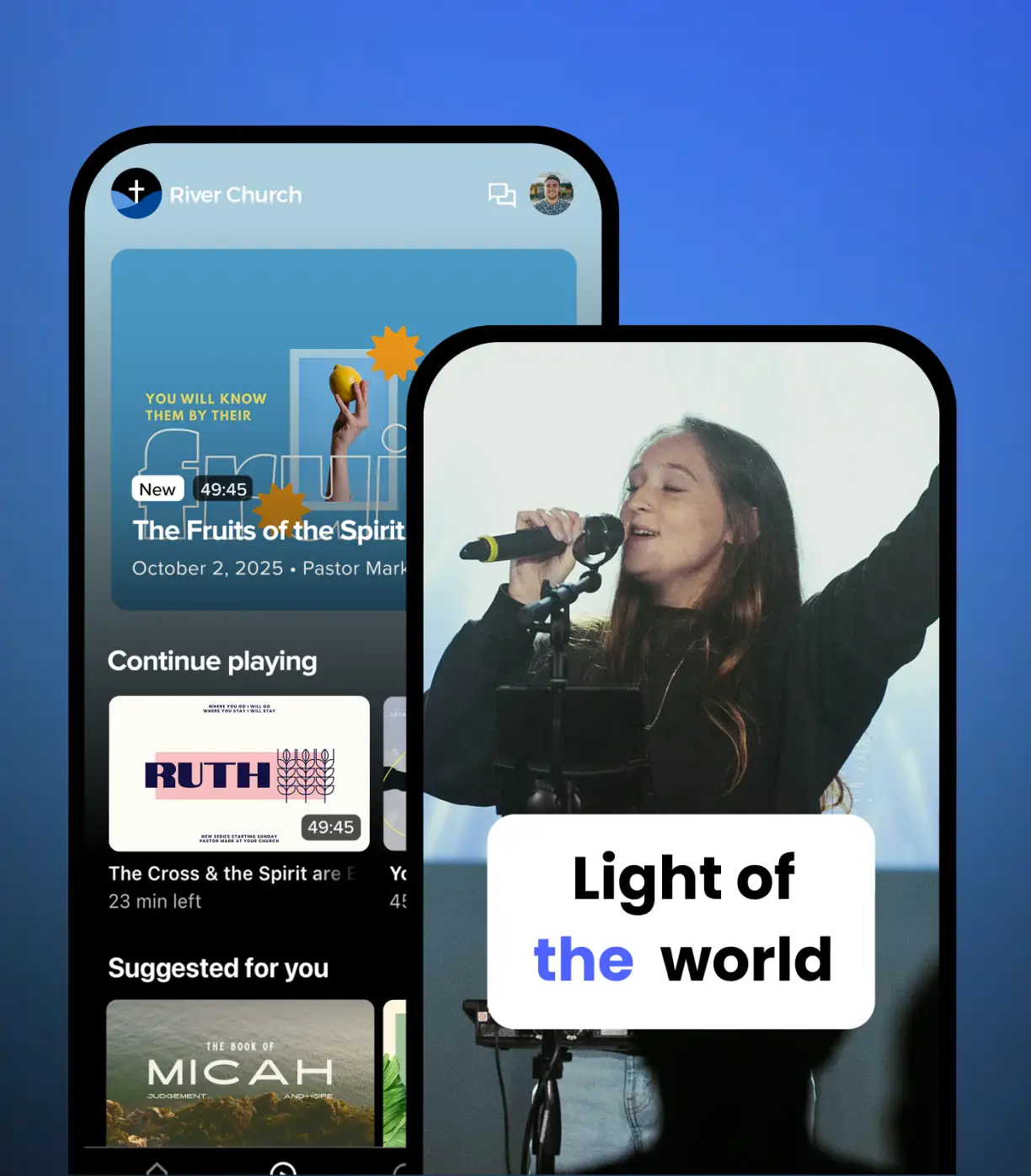


It’s no secret that we are living in a digital-first world—and churches are wisely taking notice.
From attracting first-time visitors to keeping members engaged midweek, digital ministry is changing how people connect with faith. This shift has created new opportunities for connection, outreach, and discipleship throughout the week. What have we learned so far?
To help you prepare for 2026, we’ve worked hard to put together a list of important facts for church leaders to know as they look into digital ministry. As you can see below, technology is here to stay, and many churches are taking notice—and taking leaps forward in how they reach people, communicate, and disciple their congregations.
Let’s dig into 100 data points below to see how technology is shaping church engagement, generosity, spiritual growth, and more. It all starts with understanding how Americans are engaging with technology more than ever before.
100 key facts, trends & insights for church leaders [2026]
Technology & church engagement
Church leaders who are prioritizing digital tools for outreach, discipleship, and online giving are most likely seeing higher engagement from their congregants—especially beyond their Sunday services. And when churches switch from utilizing scattered resources to a unified digital platform, they see a huge bump in increased engagement! Members can access sermons, events, live streams, recordings, small group messaging, and more—all in one place.
As you'll discover below, Gen Z and Millennials in particular are digital natives—they expect instant access to information, live streams, and interactive content. For these generations, a church’s digital presence is often the first impression, making it as important as the in-person experience.
Smartphones aren’t just communication tools—they’re gateways for ministry, discipleship, and community building in the 21st-century church. Here are twelve facts that represent how technology is reshaping the way churches communicate with people.
- 91% of Americans own a smartphone.
- Americans check their phones on average 144 times a day.
- Americans spend 57% of their time on smartphones on apps.
- Gen Z spends an average of 9 hours a day on their phones.
- This surge in overall technology use is coinciding with a trend embodied in “The Epidemic of Loneliness”, creating a major opportunity for churches to engage people, both online and in person.
- Half of highly religious Americans under 50 are heavy users of religious technology.
- 41% of visitors view church websites on mobile devices.
- 30% of U.S. adults report going online to search for information about religion.
- 80% of people will check a church’s website before visiting in person!
- 48% of church visitors reported that they are more likely to attend a church service after visiting the website.
- 89% of churches have embraced having a digital presence, even if it’s a minimal one.
- About 25 million Americans attend church online, either primarily online or both online and in person equally.
Christianity & church attendance trends in America today
Christianity in America continues to evolve in surprising ways. Younger generations, especially Gen Z and Millennials, are reshaping the landscape as faith is trending in America, with younger generations leading the U.S. revival.
The trends listed below show that while faith is trending upwards in America, the ways people connect with the church are changing. People are hungry for the Gospel, but they’re searching in fresh ways, especially by embracing digital tools and innovative ministry models.
- Overall, 59% of U.S. adults express a positive view of religion’s influence on American life.
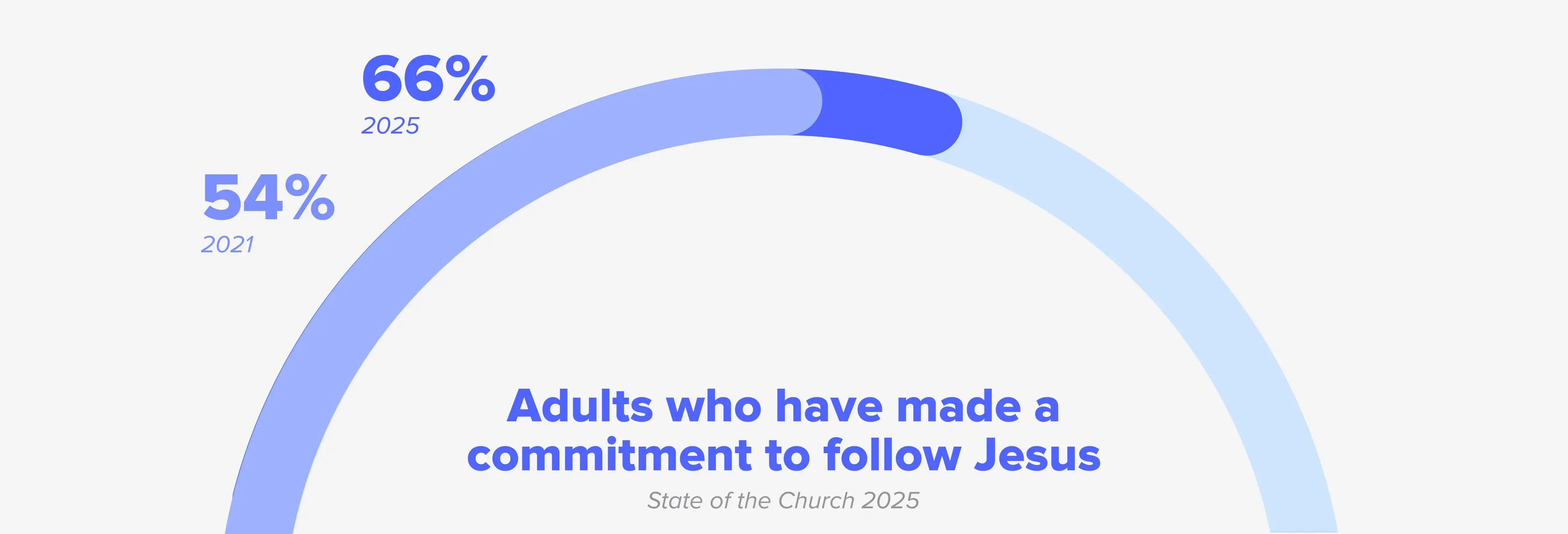
- 66% of all U.S. adults report having made a commitment to follow Jesus. In 2021, that number was only at 54%. That’s 30 million more Americans who are committed to following Jesus!
- Yet of the 62% who do identify themselves as Christians today, only 10-29% have a biblical worldview.
- 44% of U.S. adults report that they pray at least once a day.
- 33% say they go to religious services at least once a month.
- About 28% of American adults today qualify as “nones”, those who are religiously unaffiliated—and most of them are young people.
- Gen X is the most likely to attend church in person (82%).
- Millennials and Boomers are the most likely to attend online (both at 15%).
- Regular church attendance is on the rise for all young adults. Since 2019 both Gen Z and Millennials were the least likely generation to frequently attend church. Today, they are the most engaged.
- As of 2025, 43 percent of men and 36 percent of women report attending church regularly, based on reported weekly attendance.
- Even though most U.S. churches are very small, most people go to larger ones. The 2023 Faith Communities Today study found that the average church in the US has a median of 60 regular worship participants.
- However, 70% of churchgoers attend the largest 10% of congregations (over 250 regular participants).
- The percentage of Americans attending megachurches continues to grow, indicating strong interest in large-scale worship experiences. While the average megachurch sees about 4,092 attendees on a Sunday, only 20% actually reach 5,000 or more, showing that not all “megachurches” are truly massive.
Bible use stats & trends
Recent surveys prove that Bible engagement in the U.S. is evolving, and digital tools are playing a big role in how people connect with Scripture. Many churchgoers are turning to apps, podcasts, and even social media to read, listen, and learn in ways that fit their daily lives. Younger generations, in particular, are embracing these digital avenues, moving away from printed Bibles and discovering new ways to engage with God’s Word.
This shift shows that people are eager for accessible, interactive, and flexible ways to explore their faith—setting the stage for churches to meet them where they are. Here are fifteen facts that reveal how Americans are engaging with Scripture in the digital age.
- Over 80% of people who attend both in person and online regularly read their Bibles, compared to 66% of people who primarily attend in person.
- Studies show that Bible engagement among Millinnials is up to 41%.
- More than half of American adults who are Bible Users (51%) wish they read it more.
- And 25% of the “Nones” report curiosity about the Bible and/or Jesus.
- According to the 2025 State of the Bible report from the American Bible Society, Bible engagement among Gen Z remains surprisingly high at 36%.
- Millennials are leading the way in Bible engagement, growing an incredible 9% in one year—the largest increase of any generation from 2024 to 2025!
- For the first time since 2021, overall Bible use in America has increased, with 10 million more adults now reading Scripture outside of church.
- Two-thirds of Bible users access Scripture digitally—through apps, websites, or even YouTube.
- Gen Z Christians tend to shy away from printed Bibles. Among those who engage with Scripture digitally, most turn to Bible apps (59%), while about one-third listen to podcasts, and roughly one in four turn to TikTok for learning.
- 62% of digital Bible users prefer Bible apps.
- 56% of all Americans are curious about Jesus, the Bible, or both, with 88% of spiritually curious Americans (the “Movable Middle") expressing curiosity as well.
- 21% of U.S. adults use apps or websites to help them read the Bible or other religious scriptures.
- 15% of adults listen to religion-focused podcasts.
- 14% use apps or websites to help or remind them to pray.
- The American Bible Society’s 2025 report highlights that 51% of Americans say the Bible is personally relevant to them, whereas in other “Secular West” countries (e.g., many Western European nations), only 37% agree. That means that personal relevance of the Bible is higher in the U.S. than in other “secular west” nations.
The impact of digital church platforms
A unified digital church platform brings all of a church’s tools and resources into one place, making it easier for leaders to manage ministry and for members to engage. From giving and event registration to small group communication and sermon access, everything is connected and streamlined. This not only reduces administrative hassle but also creates a more consistent and seamless experience for congregants.
By centralizing these functions, churches can better track engagement, deliver discipleship content, and foster a sense of community—both online and in person—helping members stay connected and involved throughout the week.
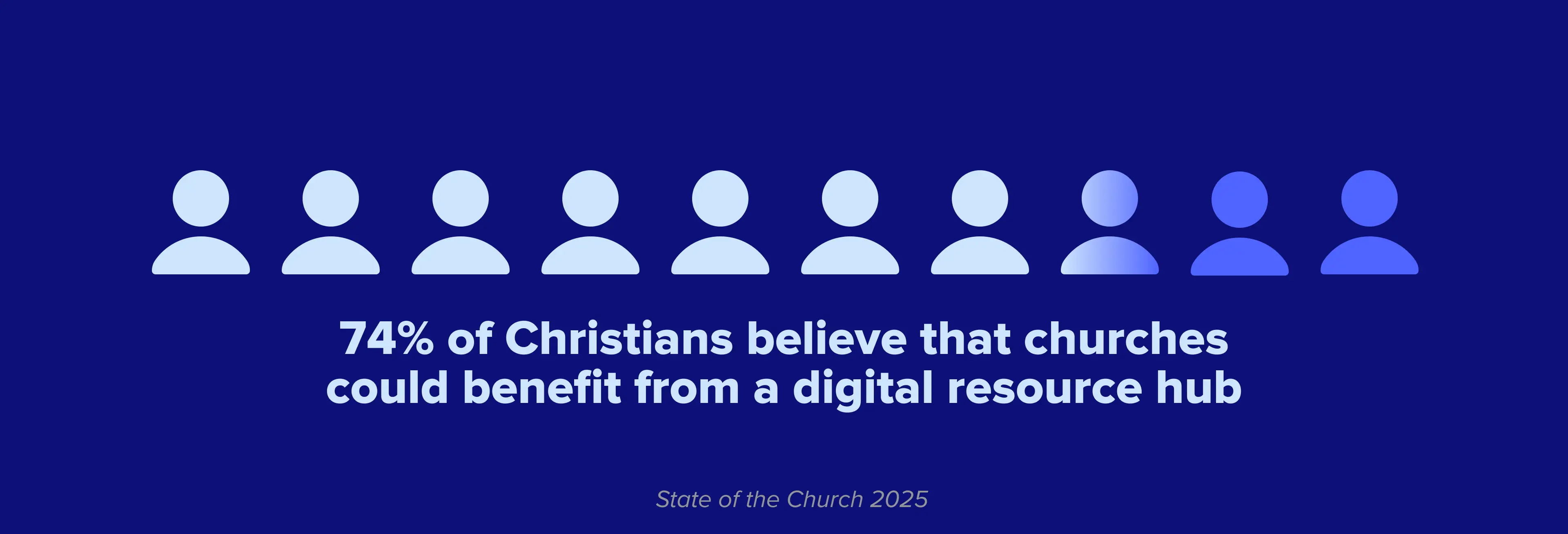
- 74% of Christians believe that churches could benefit from a digital resource hub!
- Upwards of 32% of churches report that they lack efficient digital tools for engagement and tracking their congregation.
- A unified platform consolidates all your church’s data—giving, attendance, small groups, events—into a single system, which prevents silos and gives leaders a complete, “single source of truth” for ministry decisions. It supports delivering discipleship content (sermons, devotionals, Bible reading plans, small group resources) in a consistent, connected way.
- When churches go from scattered platforms to a unified digital platform, they see a 50% increase in media and sermon plays.
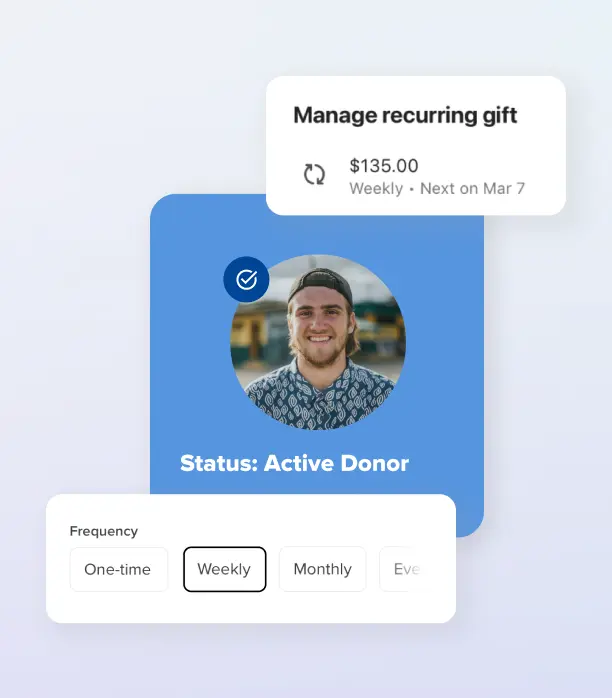
- And once churches switch to a unified digital platform, they see a 15% increase in giving!
Online giving & tithing statistics, facts & trends
Digital giving has transformed the way congregants support their churches. With smartphones and apps becoming the preferred method of payment, members can give anytime, anywhere.
Churches that offer mobile and online giving options not only make it easier for people to contribute, but they also see measurable increases in donations and participation. Monthly giving programs, donor-covered fees, and branded giving experiences all build trust and convenience, encouraging more consistent support.
In a world where nearly three-quarters of adults rarely carry cash, embracing digital giving isn’t just a convenience—it’s a vital tool for sustaining ministry and expanding outreach. Here are 18 facts that underscore how generosity and tithing is changing in the religious landscape.
- 76% of adults make purchases using their smartphones.
- 23% of all charitable donations go to religious groups like churches.
- 57% of general donors (religious and nonreligious) are enrolled in monthly giving programs.
- Nearly 70% of donors report that establishing trust is essential before donating to any nonprofit, including religious organizations.
- The vast majority of people, 76%, don’t carry more than $50 in cash at any given time.
- Approximately 50% of churchgoers prefer to donate with a card, and most no longer carry cash or want to use checks.
- Mobile donations have tripled over the last few years, as the best church donation apps are rapidly replacing collection plates in many countries.
- 75–90% of church members do not tithe.
- But, 77% of regular tithers give between 11–20% of their income.
- 94% of Scripture-engaged people are church donors.
- Donors are six times more likely to finish making a donation on an app that displays its name, logo, and branding.
- In 2019, Subsplash introduced Donor-Covered Fees. This gives your donors the option to cover processing fees, allowing you to keep more of your donations for what matters most.
- Donor-covered fees improve church’s giving rates by allowing their congregants to pay for processing fees.
- 65% of church websites do not have an online giving feature.
- Adding an online giving option increases overall church donations by 32%!
- More Millennial & Gen Z donors are giving than ever before!
- The Ethiopian Evangelical Church in Minnesota (EECMN.org) in St. Paul, Minnesota switched from “Passing the basket” to Subsplash Giving and quickly raised $500k towards their $5 million goal, successfully securing a loan from the back towards their new church building.
- Yet giving continues to change in American churches. Nearly 90% of U.S wealth is in assets, not cash, yet most churches today only ask for cash. That means that the real opportunity lies in reaching beyond traditional cash donations.
- 64% of pastors say their churches pass plates or baskets during the service—making it still the most popular method of collecting church offerings overall in 2025.
- The average cash donation is $121, while the average crypto donation is over $6,000, the average stock donation is over $5,000, and the average donation on the Engiven platform (a Subsplash partner) is over $15,000!
- Donors can utilize non-cash giving strategies, such as through Stock, Crypto, DAFs, and QCDs to make donations to their church.
- Stock & Crypto offer a “Double Tax Win” for you donors and congregants. Make sure they know about this!
- The close of the year brings an important opportunity for churches to inspire generosity and strengthen their mission: December alone accounts for 30% of total annual giving!
- The good news? According to the 2024 State of the Bible report from American Bible Society (ABS), Bible-engaged Christians are the most charitable people in the nation, and giving increases happiness for those who give generously.
- Additionally, about half (49%) of practicing Christians strongly agree that the Bible leads them to be more generous!
The state of the Church & AI
Artificial intelligence (AI) is becoming an increasingly valuable tool for churches, helping leaders focus more on ministry and less on administrative tasks. From assisting with communication and content creation to supporting outreach and community service, AI can streamline many behind-the-scenes processes.
Many pastors see AI not as a replacement for human ministry, but as a way to enhance it—freeing up time to pray, teach, and connect with their congregations. As churches explore these technologies thoughtfully, AI is opening new doors for engagement, creativity, and impact in both digital and in-person ministry.
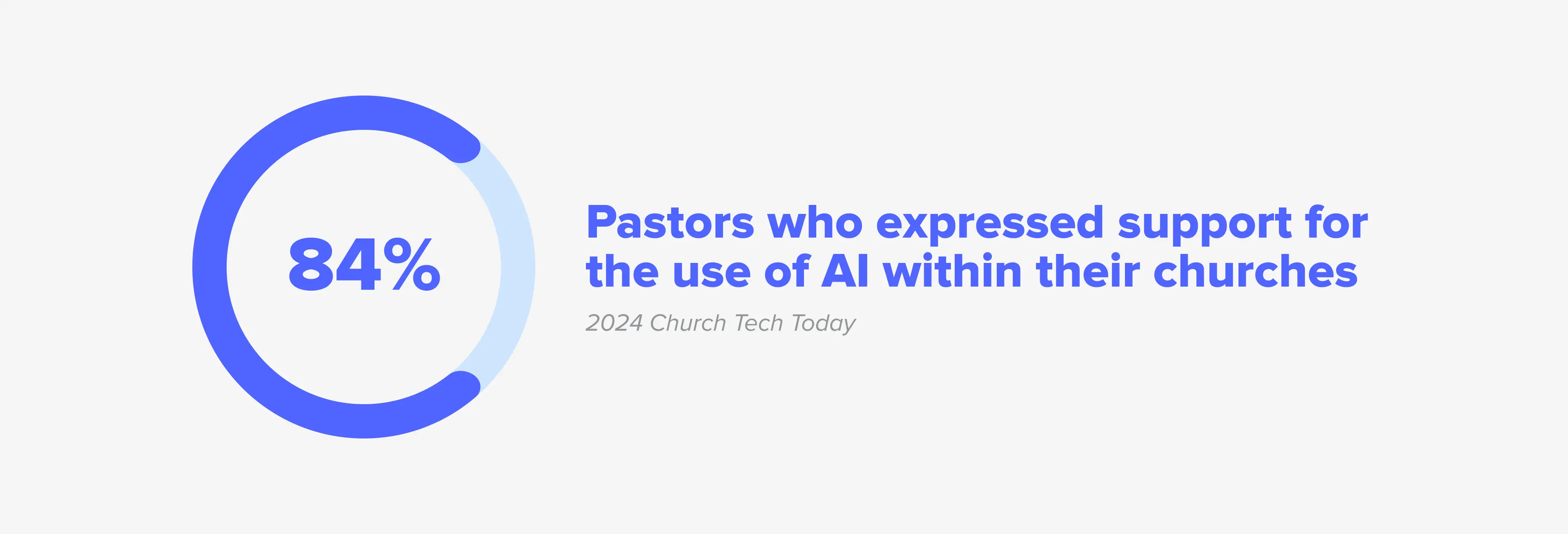
- According to the 2024 Church Tech Today survey, 87% of pastors expressed support for the use of AI in some capacity within their churches.
- 54% of pastors agree at least somewhat that AI can positively support church outreach and community service efforts.
- 77% of pastors agree that God can work through AI.
- Nearly three in five pastors (58%) tell Barna they are comfortable using AI to assist in communication.
- Yet most church leaders draw a clear boundary: while AI can assist with marketing or data organization, it should never replace the spiritual discernment required for pastoral care, counseling, or preaching.
- In terms of mission and impact: many pastors say AI frees them up to focus more on ministry and discipleship and less on research, content, and admin tasks.
- According to Exponential, 82% of church leaders believe AI will make their churches more effective in the next five years.
- There are AI platforms built specifically for pastors and leaders. These platforms have been approved for their historical accuracy, theological soundness, ethics, and excellent assistance. For instance, Pulpit AI helps pastors generate 20+ AI resources from one piece of content! Turn your sermon into newsletters, blog posts, social videos, sermon clips, and devotionals with just the click of a button.
- Recently, Southeastern University’s (SEU) Barnett College of Ministry & Theology partnered with Subsplash to integrate Pulpit AI into their curriculum, providing ministry students with cutting-edge learning resources. This partnership is designed to equip SEU’s 2,200 pastoral students with an innovative tool to enhance sermon preparation, streamline workflows, and more.
- A recent Subsplash webinar on church ministry and AI showed that 57% of attendees were already using AI, and an overwhelming 100% expressed interest in using AI for content creation—including sermon reels with captions, sermon prep, devotionals, group guides, and newsletters.
Today's discipleship needs in the Church
Despite the church's emphasis on spiritual formation, many churches are struggling to build effective discipleship pathways for visitors and new members. Pastors report that while their congregations excel in areas like worship, discipleship often receives far less focus and intentionality.
Limited evaluation, inconsistent follow-up, and a lack of dedicated leaders—especially in smaller churches—make it difficult to track spiritual growth or guide people beyond Sunday services.
At the same time, younger generations still value relational, in-person discipleship, creating both a challenge and an opportunity for churches to bridge digital engagement with meaningful, real-life community and mentoring. Here are five facts that exemplify why discipleship needs remain great in the church today.
- U.S. Protestant pastors report believing that corporate worship at their church is their best aspect (30%), as opposed to building community (16%), outreach and evangelism (14%), serving others (15%)—and discipleship (11%), which ranks dead last.
- 71% of pastors surveyed for a Lifeway study believe there are ways to measure discipleship in a congregation—yet only 30% say their church actually has specific methods to do so.
- Although half of pastors believe their discipleship strategy is effective, only 29% regularly track their congregants’ progress, and two-thirds (66%) admit they do not consistently assess the spiritual growth of church members.
- Smaller churches are less likely to have someone overseeing discipleship. About a quarter (24%) of pastors at churches with 250+ attendees report no one is responsible, compared with 31% at 100–249, 41% at 50–99, and 50% at churches under 50 members.
- Though Gen Z is online more than any other generations, over 50% of them still believe that in-person relationships are more important than digital relationships. This highlights how important in-person discipleship continues to be for the Church today.
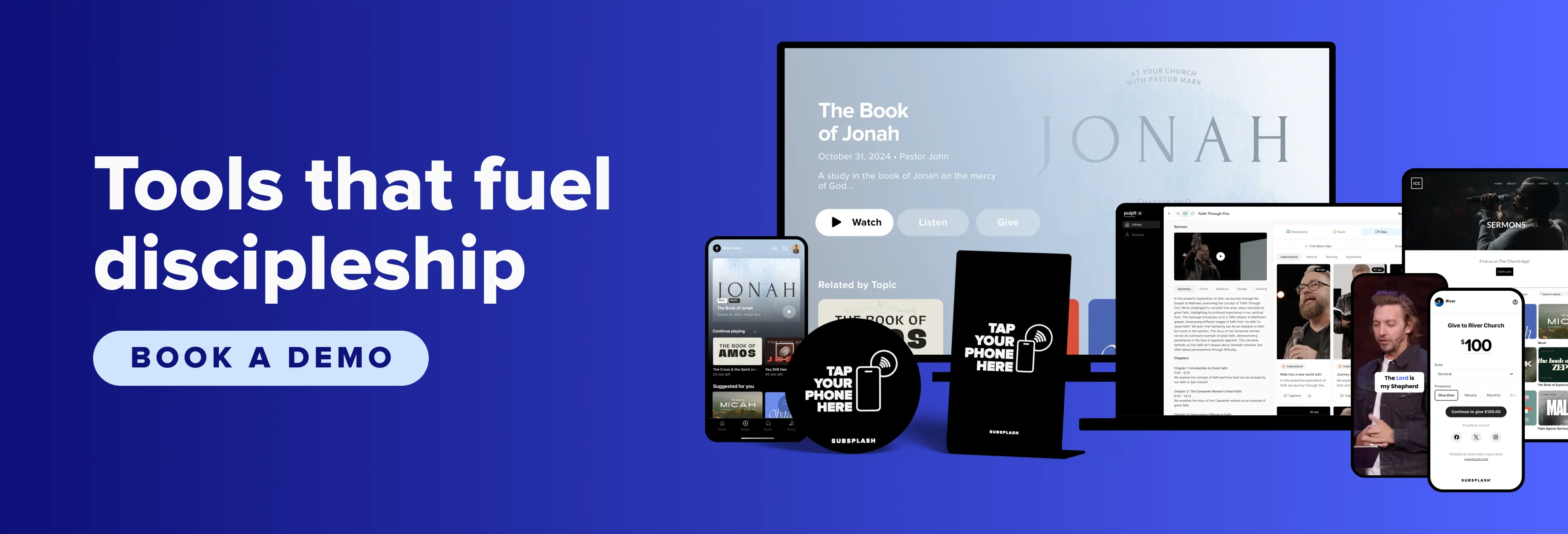
Subsplash: Empowering churches in the Digital Age
In today’s world, churches are no longer confined to Sunday services or physical walls. People engage with faith in new ways—through apps, streaming, messaging, and online giving. To meet congregants where they are, churches need tools that make it easy to connect, disciple, and foster community at any time, from anywhere.
That’s where Subsplash comes in. Subsplash provides a unified platform designed specifically for churches, helping leaders streamline communication, manage ministry, and engage their congregations digitally. From sharing messages and resources to facilitating online giving and live streaming, Subsplash equips churches to create meaningful connections that extend beyond Sunday mornings.
Check out these fifteen facts below about Subsplash’s history and why over 20,000 churches use their platform to take their digital ministry to the next level. Subsplash’s tools empower pastors and teams to reach people consistently, foster spiritual growth, and build community in a digital-first world—allowing churches to thrive in every season while keeping the Gospel at the center!
- In 2009, the first-ever church app was created by Subsplash
- Subsplash’s first church app was downloaded over 10,000 times in the first week!
- Since then, Subsplash apps have been launched over 2.3 billion times… and counting!
- In 2015, Subsplash developed the very first church apps for Apple TV which were live on day one of the Apple TV App Store launch.
- Subsplash has nearly 100 million Subsplash app downloads worldwide. From bustling cities to remote villages, people are downloading Subsplash apps to stay connected with their churches and grow in faith!
- 22+ million messages have been sent through the Subsplash Groups & Messaging. These messages aren’t just texts—they’re prayer requests, words of encouragement, and life-giving conversations. Churches are using this tool to strengthen fellowship and keep their communities spiritually connected, even when they’re apart.
- 2+ million live streaming broadcasts have happened through Subsplash apps. Thanks to live streaming, distance is no longer a barrier to experiencing the joy of God’s people gathered together. From Sunday services to special events, these broadcasts have united believers across continents in worship.
- Through Subsplash apps, nearly 30 million people have watched live content, totaling over 3 million hours of streaming.
- Since its inception, over 24 million donors have contributed through Subsplash Giving—and counting!
- Over 5.7 million push notifications have been sent through Subsplash’s platform. A simple notification can be the reminder someone needs to re-engage with God’s Word, join a prayer meeting, or watch a message.
- A total of $7.4 million has been distributed to churches through Subsplash’s GrowCurve™, a tool that automatically lowers processing rates as a church’s donations increase!
- In 2024, Pulpit AI joined Subsplash, an innovative AI platform that automatically transforms sermon videos into a suite of shareable content, saving pastors and their teams hours of work every week.
- In 2025, Subsplash Tap was introduced, a tap-to-engage solution for churches that makes giving and connecting as seamless as possible. Utilizing tap-to-give technology, users can give, sign up, or connect with just the tap of their phone.
- This year, Subsplash was also officially ranked the #1 Church Management Software (ChMS) on G2, the world’s leading peer-review platform for software! Since spring of 2025, Subsplash has climbed from 25th to 1st in Church Management Software. This recognition is a direct result of listening to churches, continually innovating with excellence, and delivering a unified platform that empowers ministry in every season. Our climb to #1 is also reflected in our client success surveys, as well as amazing testimonials we’re receiving from our clients!
- In 2025, Subsplash turned 20! Today, Subsplash has over 300 employees serving over 20,000 churches and ministries, as well as millions of users around the world. That’s twenty years of serving the local church, following God’s call, and making a difference in the lives of billions of people for the purpose of sharing the Gospel. All glory to God!
The digital edge churches need in 2026
From mobile giving to AI-assisted ministry, the digital age is reshaping how churches connect, engage, and disciple. Churches that embrace digital tools thoughtfully can reach people where they are, whether that’s streaming a Sunday service to someone across town, sharing a devotional via an app, or engaging congregants through messaging and small group platforms.
Beyond just convenience, these tools deepen engagement by creating consistent opportunities for spiritual growth, community building, and meaningful connection throughout the week. They allow churches to track impact, nurture discipleship, and respond to the needs of their members more effectively than ever before. By integrating technology into their ministry strategy, churches can amplify their mission, expand their reach, and help more people experience the Gospel—both online and in person.
In a world that is increasingly digital, those who equip themselves with the right tools can ensure that their message, their community, and their ministry continue to thrive for years to come.
[.blog-contact-cta]Talk with a real-life expert today[.blog-contact-cta] to discover how Subsplash can help you save time, simplify your processes, and reach more people this holiday season.
.webp)