





Reaching Gen Z women: Why they’re leaving church & what helps them stay
Picture a typical Sunday morning at your church as you scan the worship center from the stage or the back row. You notice the young men in their twenties are showing up, sitting together, and participating in your community life. But the young women who grew up in your youth group, left for college, and are now entering the workforce are largely missing.
This is not an isolated anecdote or a temporary phase unique to your local community. It is a documented cultural pattern that requires a thoughtful, strategic pastoral response from church leadership.
We are witnessing an unexpected cultural shift as faith-based interests regain traction with younger generations, including a new surge in church attendance. A recent analysis highlights how Contemporary Christian is one of music’s fastest-growing genres, drawing millions of next-gen listeners. This interest is translating directly into Sunday morning attendance, with national outlets tracking a significant wave of young men returning to church across the country.
Data from Barna Group confirms that young adults lead a resurgence in church attendance overall, reversing years of downward trends. Yet, a closer look at the demographics reveals a striking, deeply sobering exception—this spiritual momentum does not extend to Gen Z women.
For years, women’s ministries were the vibrant core of church volunteer bases, mid-week Bible studies, and community outreach efforts. Seeing Gen Z women detach from church life leaves a noticeable void in the weekly life of the congregation. Pastors and ministry directors often find themselves wondering what changed and how to re-engage a generation of women who seem to slip away right after high school graduation.
Addressing this challenge requires looking honestly at the numbers and understanding the cultural landscape these young women navigate.
What the data reveals & why it matters for your church
While tracking religious life in America for over 40 years, researchers have consistently found that women outpaced men in church attendance and daily spiritual practices. But today, those trends are reversing as young men surpass young women in church attendance for the first time.
According to the Barna State of the Church report, 43% of men now attend church services weekly, compared to just 36% of women. Today, 2 in 5 young women identify as having “no faith.” On top of that, Gen Z women report the lowest rates of prayer, church attendance, and Bible reading among young adults, indicating that traditional modes of faith engagement are failing to connect with their daily lives.
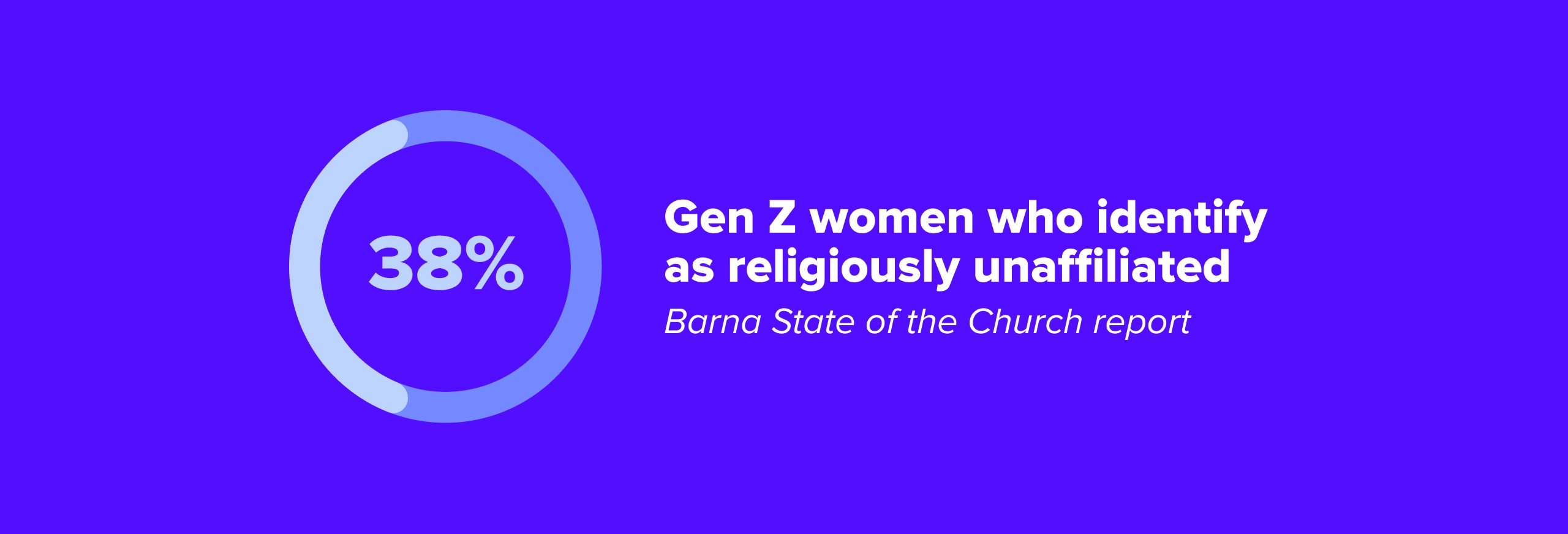
This represents the largest gender gap in a quarter-century of data collection—signaling an unexpected shift that changes how pastors must approach a modern women’s ministry Gen Z strategy. The Barna Group also found that 38% of Gen Z women now identify as religiously unaffiliated, marking the highest rate of disaffiliation ever recorded for a female demographic.
It is easy to look at these metrics and assume that young women have rejected Christian theology entirely, but the research tells a far more nuanced story. In reality, 73% of Gen Z adults explicitly state that they believe in a higher power or a personal creator. That means Gen Z remains more spiritually open than any generation researchers have studied over the past 40 years.
This generation is also navigating unprecedented relational challenges within their childhood homes, which heavily impacts their spiritual formation and view of community. Only 23% of Gen Z women feel deeply supported by their fathers, while only 36% report feeling supported by their mothers. When family units experience this level of emotional fragmentation, young women often struggle to find stable ground in adulthood.
This reality makes the local church’s role as a healthy, adoptive spiritual family more important with the younger generations. Ministry leaders must recognize that these statistics represent real individuals experiencing a profound sense of isolation. When young women disconnect from their own families, as well as spiritual communities, they lose a crucial network of support during pivotal life transitions like starting a career or moving to a new city.
To address a widespread Gen Z women faith decline, we have to firstly look closely at our ministry environments. Understanding that this data reflects a cry for genuine connection helps shift your perspective from panic to pastoral care. The goal is not merely to correct attendance percentages, but to welcome daughters of the faith back into a thriving, supportive spiritual home.
What Gen Z women are actually looking for
If we can ask honestly why are Gen Z women leaving the church, we find that the answers span across a wide range of issues. But the bottom line is that there is no single issue, but a multitude of reasons that have added up over time.
For Gen Z women who’ve walked away from the Church, or who’ve never been fully engaged from the beginning, the disengagement often reflects specific unmet needs that the local church is still positioned to meet. With intention and honesty, each challenge can become a clear path towards ministry.
Let’s explore a few of the core factors driving this generational departure—and how understanding these shifts can help your team build a healthier path forward.
To be seen as a whole person, not just a role to fill
The church that offers a vision of women's ministry built on spiritual gifts and calling—rather than conformity to a single cultural template—has a distinct advantage with this generation. That's the opportunity in front of you.
Many young women who grew up in the church during the 2000–2010 era encountered a framework of faith that, however well-intentioned, inadvertently tied a woman's spiritual worth to narrow behavioral standards. When their real-life experiences didn't match those templates, they felt disqualified. Gen Z women carry the weight of those experiences into adulthood, creating a hesitation to re-engage.
Additionally, as Gen Z redefines womanhood, the gap between how young men and women view their roles is widening. Young women who've been told that biblical womanhood is narrowly defined by marriage and motherhood often find themselves without a clear sense of belonging in that conversation. When churches build programs centered solely around traditional families, women from all walks of life—including single mothers and career-driven women—often feel there's no place for them.
The solution is a culture your leadership team intentionally builds: one that values women for their spiritual gifts and God-given calling, not just the role they're expected to fill. When young women sense that your church sees and values them as whole people, they move toward it rather than away. That shift starts with creating an environment where people feel safe bringing their real, complicated stories.

Discipleship that is led by the Church, not an algorithm
Gen Z women are not spiritually passive individuals; they are highly active in pursuing faith-based content on digital platforms. They follow independent faith influencers, stream specialized Christian podcasts, and save devotional videos on social media networks.
As church leadership expert Carey Nieuwhof observed in his 2026 church trends report, digital discipleship is happening every single day, but digital algorithms are currently outlasting the local church. Young women are turning to their phones for spiritual encouragement because the online space feels accessible, immediate, and tailored to their specific questions.
While these digital spaces provide helpful teaching, they cannot offer the accountability and deep connection of a local church community. As Jenna Mindel writes in Christianity Today, “Young Christians, too, can be tempted to engage solely online with their faith. But podcasts, influencers, or Christian books should be catalysts for in-person community, not replacements. … There are plenty of good online Christian resources to counter the secular or deconstructing ones, but what young people need more than just information is community—and that starts with embodied relationships.”
A video clip can inspire a viewer, but it cannot visit her in the hospital, celebrate her milestones, or carry her burdens. When a young woman relies solely on digital influencers for her faith formation, her spiritual life becomes isolated and disconnected from local body life. To regain influence, your church must build a credible digital presence that acts as a pathway, guiding online interest back into physical, local relationships.
Theological depth & open conversation
Are your sermons, online content, discipleship material, and small groups addressing real world issues backed by in-depth theology that leads to discipleship? For a lot of Gen Z women, as well as young adults in general, they would say the answer is a resounding no.
Gen Z women today often identify the church as shallow, boring, or even “not relevant to my career or interests”. Additionally, in one survey by Barna, 20% of young adults who attended a church as a teenager noted that “God seems missing from my experience of church”.
There are varied reasons why young Christians leave church once they become an adult or go off to college—yet none of them should be that God was “missing” from their church experience.
Online influencers often succeed in spiritually influencing young adults because they project an approachable, unpolished version of daily life that feels deeply empathetic. They speak openly about anxiety, workplace stress, gender ideologies, finances, and relationship struggles while filtering nothing. Perhaps this is why so many young people are turning online for spiritual guidance.
The bottom line is that Gen Z women are not looking for shallow discipleship that sidesteps important conversations. If your Sunday sermons and ministry communications feel distant or overly formal, young women will continue to prefer their digital feeds, or other spiritual sources. The local church must learn to speak directly to real-world issues, demonstrating that the ancient truths of Scripture apply directly to modern life.
A real church community, not a brand
For decades, the standard response to a struggling ministry was to launch a new program, remodel a room, or increase production values on Sunday morning. New data from Outreach Magazine and other pastoral studies demonstrates that Gen Z women are entirely indifferent to polished ministry brands. They are searching for deep, substantive community where they are known by name rather than being treated as a target demographic to manage. When a church prioritizes flawless execution over relational depth, it unintentionally creates a barrier for young adults who crave authenticity.
Young women do not want to see a curated, perfect version of Christian womanhood that feels impossible to achieve in their daily lives. They want to see older women who are willing to share their real struggles, their doubts, and their victories with absolute honesty.
Production value can look impressive from a distance, but it lacks the warmth that draws a lonely person into community. To close the connection gap, your leadership team must shift focus from building large events to cultivating small, unpolished spaces for genuine relationships.
When financial budgets and staff hours are heavily skewed toward staging massive weekend events, young adults notice the underlying priorities. They perceive that the church cares more about gathering a crowd than caring for the individual souls within that crowd. True belonging is forged over shared meals, late-night conversations, and quiet moments of prayer where people can take off their masks. Shifting your operational priorities away from complex programming and toward relational space is the first step in creating a sticky church environment for young women. When we prioritize real connection, we pave the way for robust Gen Z women church faith engagement that endures.
Building an environment of authentic relationship requires the right ministry infrastructure. To see how a unified platform helps you coordinate small groups, track engagement, and keep your community connected between Sundays, you can explore the Subsplash Church Management Software feature page today.

Practical strategies for building a culture of retention
Build intergenerational connection as infrastructure
Barna’s research identifies intergenerational connection as an effective path to restoring faith and belonging among young women. This means that expanding intergenerational discipleship women ministries can help bridge the gap between older mentors and young adults.
This requires your church to intentionally move away from age-segregated silos and create spaces where different generations naturally interact. You can structure your small groups to include a deliberate mix of college students, young professionals, and older saints who have walked with the Lord for decades. This blend allows younger women to see modeled faith over a lifetime, providing a sense of stability they often miss in the broader culture.
Consider developing organic mentoring frameworks that focus on life-on-life connection rather than demanding a rigid, school-like curriculum. When an older woman invites a college student into her home for a meal, handles her questions with patience, and listens without judgment, true discipleship occurs. This organic approach removes the administrative pressure of managing massive church programs while deepening the quality of care within your congregation. When a Gen Z woman has an older mentor who knows her name, the local church stops feeling like an institution and starts feeling like a home.
This model of intergenerational connection works best when it is baked directly into the long-term infrastructure of your community life. Instead of hosting a one-off mentoring event in the fall, look for ways to weave multi-generational leadership into every existing ministry team. When young women serve on greet teams, worship bands, or kids ministry alongside mature believers, mentorship happens naturally through shared labor. These collaborative environments break down generational intimidation, showing young women they have an essential, respected place in the larger church body right now.
Be present & consistent in digital spaces
Reaching Gen Z women where they already spend time requires a clear, intentional, and consistent digital presence from your ministry team. You do not need a massive media budget or an enterprise production staff to make a meaningful impact in the digital realm. Instead, you can empower the young women already sitting in your pews to use their creative voices to share their faith journeys online. Giving your congregation the tools and permission to share their real experiences creates an authentic digital front door for your church.
Sharing authentic sermon highlights, real community stories, and daily encouragement on social platforms reminds young women that your church is active and accessible. These digital touchpoints should not look like corporate advertisements, but should reflect the genuine, messy beauty of your actual community life. When a young woman encounters your church online and sees people who look like her asking real questions, her hesitation begins to melt away. Your digital presence must serve as a bridge, consistently pointing viewers toward physical gatherings where real belonging takes place.
Using advanced platforms like the Subsplash Pulpit AI feature page helps your staff maximize the value of your weekly sermon content without adding hours of extra work. This technology allows you to transform a single Sunday recording into customized daily devotionals, discussion prompts, and engaging video clips for social feeds.
By extending the reach of your physical pulpit into the digital spaces where Gen Z women spend their time, you provide a consistent source of truth throughout the week. This continuous engagement ensures that the lessons learned on Sunday remain an active part of their daily reflection.
Create spaces where real questions are welcome
The ministries that successfully retain Gen Z women share a distinct cultural trait: they do not become defensive when faced with difficult cultural questions. Young adults are wrestling with complex issues regarding culture, mental health, ethics, and personal faith, and young adults often feel that the church feels unfriendly to those who doubt.
Instead, Gen Z women need to know the church can handle their honesty. You can model this transparency from the pulpit by addressing tough topics directly and acknowledging that wrestling with faith is a sign of spiritual seriousness. When pastors speak openly about doubt and pain, it gives the entire congregation permission to drop their masks.
Create safe environments within your small groups and women’s ministry settings where doubts can be voiced without fear of immediate correction or ostracization. True spiritual growth rarely happens in an environment of forced compliance or superficial agreement. When leadership welcomes hard questions with humility and theological depth, it builds a foundation of trust that keeps young adults anchored during seasons of doubt. A church that embraces the messy process of questioning helps young women discover a resilient, adult faith that can withstand cultural pressures.
This openness should specifically extend to topics like anxiety, depression, burnout, and loneliness, which heavily impact this generation. When the church remains silent on mental health or treats it purely as a spiritual failure, young women look elsewhere for help. Incorporating professional insights alongside sound biblical theology demonstrates that your ministry cares for the whole person—mind, body, and soul. By validating their emotional realities, you show Gen Z women that the church is a safe harbor rather than an ongoing performance evaluation. This is at the heart of how to reach Gen Z women in church effectively.

Strengthen connection between church services
A healthy, vibrant church experience cannot be confined to a single two-hour window on Sunday morning. Because Gen Z women are accustomed to constant, daily communication, the six days between your weekend services are where real discipleship takes root.
You can bridge this weekly gap by providing consistent mid-week touchpoints, such as shared Bible reading plans, active prayer request threads, and small group chat channels. These simple daily interactions remind your people that they belong to a community that exists beyond the walls of a building.
This is where using dedicated tools like Subsplash Groups and Messaging allows your ministry leaders to maintain safe, church-owned digital communication channels. When a small group leader can easily check in on a member via text, or when women can share prayer requests instantly, it reinforces personal value. You keep your community connected without forcing staff members to manage multiple third-party social media messaging platforms. By providing a central, secure space for daily communication, your church ensures that no young woman falls through the cracks during the week.
When communication is scattered across various texts, personal emails, and unmanaged social networks, it creates confusion and administrative fatigue for your team. A unified messaging channel gives your small group leaders a direct line to check on individuals who missed a week or are going through a crisis. This reliable digital infrastructure transforms a large congregation into an intimate, accessible network of care where real needs are met in real time. Ensuring that your digital tools support your relational goals allows you to grow, engage, and connect your community effectively.
Preach the gospel & emphasize community
While the Bible promises that the cross is “folly” to nonbelievers (1 Corinthians 1:18), we know that God’s Word is the same yesterday, today, and forever (Hebrews 13:8). That means while the culture will always be in flux and changing from generation to generation–and even hour to hour in our modern era—the truths of the Gospel will remain the same.
Young women don’t need a watered down gospel that’s catered to their whims and desires and changes season by season. Instead, they need foundational truths that will carry them through life’s greatest hardships and their deepest questions. By preaching the Gospel of Christ crucified (1 Corinthians 1:23), and putting God first in your ministry to Gen Z women, you can help them encounter the One who has a plan and purpose for their lives. Your job as the pastor isn’t to “convince” them that Christianity is worth sticking around for with cool tech and sound arguments, but to lead them to encounter the Living God will touch their souls with His love. If that’s not happening at your church, that may be why Gen Z women across the country are leaving church in general.
And just as importantly, young women need to experience the power of a Christian community. They need people who will come alongside them, pour into them, answer their questions, pray over them, call them, text them, and get to know them. A tenant of our modern culture is extreme isolation, chronic autonomy, and total self-reliance. However, these are not tenants of the Gospel. In fact, far from it.
By preaching the Gospel, helping young women encounter the living God, and intentionally setting your Gen Z women up to become deeply known and loved, you’re taking important steps to disciple the next generation of women who desperately need the truth of the Gospel.

Moving forward with hope & purpose for Gen Z women
Reversing the current trends around young adult disengagement is not about discovering a marketing trick or chasing a temporary cultural fad. It is about returning to the timeless, relational heart of the local church—a place where women have always discovered their calling and experienced Jesus.
By building a ministry culture rooted in intergenerational connection, digital presence, and radical authenticity, your church can become a refuge for a generation looking for truth. You simply need to build the relational infrastructure that allows your people to know, engage, and grow your church daily.
Ready to equip your women’s ministry and small groups for deeper relationships? Discover how Subsplash provides the complete platform built for churches to foster lasting community, and see how you can easily expand your digital reach.
Take a moment to [.blog-contact-cta] book a free demo [.blog-contact-cta] with our team today, and let’s discuss how we can partner together to help your church reach more Gen Z women with the truth of the Gospel!