

.webp)






Can you imagine if the next Billy Graham or Mother Teresa were to come from your church? Imagine being able to say, “I remember when they first came to our church, got baptized, and began their discipleship journey!”
It’s true—reaching just one person with the gospel can change the world. Jesus’ final command to his disciples (best known as The Great Commission) was to go and make more disciples:
“Therefore go and make disciples of all nations, baptizing them in the name of the Father and of the Son and of the Holy Spirit, and teaching them to obey everything I have commanded you.” Matthew 28:19-20 (NIV)
Discipleship is the lifelong journey of becoming more like Jesus by learning how to think, act, and feel as a follower of Christ. It’s a gradual process that requires godly teachers who set personal examples for others to follow.
Jesus’ twelve disciples obeyed his commands and changed the course of history. They took advantage of the latest technology of their day to reach as many new people as possible and make disciples: The Roman roads allowed the disciples to travel farther and faster; Thomas sailed on ships to bring the gospel to India; and Paul sent letters from prison to teach his disciples.
Today, technology allows us to share the gospel around the globe and offers more opportunities than ever to raise up new disciples. This process is known as “digital discipleship” or “virtual discipleship.” But exactly what is it, how does it work, and what does it look like when it’s done successfully?
What is digital discipleship?
Digital discipleship uses today’s digital tools (such as church websites, custom mobile apps, and live streaming) to teach people how to become more like Jesus. These resources have a global reach and are available anywhere, anytime. This means you can disciple people locally and globally—those both inside your church building and around the world.
However, digital discipleship is not meant to replace face-to-face discipleship ministries—rather, it should amplify them. While there are some churches that meet online exclusively, most churches today are adopting a hybrid strategy that offers both in-person and online experiences.
The truth is your church members are already “digital disciples.” Like it or not, they’re being taught and trained how to think, act, and feel by influencers, podcasts, news, entertainment, ads, and social media. Here are some examples of how this is happening:
- 254 million Americans spend time on social media through their mobile devices
- Americans spend about seven hours a day online
- U.S. adults spend nearly four hours a day watching TV
In other words, from the time they wake up until they go to sleep, your congregation is bombarded with messages from a wide range of sources—some of which are good, while others are questionable at best. How can your church compete with these voices calling out for your flock’s attention?
How does digital discipleship work?
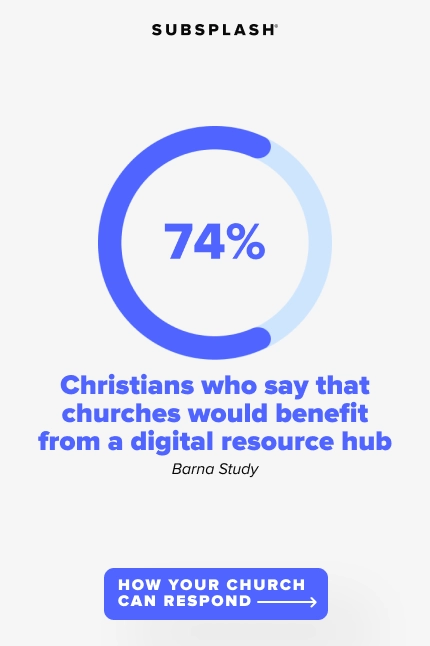
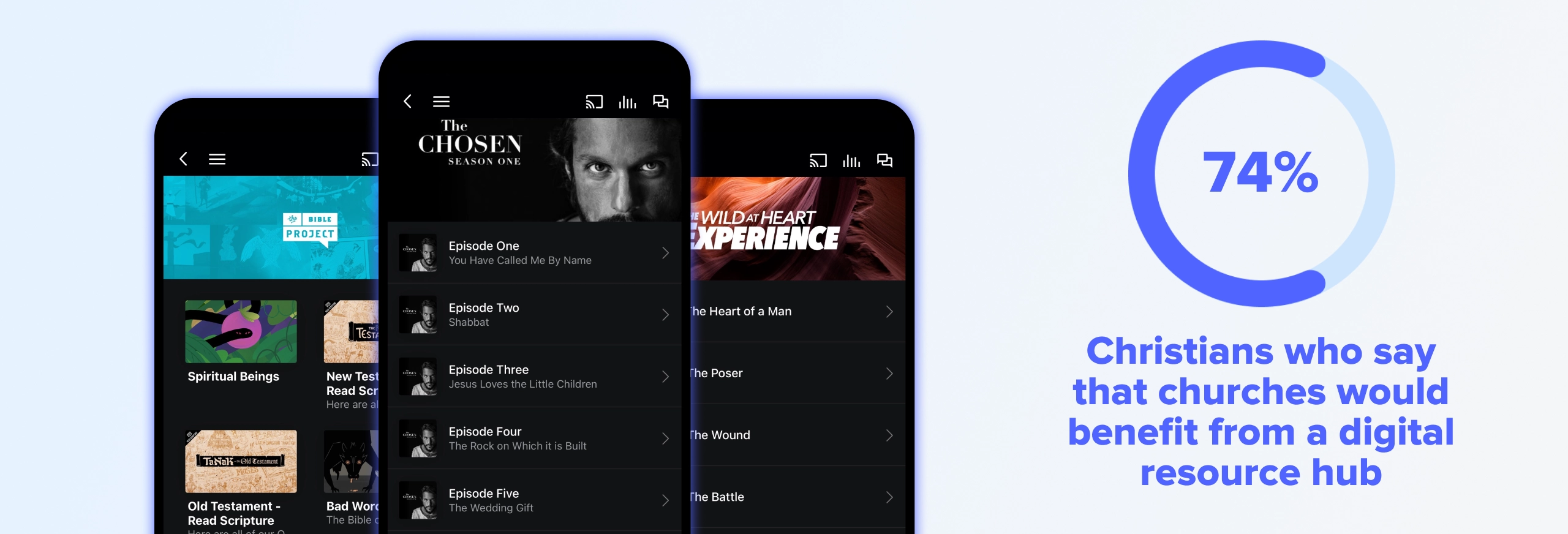
Recent surveys show that 74% of Christians want a digital resource hub from their local church.Being a disciple-maker in this day and age means providing online content that presents the gospel story, teaches believers how to live like Christ, and helps them grow in spiritual maturity.
Digital discipleship creates multiple online touch points that take your community further and deeper through each step of the discipleship process, including:
- Reaching: Telling the gospel story and beginning the discipleship process requires reaching people with your message. The most effective tools to do this are your church’s website and custom mobile app, where you can share live streams of your services as well as on-demand media.
- Teaching: Provide resources on your website and mobile app such as online sermons, Bible studies, Bible reading plans, and podcasts that engage people and help them discover the good news of the gospel.
- Connecting: Create discipleship-focused events to gather people together for opportunities to meet face-to-face or have online meetings. Sending invitations and building excitement about your events provides opportunities for people to create connections.
- Engaging: Provide your congregation with a powerful group messaging tool, like Subsplash Messaging, on your website and mobile app to encourage people to have meaningful conversations. Disciples need to be able to openly ask questions, get answers, have discussions, and build real relationships. Allowing people to message each other shows that your church wants to listen and better understand the people you are discipling.
- Multiplying: Healthy disciples multiply. As your disciples grow more mature and begin to reflect Christ in their lives, this will open up opportunities to share the gospel with others. Because your church’s discipleship content is accessible online, your disciples can share this content with their friends and families, allowing them to begin their own discipleship processes.
- Equipping: True discipleship moves beyond passive listening to active ministry. Use your digital platform to provide leadership training videos, volunteer handbooks, and spiritual gift assessments. When you give your community the tools they need to serve—right on their phones—you’re equipping them to lead small groups, serve on ministry teams, and take ownership of their faith journey.
- Innovating: Staying relevant in a changing culture means using the latest innovative tools to share an unchanging message. By adopting AI-driven technology for churches, like Pulpit AI, you can instantly turn a single sermon into dozens of shareable resources—like devotionals, social posts, and discussion starters. This doesn’t replace the heart of your ministry; it simply automates the heavy lifting so your team can focus on people. Pairing this with Trends AI allows you to see what’s resonating with your community in real time, helping you lead with intentionality and ensure your digital discipleship strategy is always moving forward.
What does successful digital discipleship look like?
It’s one thing to explain how to disciple your followers online, but let’s take a closer look at three real-life examples of successful online discipleship in action.
1. Lives changed—First Baptist Church of Gulfport, MS
Lisa C. was not a Christian and she didn’t go to church. However, during the pandemic she began watching devotionals and online services from the First Baptist Church of Gulfport, Mississippi. The messages she heard touched her heart and she accepted Jesus on Easter, 2020. She then drove for over an hour to meet Pastor Jimmy Stewart, get baptized, and begin her personal walk with Christ.
Pastor Stewart shared that many other people connected virtually with their church from other states, countries, different backgrounds, and at different stages in their discipleship journeys. From nonbelievers to lifelong Christians, they all have grown in their faith by engaging First Baptist Church of Gulfport’s online content. (Download their mobile app to see for yourself!)
2. Building community online—Imagine Church, Gilbert, AZ
Pastor Justin Klatt originally set up Imagine Church as a traditional in-person model. However, he felt challenged to use the power of technology to help people connect with God, with their church, and with each other.
Imagine Church now has online communities in five countries and 218 cities that allow friends and family to attend church together even if they live physically apart. They credit much of this growth to using digital tools like their website and mobile app to host their teaching, worship, and digital conversations on Sundays and throughout the week.
This is what successful digital discipleship looks like. It doesn’t have to replace in-person gatherings. It’s discipling your congregation Monday through Saturday by providing online resources, media, Bible studies, reading plans, and more. It opens your church doors to people from around the world. It allows your church to reach people who may never physically attend your services, but they can still experience Christ in a real way online.
3. Growing as a church—Emmanuel Church, Greenwood, IN
Sometimes, there just aren’t enough hours in the day. And in the midst of juggling hectic school schedules, work projects, and family obligations, quiet time with God can fall by the wayside, even for many passionate churchgoers. To help combat all the distractions, Emmanuel Church developed a custom daily quiet time experience right in their church’s mobile app. By leveraging the Subsplash Platform’s integration with Rock Enterprise and native block features, this custom feature helps users dive into scripture and connect with God every day. Their project is a testament of how churches can use Subsplash’s integrations to bring big, unique ministry ideas to life!
Digital discipleship: Using the right tools to engage your community
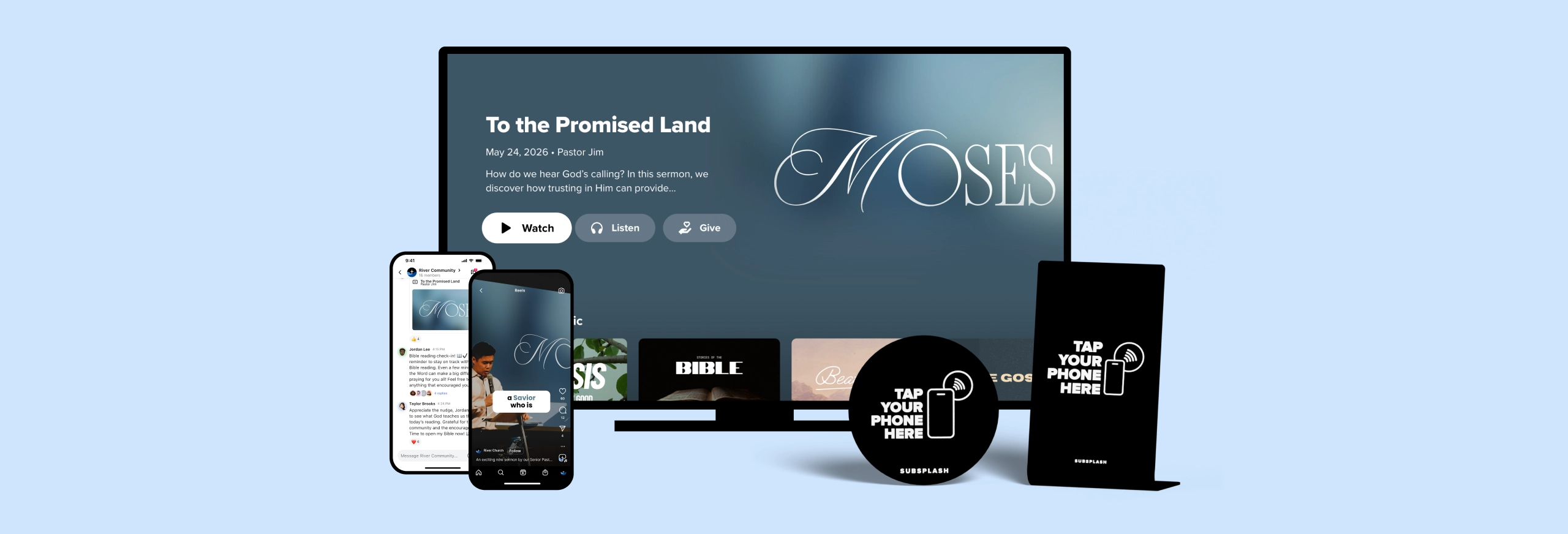
Digital discipleship is most effective when using the right tools to engage your community and expand your reach. Subsplash One streamlines your content on a single platform that includes church websites, custom mobile apps, live streaming, group messaging, on-demand media (like sermon videos and podcasts), online giving, and more.
To see how your church can use these tools to better engage your community with your content and help people grow in their discipleship journey, [.blog-contact-cta]let’s chat![.blog-contact-cta]


