When it comes to church software, church leaders often feel like they’re putting together a puzzle without all the pieces. You got into ministry to make disciples, and database management can quietly eat up the hours meant for that work. In fact, one in three U.S. pastors wish they’d been better prepared to handle administrative burdens.
You want to build disciples—not manage databases. The missing piece that makes everything work together is finding the best church management software (or ChMS) for your ministry.
ChMS technology has grown more powerful and user-friendly than ever. But which is the best option for your church? A quick search online turns up a seemingly endless list of church management software programs, each with their own features, advantages, and limitations. Whether your church is already using a ChMS or you’re looking to try something new, start by identifying which features matter most for your ministry’s goals.
Let’s take a look at the best ChMS features to give you a clear understanding of what’s available so you can make an informed decision for the greatest possible impact!
17 best church management software features for 2026
- Centralized database
- People management
- Groups & teams
- Automated workflows & processes
- Church communication
- Child & volunteer check-in
- Online giving
- Worship planning
- Forms & registrations
- Attendance tracking
- Event planning & management
- Financial tools
- Church health dashboard
- Website & mobile app
- Security & privacy
- Media & content management
- Reporting tools

1. Centralized database
Church administration can be a daunting task for churches of any size, and managing multiple church management software programs on multiple platforms can be incredibly confusing and frustrating. That’s why one of the most attractive features of a solid church management solution is having one centralized hub for all of your church management data. Your church leaders can access this software anytime and anywhere to manage operations, communications, finances, people, giving, groups, and more—and data and information stays consistent and updated, whether in mobile, desktop, tablet, or anywhere else!

2. People management
Probably the most popular feature offered by church management software solutions is people management. Your ChMS should contain church member profiles that include names, contact information, family relationships, attendance history, demographics, giving history, and so on.
The last thing church leaders want is for anyone from their community to slip through the cracks. With the right tools, your staff can enhance communication, management, and follow-up workflows (see point 4 below).
A good ChMS offers features that can match the best church directory software, like finding and merging duplicate records, as well as allowing your members to manage and update their own user profile information. And a great ChMS should create profiles automatically for new visitors via check-in, registration, giving, or connect forms. It should also allow you to set up custom fields to track things unique to your ministry!

3. Groups & teams
Small groups are essential for building meaningful relationships and a healthy church. Your ChMS should make it easy for your people to get connected to the right groups. That’s why Group Management capabilities are key to utilizing the right ChMS. These capabilities include group searches based on criteria (e.g., by location, interests, age of children, etc.) that work best for your visitors and members. Look for a group finder that lets visitors and members search by criteria like location, interests, or age of children.
And when it comes to Group Management, your ChMS should include volunteer management, event management software, and scheduling tools to keep everyone updated through email, text, or group messaging. It should also include group leader communication and communication among group members, such as prayer requests, sharing Bible verses, and event communications.
As you can see, group communications is an integral part of church communications as a whole. The right ChMS includes multiple avenues of communication for all different types of groups, helping your church members communicate with ease and success!

4. Automated workflows & processes
As a church leader, you have a lot on your plate, and it’s easy to become overwhelmed by tedious administrative tasks. The best church management software makes it simple for you to create workflows that automatically handle time-consuming processes! This allows you to literally set it and forget it.
For example, when someone is added to your database for the first time, a workflow can automatically send a welcome email or remind you to follow up with that new guest. No more worrying about forgetting to send a follow-up text to first-time visitors.

5. Church communication
A good ChMS puts all of your church communications–including emails, texts, push notifications, and group messaging—in one place, making it much easier to keep in touch with everyone. You can also see all of your outgoing and incoming communication history at a glance.
Don’t forget that church admin can set up custom reminder emails to volunteers, staff, and church members that go out automatically. You can also schedule tasks for important actions like following up with someone who’s not attended for a while or sending a financial report before your next board meeting.

6.Check-ins
Check-ins are an important step for child safety and also helpful for volunteer management. Your ChMS should make it simple for anyone to check in from their smartphone (or other devices) and receive SMS messages in case of an emergency. The best church management software will also go above and beyond for added security, such as AirPrint and unique PIN numbers.

7. Online giving
Any ChMS programs worth considering should integrate with your mobile, online, and text giving platforms—like Subsplash Giving—making online giving safe, simple, and worry-free for your donors! The right ChMS puts the donor first, such as making giving simple and easy, offering in-app giving, and helping donors see their giving history whenever they need it. Donors should be able to access online giving from an integrated mobile app, which means they can give anywhere, anytime, right from their phones.
And when tax season arrives, the best ChMS allows you to send end-of-year charitable tax statements, view your donation summary with advanced analytics, and use this information to forecast future incoming gifts.

8. Worship planning
Managing your church’s musicians, speakers, and volunteers for upcoming meetings is no small task. You should expect your church management software solution to help with the heavy lifting by automating this process with tools like:
- Seeing everyone’s availability
- Verifying confirmed or declined invitations
- Coordinating worship practices
- Team communication
- Order of services, notes, and schedules
- Collaborating song sets and libraries

9. Forms & registrations
Churches use forms for all kinds of important actions that keep people connected: event registrations, volunteer opportunities, small group sign-ups, and so on. In fact, every church admin knows that forms quickly become an integral part of church communications!
Your church management system should make it easy to create these custom forms and registrations so you can quickly gather all the information you need in one place. Plus, custom workflows can use this information to make communication and coordination more simple than ever.

10. Attendance tracking
Automated church attendance tracking gives church staff insights into who has been coming or missing out on church services and events.
Armed with this information, you can create workflows to schedule and send follow-up communication to check in so nobody falls through the cracks. These processes optimize the impact of your ministry outreach and provide insights by monitoring attendance trends.

11. Event planning & management
Church events take a lot of planning, coordination, and communication. Your ChMS should include event management software for churches with an event scheduler that will:
- Sync with your church’s calendar
- Connect with your registration forms to track signups
- Automatically send communication to build excitement and increase event attendance
Event planning also requires good volunteer management tools, making it easy to stay connected with those who are signed up to help.

12. Financial tools
The best church management software monitors your finances to give insights into your online giving, cash contributions, donor information, expenditures, and the overall financial health of your organization.
Both providing your leadership team with key financial information and pulling reports for board meetings and audits are important safety measures that create transparency and accountability.

13. Church health dashboard
A ChMS collects vital data from attendance tracking, check-ins, emails, media hosting, and church giving that can provide a holistic view of your church’s health. The dashboard should quickly and clearly give your team a bird’s eye view of key metrics that answer important questions, such as:
- Are our church attendance numbers growing, plateaued, or declining?
- Is our giving on track to meet our financial goals?
- Which of our events have had the most people register and attend?
Creating customized reports will provide vital information in an easy-to-understand format for each ministry team and department.
To gain even deeper insights into your community’s engagement, you can use Trends AI. This tool allows you to ask natural questions about your church data—like “Which age group is most active in small groups?”—and receive instant, clear answers. By using Trends AI to identify patterns and predict future growth, your leadership team can make more informed decisions to reach more people and fuel your mission.

14. Website & mobile app
The best ChMS will be part of a platform that integrates with your church’s website and custom mobile app. Your church’s website is its front door, so make sure that it creates a welcoming first impression for visitors. Choose a website meant for churches, like SnapPages™, which will give you church-focused templates, online giving integrations, easy drag-and-drop functionality, and much more.
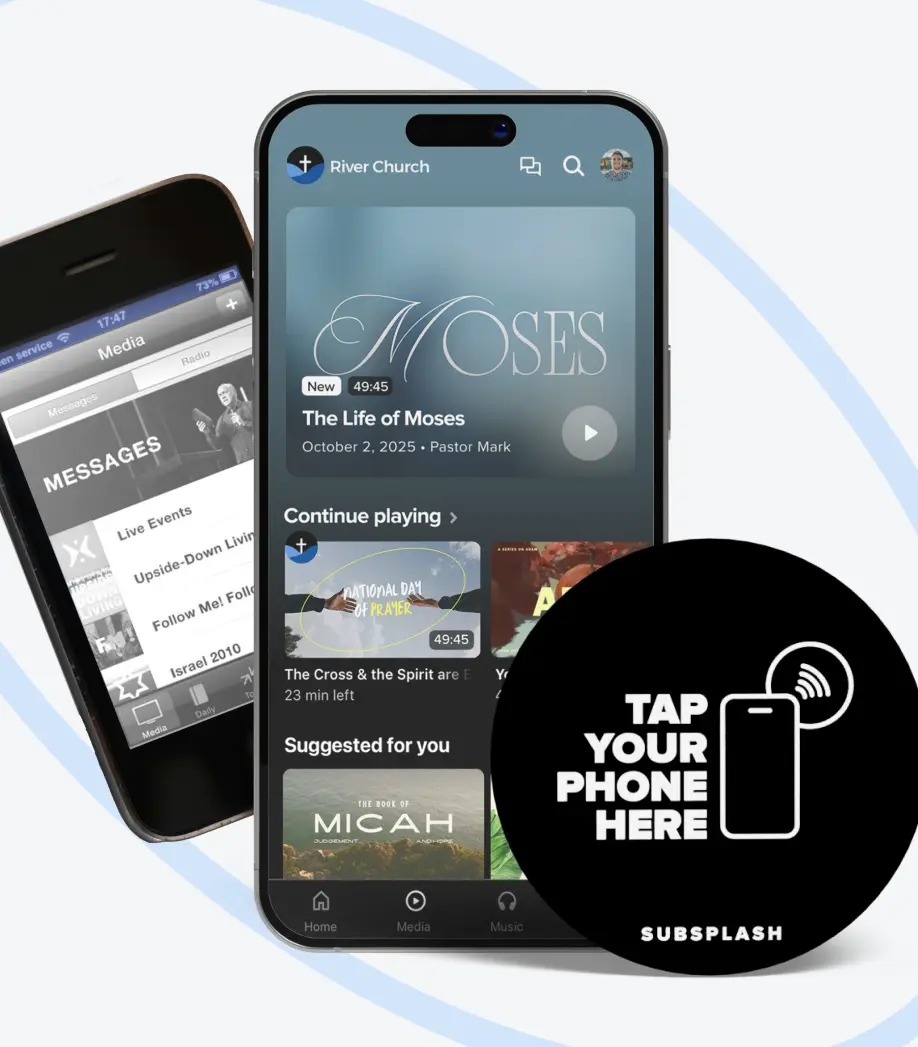
Your church’s custom mobile app is the hub where your church members go to engage with your church’s content, such as sermon videos, Bible reading plans, podcasts, and live streams. Subsplash apps are the industry standard for powerful custom-branded church apps that are individually available on all the major app stores.

15. Security & privacy
ChMS databases contain a lot of private personal data, so it’s crucial that they also provide the highest levels of security. Keep that information safe by controlling user access to private information and church data. Each of your church members with access to your ChMS should also be able to keep their personal data private.

16. Media & content management
Your church’s ChMS should be part of an all-in-one church media platform that hosts, manages, and delivers your live streams and on-demand content from a single dashboard. Subsplash Live simultaneously streams high-quality broadcasts from your church to your website, mobile app, YouTube, and Facebook Live. Your live stream is instantly converted to on-demand content that can be tailored to suit your needs with Subsplash’s live stream trimming tool.
Subsplash Media allows you to publish, stream, and share your church’s videos to your website, mobile app, and TV app. You can also convert your videos to audio for podcasts with one click of a button.
Your media and content management in your ChMS should also encompass innovative and relevant new tools, like those related to AI. To make your message go even further, you can now use Pulpit AI by Subsplash to turn a single sermon or teaching video into over 20 pieces of discipleship material. With just one click, you can generate everything from small group discussion guides and devotionals to ready-to-post Instagram captions and video clips. This helps your team save hours of work while ensuring your community stays engaged and informed.

17. Reporting tools
The best church management software will come with built-in reports that provide in-depth insights to information your leadership needs, as well as bring insights to questions they may not have thought of yet.
These reports should be able to cross-reference your system, export the data, and be able to schedule pulling and sending reports automatically so that your data is always available at the right time.
To take your data even further, Trends AI allows you to skip the manual work of building complex spreadsheets. Instead of digging through rows of data to find a specific trend, you can simply ask Trends AI a question in plain English—like "Which of our campuses had the highest first-time guest retention this month?" This makes your data more accessible for every member of your team, allowing you to focus on ministry rather than administrative hurdles.
Increase your reach. Engage your community.
Churches today can benefit from technology that reaches more people, improves communication, and simplifies their administrative tasks. With the right ChMS in place, church leaders can enjoy the peace of mind that comes from being able to make the best possible decision they can to achieve their goal of making more and better disciples.
Subsplash provides the best digital engagement tools for over 20,000 churches and organizations. Millions of people hear the gospel and grow in their discipleship journey through The Ultimate Engagemen/t Platform™ from Subsplash.
To find out how your church can increase their reach and better engage your community, [.blog-contact-cta]let’s chat![.blog-contact-cta]