

Churches have a lot of information to manage. From finances to volunteer schedules, member information to first-time visitors, class curriculum to children’s ministry…the list goes on and on. Ask any pastor or church administrator, and they’ll tell you that capturing and organizing so much information can be overwhelming!
That’s where church database software comes in—to help churches thrive by reducing clutter, organizing data, and making it easier to stay on top of daily operations. Today, the right database software does far more than store records—it fuels your entire discipleship strategy.
Let’s explore what a church database system is, its advantages, and how to choose the best solution for your church.

What is church database software?
Church database software is a cloud-based technology that allows church administration to collect, store, and organize information in a way that is easily accessible later. Because this software is made specifically for ministries, you should expect it to track these essential details:
Member information: How are your church members doing? Do you know who has stopped attending, who has moved, and who might be in need of help or encouragement? Church database solutions act as a super-powered virtual church directory, storing basic contact information alongside volunteer history, education, and church classes completed—anything that helps you care well for your community.
New visitor information: Most churches work hard to make visitors feel welcome, but many find it challenging to consistently and effectively follow up with visitors. A church database helps you capture and store information from first-time visitors that can be used for follow-up communication strategies.
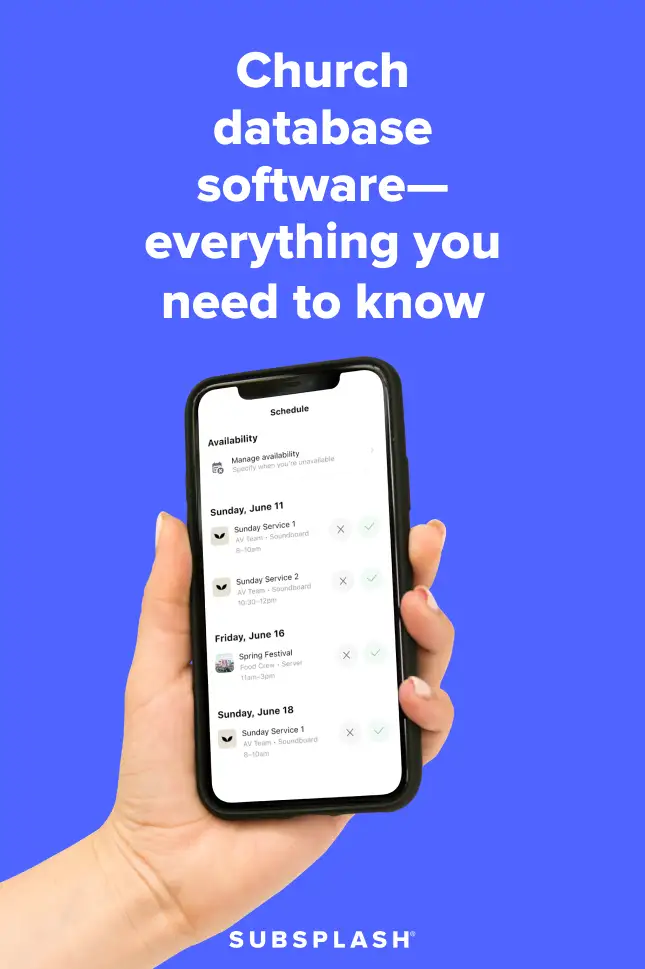
Calendars: Churches typically have multiple calendars to manage, including children’s ministries, youth activities, small groups, volunteers, and more. The right software can help organize your church’s calendar with the dates for your events, meetings, groups, and classes in a central location that everyone can access.
Financial information: Store and organize incoming donations and outgoing expenses, send end of year charitable contribution statements, and track payroll and taxes.
Staff information: Manage human resources information for your church’s staff. Things such as hire dates, benefits, and payroll information can be stored in your church database system.
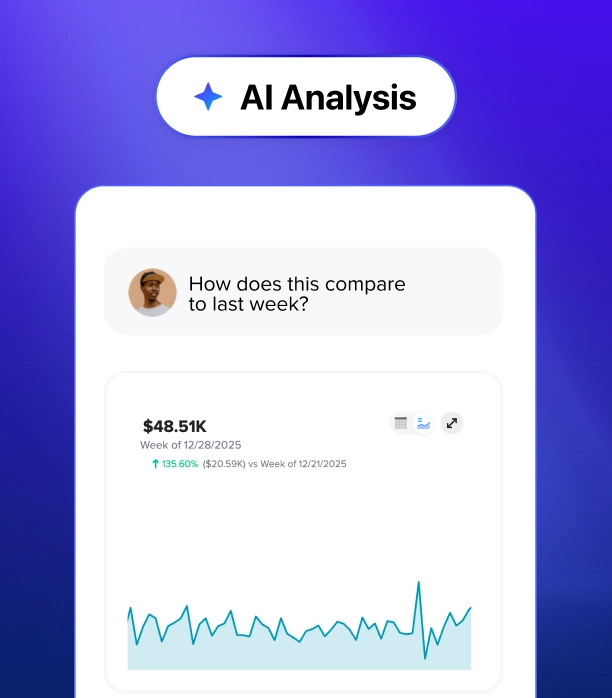
Reports and insights: Reporting allows churches to gain clear visibility into community health, encouraging transparency and accountability. Advanced tools like Trends AI by Subsplash take reporting a step further by surfacing giving patterns and attendance trends, helping leaders make informed ministry decisions faster.

What are the advantages of a database?
The benefits of a database built for churches goes beyond the essential functionalities mentioned above. Let’s take a look at these other advantages they offer.
- Reduce data duplication: Without a church database system, users will often create similar spreadsheets and files. This creates a lot of duplicate information, and it can be confusing to know which spreadsheet is the most current or relevant. A good church database will identify duplicate information in your files, merge duplicate contact records, and reduce the number of redundant records.
- Streamline data entry: Manually entering data into multiple tables, spreadsheets, and documents can be time consuming and frustrating. Databases should require you to enter information only once and access it immediately afterwards.
- Organize large amounts of data: Simply put, your church database will allow you to add and manage much more data than you can handle with traditional spreadsheets!
- Provide data integrity: Data is only valuable if it is accurate. Compared to using handwritten records or disconnected spreadsheets, a database reduces updating errors and improves data consistency.
- Simplify data access: Gone are the days of having to run to the church to use the office computer or search through dozens of spreadsheets for one piece of data. Cloud-based data sharing allows authorized users to access your church’s data from anywhere. And because your data is all in one place, you can quickly search and find the information you need.
- Ensure data security: Today’s online church database solutions offer multi-level security to ensure the safety and privacy of your data. You can also assign each user a certain level of access to specific areas of your database based on their job roles and responsibilities.

Overcoming common church database disadvantages
While they offer many benefits, there are some challenges when it comes to using a church database system, including:
- Complexity & customization: Some databases are complex and require customization in order to supply your church with the information you need.
- Cost: Church database solutions may require purchasing expensive hardware and software. There can also be substantial setup fees and conversion costs to import your data from other systems.
- Limited integrations: Some databases may have limited features and capabilities, offering little to no integration with software your church uses.
- Extensive training: Because of their complexity, initial training will be required for your programmers and users. If your church has limited staff skilled with technology, this may prove a hurdle for adopting a church database system.
Single-purpose database software vs. all-in-one engagement platforms
When evaluating technology for your church, you will encounter two primary options: single-purpose database software and all-in-one engagement platforms. Understanding the difference helps you make the best long-term decision for your staff and congregation.
Single-purpose database software
- Core function: Operates primarily as a digital filing cabinet for contact information, attendance tracking, and basic giving records.
- The complexity tax: Requires your team to manage a fragmented stack of disconnected tools to handle your website, media hosting, and mobile app.
- Cost of ownership: Often includes hidden financial costs and unexpected fees associated with forcing third-party software integrations to work together.
- Staff impact: Managing rigid, scattered systems pulls your staff away from people and toward computer screens.
All-in-one engagement platforms (like Subsplash)
- Core function: Connects your database records directly to your communication, discipleship, and media delivery tools.
- Simplified process: Eliminates friction by using an integrated ecosystem that acts as a force multiplier for your mission.
- Cost of ownership: Provides a single vision supported by one platform, reducing the financial drain of paying for multiple isolated subscriptions.
- Staff impact: Automates follow-ups and data entry so your team saves hours of manual administrative work, allowing them to focus on real relationships.
By unifying your technology, you create a resilient, future-proof church that can adapt quickly because you are not weighed down by complex systems.

Why you need more than just a database to manage your church
While church database software makes managing information easier and more organized, data storage alone falls short of building community. Churches need a holistic engagement solution that connects administration, communication, and discipleship into one connected ecosystem.
Fortunately, technology has advanced to the point where churches can use an all-in-one platform that combines database features with mobile apps, media streaming, and communication tools.
More than 20,000 churches use The Ultimate Engagement Platform™ from Subsplash to engage millions of people through church websites, custom mobile apps, live streaming, group messaging, and media storage and delivery.
Find out more about using digital tools to grow and disciple your church today. [.blog-contact-cta]Let’s chat![.blog-contact-cta]