.webp)




What to know before you start comparing church apps
Picking a church app is easier than it used to be. The harder part is figuring out which features your church actually needs before you sign a contract.
Most platforms look similar in a demo. A polished home screen, a media player, a giving tab: they'll all show you the same thing. What separates platforms isn't the feature list on a sales page. It's how those features work together day-to-day, whether your staff can manage the app without constant IT help, and whether the platform grows with you as your church grows.
The 15 features below aren't a ranking. They're a checklist — the things worth asking about, testing during a trial, and confirming before you commit.
1. Video player
Your congregation should be able to watch sermons, devotionals, and announcements anytime, from anywhere, without hitting a paywall or sitting through ads. That rules out apps that pull content from YouTube or Vimeo directly, since those players come with recommended videos, ads, and content your church didn't choose.
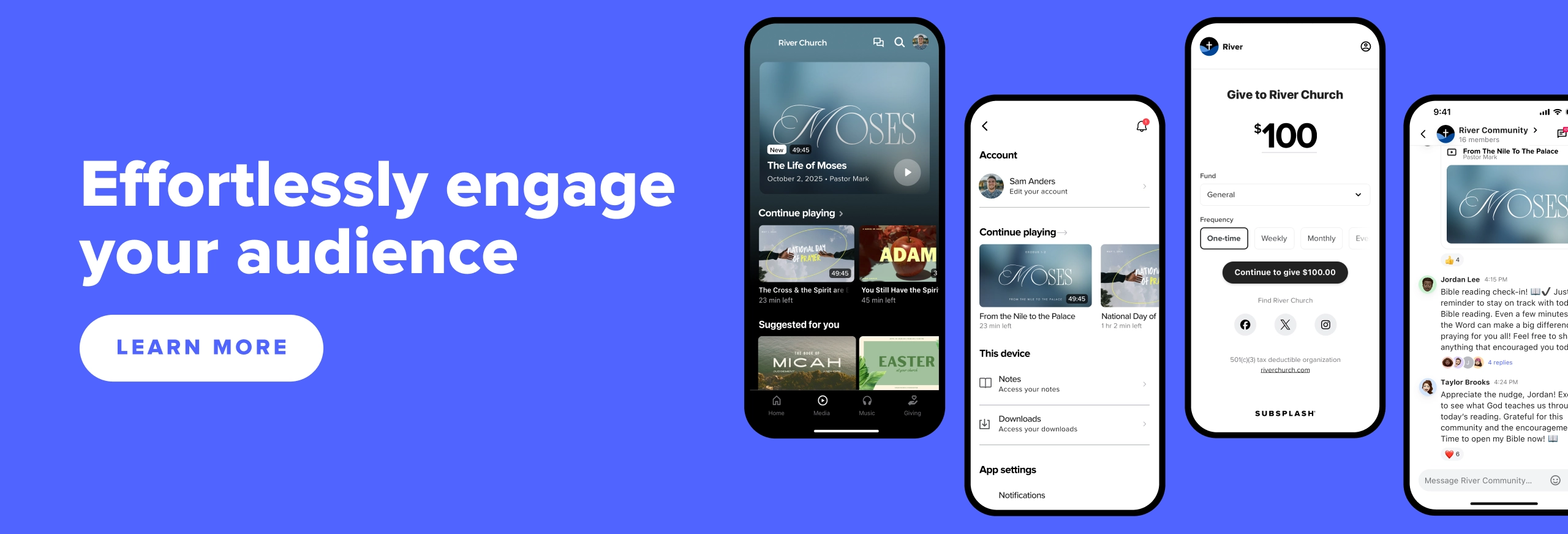
Look for a native video player that stores your content on the platform itself, loads quickly, and gives you full ownership of your media. Subsplash Media, for example, provides churches with up to 5 terabytes of ad-free video storage and a custom player so your content stays yours.
2. Audio player & podcast streaming
Your congregation doesn't stop learning on Sunday. Many people listen to sermons during their commute, while cooking, or on a walk — and a good church app audio player needs to keep up with that. It should start quickly, pick up where the listener left off, and keep playing when someone switches to another app. Apps that pause the moment you leave the screen frustrate listeners and quietly reduce how often people come back. Podcast listening continues to grow year over year, and church audio is one of the most natural fits for the format.
3. In-app giving
Most people in your congregation no longer carry a checkbook to church. Many don't carry cash either. An in-app giving experience should let donors enter their amount, choose a fund, and set up recurring gifts without leaving your church's branded environment. Mobile giving has tripled in recent years as a result. Watch for hidden fees, monthly minimums, and giving flows that redirect donors to external websites and never bring them back.
4. Push notifications
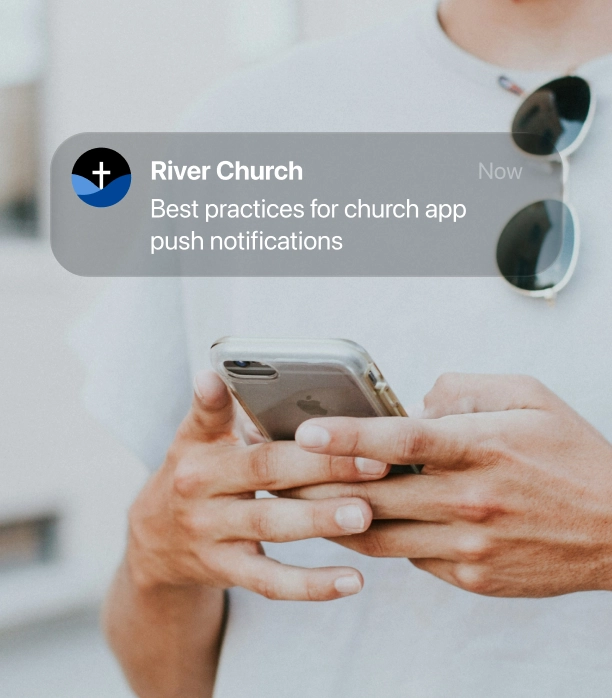
A mid-week message to your congregation is only useful if people actually see it. Push notifications are opened at roughly twice the rate of marketing emails, which makes them one of the most reliable tools you have for reaching your congregation between Sundays. The best platforms let you send targeted notifications to specific groups (volunteers, small group leaders, first-time guests) at no extra cost per message.
5. In-app messaging & group chat
Email threads and Facebook groups are hard to manage and easy to ignore. A dedicated messaging feature inside your church app keeps conversations connected to the community they belong to: prayer chains, small group coordination, volunteer updates. Look for platforms that offer secure, branded messaging rather than routing conversations through a third-party tool your congregation has to download separately.
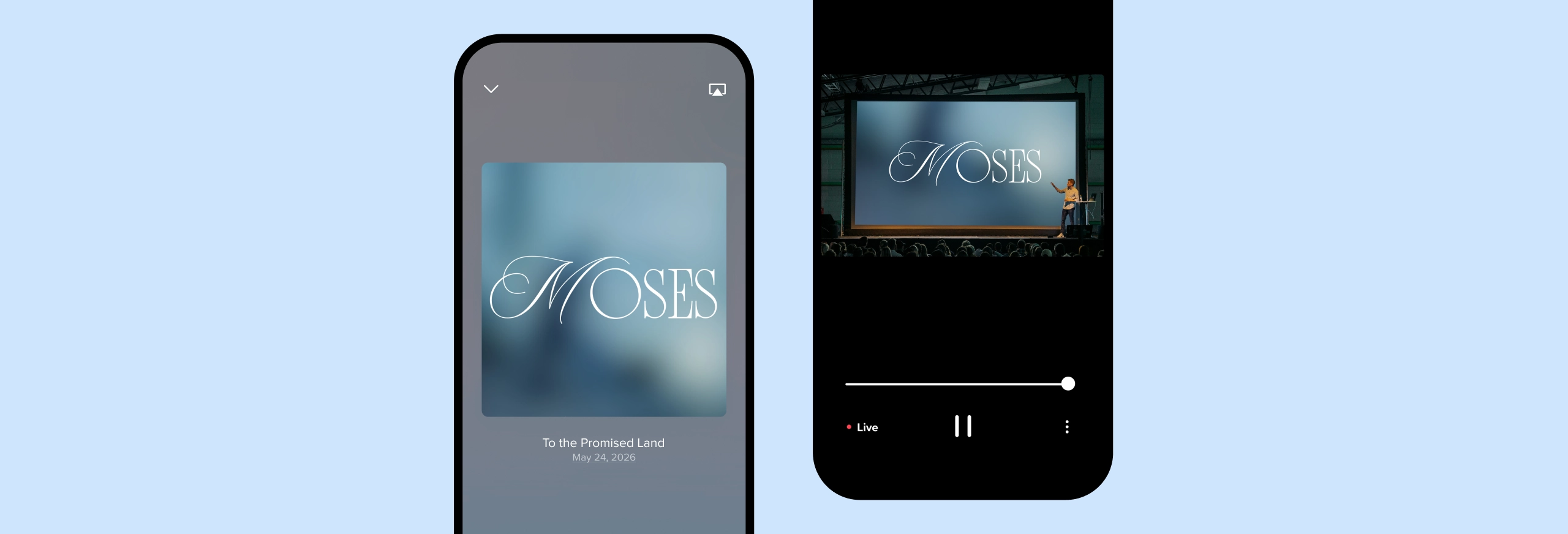
6. Live streaming
Live streaming lets your church reach people who can't be there in person, whether that's a housebound member, a traveling family, or someone checking out your church for the first time. The best live streaming setups push your broadcast to your app, your website, and platforms like YouTube and Facebook simultaneously, with minimal setup from your team each week.
7. Custom branding
Your church app should look and feel like your church: your name, your logo, your colors. A custom-branded app builds trust with your congregation and gives first-time visitors a clear sense of who you are before they ever walk through the door.
8. Events calendar
An events calendar does more than list dates. It gives your congregation a reason to open the app regularly, keeps ministries coordinated, and reduces the volume of "when is that again?" messages your office team handles on Monday mornings. Look for a calendar that supports registration forms, maps, and contact details for each event, not just a list of names and times.

9. Blogs & devotionals
Connecting your blog's RSS feed to your app means your newest posts appear in front of your congregation automatically, without extra publishing steps. This is one of the easiest ways to extend the life of your teaching content — a post that took hours to write doesn't have to live only on your website. For churches that publish devotionals on a regular cadence, this feature turns your app into a daily touchpoint without adding anything to your team's workload.
10. Sermon notes & fill-in notes
A note-taking feature turns passive listeners into active participants. Journaling, highlighting, and fill-in-the-blank outlines help your congregation engage with your teaching and return to it throughout the week. Look for platforms that keep notes tied to the sermon they came from, so they're easy to find later.
11. In-app Bible & reading plans
Scripture engagement doesn't happen by accident. Research shows that people who engage with the Bible at least four times a week are significantly more likely to grow in their faith, and a church app can be one of the most practical tools for making that a daily habit. A Bible built into your app, with the ability to highlight verses, copy them into messages, and share them in group chats, keeps Scripture connected to the community rather than siloed in a separate app your congregation has to remember to open. Custom reading plans tied to your sermon series give people a clear path to follow throughout the week.

12. Small groups & group management
Small groups are where discipleship actually happens, and your app should make it easy for people to find a group, join it, and stay connected. Look for a platform that supports group discovery, member communication within each group, and leader tools that don't require a separate login or dashboard. The friction of a separate login might seem minor, but it's often the difference between a group leader who actually uses the tools and one who defaults back to a group text.
13. Digital forms & connect cards
Visitor cards, prayer request forms, event sign-ups, and volunteer intake forms can all move into your app. Digital forms reduce printing costs, eliminate manual data entry, and give your team access to responses immediately. For first-time guests especially, a connect card inside your app is a lower-friction ask than a paper form — and the response lands directly in your church management system rather than in a stack of papers someone has to process on Monday morning.
14. Volunteer scheduling
Volunteer coordination is one of the most time-consuming tasks for church staff, and it's one of the clearest signals of whether a church app is built for operations or just for consumption. A scheduling tool inside your app lets volunteers accept or decline requests, check their upcoming schedule, and set their availability without a separate login. For your team, it reduces the back-and-forth that currently happens over email or text.
15. Engagement analytics
You can't improve what you can't measure. An analytics dashboard shows you which sermons your congregation is watching, when they're most active in the app, what content drives giving, and where people drop off. That means your communications director can double down on what's working instead of guessing, your executive pastor can justify budget decisions with actual usage data, and your lead pastor can understand which topics are resonating long after Sunday morning is over.
What sets Subsplash apart from other church app platforms
Most church app platforms cover the basics. The differences worth paying attention to are the ones that affect how your staff manages the platform day-to-day and how your congregation actually experiences it.
Subsplash has been building church apps since 2009, longer than any other platform in this space. That history shows up in the details: a native media player that doesn't pull content through YouTube or Vimeo, a giving experience that keeps donors inside your branded app from start to finish, and a single dashboard that publishes to your app and your website at the same time.
A few things that don't show up on most feature comparison pages:
- Personalized media recommendations surface content based on each person's viewing history, so your congregation sees sermons and series that are actually relevant to them rather than just your most recent upload.
- Phone number login removes the password friction that keeps people from engaging with your app consistently.
- Subsplash Tap lets you place QR codes on bulletins, signage, or direct mail that open directly inside your app, not a browser.
Subsplash also offers Pulpit AI and Trends AI, two AI tools built specifically for church teams. Pulpit AI helps pastors and content teams create sermon-based discipleship content faster. Trends AI gives you visibility into what your congregation is engaging with and where growth opportunities exist — the kind of insight that typically requires a data analyst to surface.
Want to see the Subsplash difference? [.blog-contact-cta]Schedule a free demo with our team.[.blog-contact-cta]
Church app FAQs for 2026
What church app features matter most for discipleship?
The features that most directly support discipleship are an in-app Bible with reading plans, small group messaging and management, sermon notes, and push notifications that surface relevant content at the right time.
An in-app Bible matters because it keeps Scripture engagement connected to your church community rather than isolated in a separate app. Small group tools matter because discipleship happens in relationships, not just through content. Sermon notes and fill-in outlines help people engage actively with your teaching rather than passively consuming it. And push notifications — used thoughtfully, not constantly — can prompt your congregation to return to content, join a group, or read a passage in a way that email and social media rarely accomplish.
Do churches need a mobile app, or is a website enough?
A website and a mobile app serve different purposes. Your website is where people find your church for the first time; it's a front door for search traffic and first-time visitors. Your app is where your congregation comes back throughout the week to watch a sermon they missed, give, check the events calendar, or message their small group.
Mobile users spend the majority of their digital time inside apps, not browsers, which means an app gives your church a place in the daily rhythm of your congregation's life that a website alone can't replicate. Most churches that invest in both see higher week-to-week engagement than those that rely on one or the other.
How do you get your congregation to actually use the church app?
Adoption is the challenge most church app conversations skip over. The technology is the easy part — getting your congregation to open the app consistently requires a deliberate on-ramp. The churches that see the strongest engagement typically do three things well: they announce the app from the stage with a specific, immediate reason to download it (not just "we have an app now"), they build habits by pointing people to the app for things they already do (give, find the bulletin, follow along with the sermon), and they keep the content fresh enough that opening the app on a Tuesday feels worthwhile.
Push notifications are the most underused tool in this process. A well-timed mid-week message tied to Sunday's sermon, a reading plan reminder, or a group event alert gives your congregation a reason to return that has nothing to do with Sunday morning.
What's the difference between a church app and a church management system?
These two tools are often confused because some platforms offer both, but they serve different audiences within your church. A church management system (ChMS) is primarily a staff tool — it manages your membership database, tracks attendance, handles volunteer scheduling, and processes giving records. Your staff lives in it; your congregation typically doesn't.
A church app is primarily a congregation tool — it's what your members and guests use to engage with your church's content, give, connect with groups, and stay informed. The best church technology setups have both, and they talk to each other. When a new visitor fills out a digital connect card in your app, that information flows into your ChMS automatically. When your ChMS processes a volunteer schedule, it shows up in the app. The integration between the two is where a lot of the operational efficiency lives — and it's one of the strongest reasons to evaluate platforms that offer both under one roof.
Should your church build a custom app or use a church app platform?
Building a custom church app from scratch sounds appealing — full control over every feature, no platform constraints, exactly what you envision. In practice, it rarely works out that way. A custom app requires a developer (or a development team) to build it, maintain it, update it for every new iOS and Android release, and fix it when something breaks. That's not a one-time cost; it's an ongoing operational commitment that most churches aren't staffed to support.
Church app platforms exist because the infrastructure problem has already been solved. The media player, the giving integration, the push notification system, the App Store compliance — all of that is maintained by the platform so your team doesn't have to think about it. What you give up in theoretical flexibility, you gain back in time, stability, and a support team you can actually call when something goes wrong. For the vast majority of churches, the platform approach isn't a compromise. It's the smarter operational decision.
See what your church app could do
Subsplash has been building church apps since 2009 — the first platform to do it. Over 20,000 churches and ministries worldwide use Subsplash to reach and engage their congregation every day of the week, not just on Sundays.
Every feature in this guide is available on the Subsplash platform, managed from one dashboard with one login. Content publishes to your app and website at the same time. Giving data connects to your platform without manual reconciliation. Volunteer shifts flow through the same system your staff already uses. When your tools work together, your team spends less time managing technology and more time doing ministry.
If you're ready to see it in action,[.blog-contact-cta] schedule a free demo with our team.[.blog-contact-cta] We'll show you how it works for churches your size.