

You’ve likely felt the shift at home, walking around town, and even with your own family and friends. There’s a quiet distance that has started to settle between people in our culture—and you can even feel it at church.
Today, we’re witnessing a quiet, cultural emergency that social scientists have named the “Loneliness Epidemic”, or the "Friendship Recession". This epidemic is felt in all corners of society as Americans become increasingly isolated from each other, spending less time with people, less time in social gatherings, and more time on screens—and it’s even impacting the Church.
Yet thankfully, the antidote to the loneliness epidemic is found in the Church as well! Let’s take a look at how this health crisis is affecting our culture—and how your church can help turn it around.
The Loneliness Epidemic by the numbers
In May 2023, U.S. Surgeon General Dr. Vivek Murthy released an advisory and report declaring loneliness a widespread public health epidemic, affecting nearly half of American adults. According to the report, loneliness is associated with a greater risk of cardiovascular disease, anxiety, depression, dementia, stroke, and premature death.
And while nearly half of our population struggles with feeling lonely, young adults are almost twice as likely to feel lonely than those over the age of sixty-five. Loneliness amongst young adults has increased every year between 1976 and 2019, and it’s only getting worse.
For most of us in ministry, this isn’t just a headline or a report. It’s the face of a high schooler who feels more seen by an algorithm than his peers. It’s the young professional who finds herself completely alone by 6:00 PM every evening. It’s the young man who has volunteered for a few events at your church, but hasn’t made a friend.
While the world promotes connection through screens, human souls are starving for a listening ear, the sound of a familiar voice, and an authentic community that will know and love them intimately.
The data tells a story of a society that’s pulling apart at the seams. But for the local church, this is our greatest opportunity to do what we’ve done for two millennia: giving the lonely and forgotten a family in the form of a loving church community in the Body of Christ. Let’s take a look at how your church can respond to this crisis and help transform our hurting world.
How a church community is the answer to the loneliness crisis
When we turn to the book of Acts, we see the church community in action for the first time. Acts tells the powerful story of the first Christians coming together in small house churches, supporting each other monetarily, and going out together to evangelize to other communities.
It’s a beautiful portrait of the Christian life lived in community. From the New Testament, we learn that community is integral to the life of a believer:
- Each of us is an important member of the Body of Christ, and we all need each other in that Body (1 Corinthians 12:12-27).
- We all have important and uniquely personal spiritual giftings (1 Corinthians 12:1-11)
- We’re called to build each other up (1 Thessalonians 5:11), and to not neglect gathering together (Hebrews 10:24-25).
As we see in the book of Acts, the benefits of living in a church community are many—and they still apply today. These benefits include spiritual support, deliverance, communal worship, monetary support, receiving prayer and healing, being discipled, finding lifelong friends, and being taught the Word of God by other believers. And these are just to name a few!
It’s obvious that the Church has the answer to this loneliness epidemic. Let’s turn now to five causes of the loneliness epidemic, and learn how your church can provide hope in the form of Christian relationships and community.

Five cultural shifts fueling the Loneliness Epidemic
1. The vanishing "inner circle"
We were never meant to carry the weight of life alone, yet our support systems are evaporating. Millions of people today don’t have a single person they can call in a crisis. According to a Harvard report, the percentage of U.S. adults who report having no close friends has quadrupled to 12% since 1990.
This isn’t just a social bummer; it’s a spiritual crisis. When someone loses their inner circle, they lose their safety net. Most importantly, without a spiritual community, they lose out on spiritual renewal, healing, wisdom, guidance, support, and discipleship.
Where the world often ignores people, the church offers authentic community for all, especially the least of these (Matt. 25:35-40). We aren’t a club of people with similar hobbies; we’re a family rooted in a shared identity that doesn’t depend on how likeable someone is.
When the world’s social circles shrink, the Church expands, providing a built-in inner circle for every person who walks through our doors.
2. The death of in-person relationships
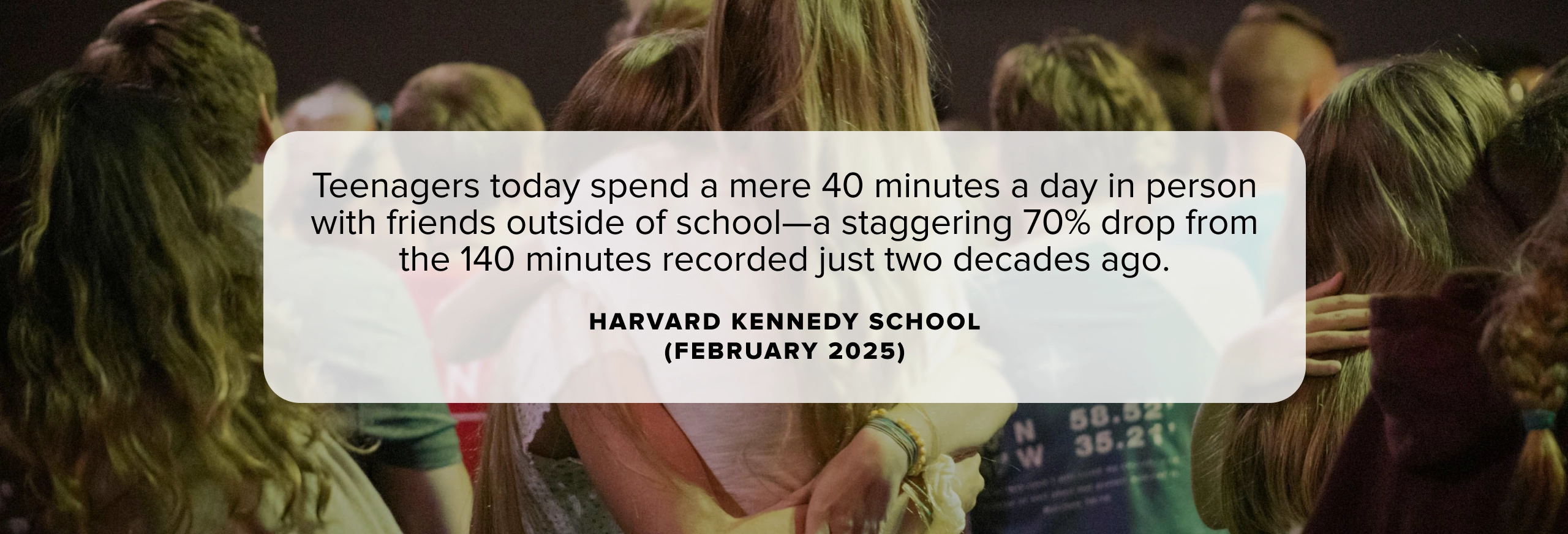
Our youth are growing up in a world where face-to-face interaction is becoming an elective rather than a requirement. Teenagers today spend a mere 40 minutes a day in person with friends outside of school—a staggering 70% drop from the 140 minutes recorded just two decades ago.
On top of that, the American Psychological Association reports that nearly all U.S. teens have smartphones (95%), with nearly half reporting they are constantly online. Many of these teens received their first smartphone between the ages of eight and nine, leading to a phone-based childhood.
Replacing meaningful friendships with long hours of screen time and scrolling on social media means a whole generation is losing the ability to read cues, navigate awkwardness, and resolve conflict.
This is why your youth ministry and small groups are more vital than ever. Youth pastors, volunteers, and parents play a crucial role in encouraging teenagers to invest in in-person friendships. They provide the training grounds for human connection, teaching that the messiness of being together is where growth actually happens.
Truthfully, the sense of community formed in a fun and intimate youth group is where many lifelong Christians today first learned about authentic discipleship. It’s where leaders took time to be vulnerable, explain the Bible, and invite youth alongside them in their faith journey. It’s where teenagers hear powerful testimonies; receive prayer, worship with their peers, and get their first introduction into God’s church family as a personal and authentic lived-out reality.
Taking the time to assess your own youth group is vital for building the next generation of church leaders. Ask yourself important questions such as,
- Are your youth actively engaged or passively attending?
- Is your church ensuring that investing in teens is a priority?
- How does your church prioritize the discipleship of the next generation?
When investing in the spirituality and lives of middle schoolers and teenagers becomes a priority, local churches create a real antidote to the loneliness epidemic. Instead of turning to their screens students learn they are valued in the Kingdom of God and that real relationships are formed in person by spending time with others.
When they have doubts or are just navigating the regular ups and downs of teenage existence, they will learn they have real people to turn to who truly care. In fact, they have a whole Church family who can show them the love of God.

3. The retreat into “solitude by default”
More and more people are making isolation their default. Studies show that Americans are exchanging the vibrant “Third Places” of their neighborhoods—parks, coffee shops, and other types of community centers—with digital consumption.
The truth is, many of us are retreating into our homes, and we’re staying there. Teenagers now spend an average of nine hours a day on screens, while the time Americans spend at home has risen by nearly two hours every single day.
But this isolation has a cost: the loss of authentic, life-giving connections that make life rich.
The local church remains the last standing, widely accessible Third Place. The local church was designed for community, in person discipleship, and continuous support. When someone needs a pastoral visit, a listening ear, prayer, someone at their loved one’s bedside in hospice care, or discipleship, we are called to say yes, to serve, to visit, to arrive in person with an open heart and a servant’s attitude.
As a local church, it’s important to create spaces where people can be motivated to gather in person. Where your church offers a coffee shop for fun hangouts, a soup kitchen for the homeless and hurting, or Celebrate Recovery meetings, it’s important to create an environment that prioritizes belonging over mere attendance.
In a world that is increasingly homebound, your church’s physical space can be a beacon of hospitality that proves the value of leaving the house. By stewarding these Third Place opportunities, you are offering a lonely culture something a screen never can: the comfort of a listening ear, the power of shared prayer, and the transformative reality of being a known and valued member of the Body of Christ.

4. Going digital for emotional support
As real connections feel harder to maintain, a dangerous substitute has emerged: people are turning to artificial intelligence for emotional connections. For teenagers, the temptation is even worse. About 72% of teens have turned to AI companions, with many using AI for emotional support.
At the heart of the Friendship Recession is the continual rise of screen reliance for emotional fulfillment. It’s no secret that many people use movies, TV shows, social media, and online shopping for emotional support. People are turning to the glow of a screen for what feels like immediate escape or a fun dopamine hit. As one teenager aptly put it online, “Ever since I got my phone, I’m never bored.”
However, God designed each person for in-person community. Churches have the unique opportunity to bridge this gap. An algorithm or television can only offer so much support. Real transformation is found in doing life in community with other believers who are filled with the Holy Spirit and chasing God’s calling. When congregants can step into this reality, they will find their loneliness has a solution: the Body of Christ.
5. The collapse of weekly rhythms
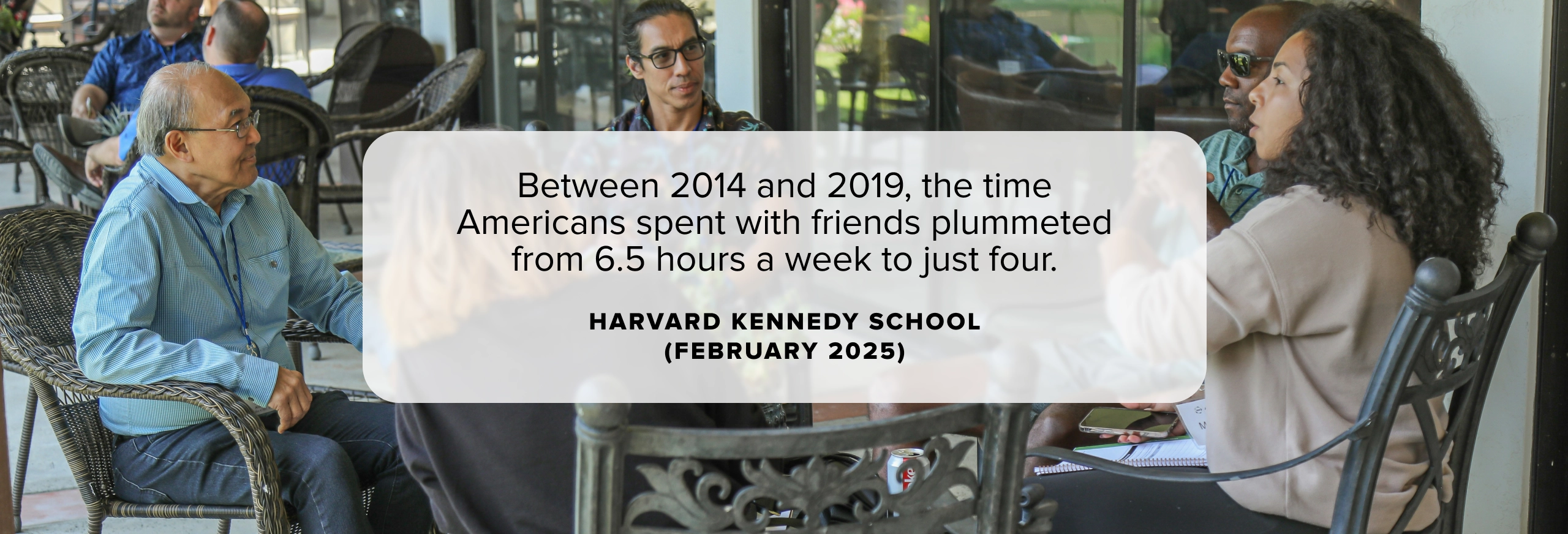
Finally, we’ve lost the cadence of friendship. Our lives used to be anchored by frequent, regular face-to-face touchpoints. Now, those have been replaced by sporadic, asynchronous digital signals. Harvard researchers found that between 2014 and 2019, the time Americans spent with friends plummeted from 6.5 hours a week to just four.
People’s lives used to be centered around community. Now, they’re centered around screens. That’s why weekly rhythms in authentic community are so important.
From Sunday gatherings to Wednesday night services, from weekly small groups to consistent volunteering, your church should offer ample opportunity for congregants to meet, connect, and grow together. No matter how congregants get plugged into the church, a weekly rhythm of connection is a true antidote to the friendship recession facing Americans today.
Today, Sunday gathering is so much more than a service—it’s a non-negotiable weekly rhythm of belonging. By gathering every week, we ensure that connection doesn’t fade into the background of a busy life.
It’s okay to challenge and encourage your congregants to consistently visit on Sundays and get involved at church. When you sense a hesitancy, meet with that person for coffee and get to know them. You might be surprised at what a difference that first personal connection makes!

Leading your people back to the table
If you’re a leader focused on growth, recognize that the Loneliness Epidemic is the primary felt need of your community. People aren’t just looking for a better sermon; they’re looking for a place where they are known, valued, and cared for, and can share that experience with others.
At Subsplash, we’ve built our platform to help you bridge this gap. We believe technology should get out of the way so you can get back to the work of pastoring. Whether it’s using an app to coordinate mid-week groups or leveraging messaging tools to keep your community connected between Sundays, our goal is to help you create more space for real-world, in-person discipleship.
When technology can reach disconnected people and bring them together in person for deep connection, authentic community, and discipleship, your church tech tools are truly doing their best work.
Let your tools lead people to your church. It’s time to lead your community back to the table where they can experience the life-changing power of a true spiritual family.
Start reaching more people with Subsplash.[.blog-contact-cta] Connect with our team today! [.blog-contact-cta]
More resources you may find helpful:
- Free Easter Graphic Templates for 2026: Save hours on design & prep!
- The first 90 days: A strategic roadmap for pastors
- How churches reach 3X more people with Subsplash
- 10 Inspirational Easter sermon ideas for pastors
- 3 Strategic ways to use your church app to increase volunteer recruitment
- Post-Easter push notifications: Ideas, tips & templates
%20strategy%20guide%20for%20churches.webp)
%20for%20churches.webp)
.webp)