




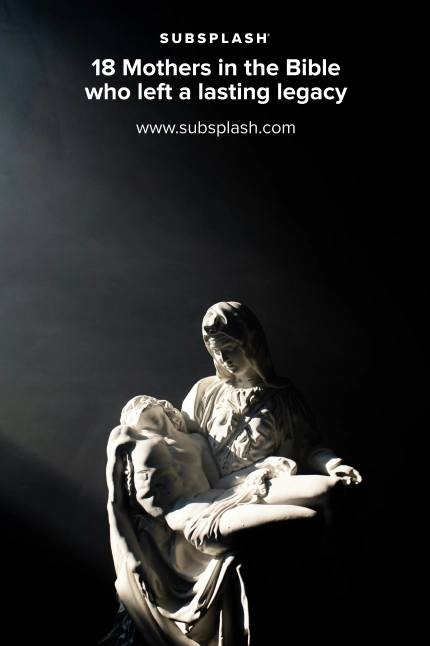



Summary: Throughout history, God has used the faithful influence of women to guide his people and fulfill his promises. This overview of 18 mothers in the Bible explores their stories of courage, prayer, and sacrifice. By reflecting on these lessons from mothers in the Bible, your church can find fresh inspiration for honoring families and celebrating the impact of godly motherhood on Mother’s Day—and all year long.
Did you know there are many godly mothers in the Bible? Mothers play a pivotal role in Scripture, shaping the lineage of faith and demonstrating God’s providence through every generation!
Whether you’re looking for sermon ideas for Mother’s Day, ideas for women’s ministries, or lessons from mothers in the Bible, this list provides a quick look at eighteen women of Scripture who helped change the world!
By reflecting on these lessons from mothers in the Bible, your church can find fresh inspiration for honoring mothers and celebrating their impact on Mother’s Day—and all year long.
18 Mothers in the Bible: Lessons from women who left a lasting legacy

1. Eve: “The mother of all living”
Eve’s legacy is often overshadowed by the fall, but her role as the first mother is foundational. She is the recipient of the first Gospel promise—that her offspring would eventually crush the head of the serpent (Genesis 3:15).
Her life teaches us about the weight of our choices and the reality of God’s redemptive grace. Even in the face of heartbreak and the loss of her sons, she remains the mother of all living, reminding us that life persists through God’s mercy.
2. Hagar: The mother who was seen
Hagar’s story is one of survival and divine intervention. As a mother cast out into the wilderness with her son Ishmael, she reached a point of total despair. Scripture says that she even turned away from her son in the wilderness, not willing to watch him die.
Despite her lowly status on earth, God met her in the wilderness. She is the only person in the Bible to give God a name: El Roi, the God who sees me (Genesis 16:13). Her legacy is one of resilience, showing every mother that even when they feel invisible or abandoned, God is watching over them and their children.
Hagar’s story is a powerful reminder for those in your pews who feel overlooked: God sees the invisible.
3. Sarah: The mother who waited & witnessed a miracle
Sarah’s journey was defined by a long season of waiting. For decades, she lived with the ache of infertility—until God performed the impossible in her old age (Genesis 21:1-7).
Her legacy is a testament to God’s timing over our own. While she struggled with doubt, she ultimately became the mother of Isaac—the son of the covenant—proving that God’s word is never void and his promises are always worth the wait.

4. Rebekah: The mother with a great love story
Rebekah’s story begins with a beautiful and inspiring love story that only God could have divinely orchestrated. From the moment she agreed to travel to a distant land to marry Isaac, she displayed a bold trust in God’s divine plan. And as the mother of Jacob and Esau, she greatly intervened to save the life of her son. While she would also deceive and lie to her husband, her plans could not thwart God’s plan for her children.
Her story in Genesis reminds us that God plays a strategic role in our love stories—and that mothers play a strategic role in God’s unfolding plan.
5. Leah: The mother of the tribe of Judah
Though Leah lived in the shadow of her sister’s beauty and her husband’s preference, she found her worth in the Lord. Through her son Judah, she became the matriarch of the royal line that would eventually produce King David and Jesus Christ.
Her life is a profound lesson for anyone who feels second best—showing that God chooses the overlooked to accomplish his most glorious work.
6. Rachel: The mother of perseverance
Rachel’s life was marked by deep longing and intense competition, yet she never stopped pursuing the blessing of motherhood. Her sons, Joseph and Benjamin, became pillars of the nation of Israel.
Rachel’s legacy is one of "hope deferred," teaching us that the struggles and tears of a mother are seen by God and can lead to a harvest of leadership and salvation for an entire people.
7. Jochebed: The mother of courageous sacrifice
Despite her lesser-known name, Jochebed is one of the most famous mothers of the Bible. Living under the shadow of a genocidal decree by the Pharaoh of Egypt, Jochebed used her creativity and courage to hide her newborn son Moses in a basket, literally entrusting him to the waters of the Nile—and his life to God.
Her faith is the ultimate example of letting go so that God can take over. Because of her brave sacrifice, the deliverer of Israel was preserved—and history was changed forever.
8. Deborah: The mother of a nation
During her time ruling as a judge and a prophetess, Deborah is specifically described in Scripture as a "mother in Israel." Her leadership wasn't just about military strategy; it was about nurturing the spiritual health of a nation that had gone astray.
Deborah’s strength shows us that "mothering" extends beyond the home—it is a mantle of protection, wisdom, and guidance for the entire community of faith.
9. Naomi: The mother of restoration
Naomi’s story begins with bitterness and loss, as she buried her husband and both of her sons in a foreign land. However, her legacy is defined by how she mentored her daughter-in-law, Ruth.
Through her life, we see that a mother's influence doesn't end when her children are gone; she became a "spiritual mother" to her daughter-in-law whose wisdom paved the way for a new generation and a restored family line.

10. Ruth: The mother of royalty
Though she began as a Moabitess, Ruth’s devotion to her mother-in-law Naomi and the God of Israel led her to become the great-grandmother of King David.
Her legacy is one of radical trust and steadfast love. As a mother to Obed, she proved that your past doesn't define your future—God can take a "foreigner" and make her a cornerstone of the Messiah’s genealogy.
11. Hannah: The mother of fervent prayer
Hannah had struggled for many years with infertility. In fact, Scripture tells us that “the Lord had closed her womb” (1 Samuel 1:5). However, Hannah did not give up in her prayers. She desperately sought the Lord out of her deepest grief and made a vow to the Lord. Soon after, God remembered her and answered Hannah’s prayers. Her lasting impact is her child Samuel, whom she faithfully dedicated to God’s service.
Hannah teaches us that our children ultimately belong to the Lord, and our greatest work as mothers is to cover them in prayer and release them into their divine purpose.
12. The Widow of Zarepath: The mother who obeyed
Zarepath was approached by the prophet Elijah in what would become a life-changing encounter. During a time of devastating famine and personal desperation, this mother chose to obey the word of the prophet. She believed in the word of God spoken to her by his messenger and, as a result, she received the provision she and her son needed to survive.
Zarepath’s legacy is one of provision through obedience, showing that when a mother puts God first, he takes care of her entire household.
13. Bathsheba: The mother of wisdom
There is no doubt that Bathsheba is a controversial figure. Bathsheba’s life was filled with public scandal and private grief, yet she rose to become a powerful queen mother. She was instrumental in ensuring that her son Solomon took the throne.
Bathsheba’s story is one of redemption and strategic influence. She moved from a place of victimhood to a position of authority, helping to shape the wisest king Israel ever knew.

14. Mary: The mother of the Messiah
Mary, mother of Messiah, is revered by millions around the world for her faith and trust in God, and for being the mother of Christ himself. Mary’s "yes" to the angel Gabriel is one of the most significant acts of submission in history. She carried, birthed, and raised the Son of God, standing by him from the manger to the cross.
Mary’s world-changing legacy is one of total availability to the Holy Spirit. She reminds every mother that God can do extraordinary things through a humble heart that is willing to say, "Be it unto me."
15. Elizabeth: The mother of John the Baptist
Elizabeth’s life was defined by "walking blamelessly" before the Lord, even in the midst of the "reproach" of barrenness. After she finally conceived John the Baptist, she was the first to recognize and announce the presence of Jesus while he was still in the womb to his mother Mary (Luke 1:39-45).
Her example for us is one of waiting, divine provision, and being a prophetic witness to what God is doing in the lives of others.
16. Salome: The mother of James & John
Salome was more than just the mother of James and John; she was a dedicated follower of Jesus who traveled with him and supported his ministry. While she once ambitiously asked for high positions for her sons (Matthew 20:20-21), she was also one of the women watching when Jesus was crucified. And a few days later, she was one of the women to discover the tomb was empty and first celebrate Easter!
Her story is being one of Jesus’ female disciples, being the mother of disciples James and John, and meeting the angel at the tomb (Mark 16:1-8).
17. Eunice: The mother of sincere faith
Eunice is proof that a mother’s daily discipleship matters. Living in a home with a non-believing husband, she took it upon herself to teach her son Timothy the Holy Scriptures from his infancy.
Her sincere faith was so evident it caught the attention of the Apostle Paul, leading Timothy to become a vital leader in the early Church.
18. Lois: The grandmother of a legacy
Lois shows us that the influence of a mother doesn't stop at one generation. As Timothy’s grandmother, she was the first link in a chain of faith that stretched into the future.
She exemplified unfeigned faith that she passed to her daughter and then to her grandson. She is a reminder to every grandmother that her prayers and examples are powerful seeds planted for the next century of ministry.

How can your church honor these legacies?
As we approach Mother’s Day, churches have a unique opportunity to show your communities the depth of God’s love through these stories. These women aren’t just historical figures—they’re examples of how faith is passed down from one generation to the next through amazing mothers and women of the Bible. The lessons from mothers in the Bible aren't just for a once-a-year sermon; they are blueprints for how we build our families today.
Click here to get free professional graphic templates with over 31 characters of the Bible. You can use these graphics to celebrate Mother's Day with social posts, sermon slides, invitations, and much more!
More resources you may find helpful:
- 25 women’s ministry ideas for faith, fun, & fellowship
- Little disciples, big faith: 20 exciting & fun children's ministry ideas
- Top 30 church event ideas for 2026
- Fun-filled faith: 15 Exciting games for children’s church
%20features%20for%20a%20thriving%20church.webp)
.webp)
.webp)
.webp)

%20strategy%20guide%20for%20churches.webp)