




Every week, your church likely receives gifts through cash, checks, or credit cards. Those offerings sustain ministry, but they represent only a fraction of the generosity potential sitting in your congregation.
Across the United States, the vast majority of personal wealth is locked up in non-cash assets like investments, property, and retirement accounts. In fact, over half of homeowners have at least 45% of their net worth locked up in home equity. Yet checking and savings accounts make up a median of just 5% of household net worth, and that's the only slice most churches are set up to receive.
That gap matters. When high-capacity givers want to donate appreciated stock, real estate, or other assets, many ministries aren’t ready. The result? Those gifts often go to hospitals, universities, or community foundations that are prepared.
This guide will show you how to change that. You’ll learn what counts as a non-cash charitable donation, how these gifts work, and the simple steps your church can take to unlock a whole new era of generosity that aligns donors’ wealth with your mission.
This article is for informational purposes only and should not be considered legal or tax advice. Donors should consult their financial or tax advisor for personal guidance.
The hidden wealth of non-cash giving
Federal Reserve data shows that the majority of U.S. household wealth is tied up in non-cash assets like stocks, real estate, and business ownership, not in checking or savings accounts. Among higher-income households, more than 70% of financial assets are held in equities alone. In other words, the real giving potential in your congregation is likely sitting in portfolios, not wallets.
That means when your ministry only accepts cash or card donations, you’re effectively limiting your donor base to a small fraction of their real capacity to give.
And for donors, cash is the most tax-inefficient way to give. When they sell appreciated assets to donate cash, they often pay capital gains taxes first, which reduces how much ultimately goes to the church.
Non-cash charitable donations, including gifts-in-kind (GIKs) like goods and equipment, solve this problem. They allow donors to give assets directly, unlock higher tax benefits, and often result in much larger gifts.
For churches, this represents the next frontier of stewardship. Sophisticated givers, especially high-capacity donors, already expect to give this way. If your church isn’t ready to receive these gifts, you’re likely missing out on opportunities that could transform your ministry’s reach.

Types of non-cash assets churches should be ready to receive
Not all non-cash gifts are equal. Some are simple to process. Others require due diligence and expertise. Below are the most common types your church should be prepared to handle and why they matter.
Appreciated securities (stocks, mutual funds, bonds)
This is the most common and strategic form of non-cash giving. When a donor gives appreciated securities held for more than a year, they receive a double tax benefit:
- A charitable deduction for the fair market value (FMV) of the asset
- Avoidance of capital gains tax on the appreciation
For example, if a donor bought $10,000 in mutual funds that are now worth $40,000, selling them would trigger capital gains taxes on the $30,000 profit. Donating them directly means the donor avoids those taxes, and your church receives the full $40,000.
It’s one of the most efficient ways for donors to give and one of the easiest for churches to accept through brokerage-to-charity transfers.
Donor-Advised Funds (DAFs)
Many donors already give through Donor-Advised Funds, which are charitable investment accounts managed by organizations like Fidelity Charitable, Schwab Charitable (DAFgiving360), or the National Christian Foundation.
DAFs allow donors to contribute non-cash assets, like stocks or crypto, into their account, receive an immediate tax deduction, and then recommend grants to charities like your church.
Your ministry doesn’t need to manage a DAF itself either. It just needs to be ready to receive a grant from one. That means clearly listing on your website that you accept gifts from Donor-Advised Funds.
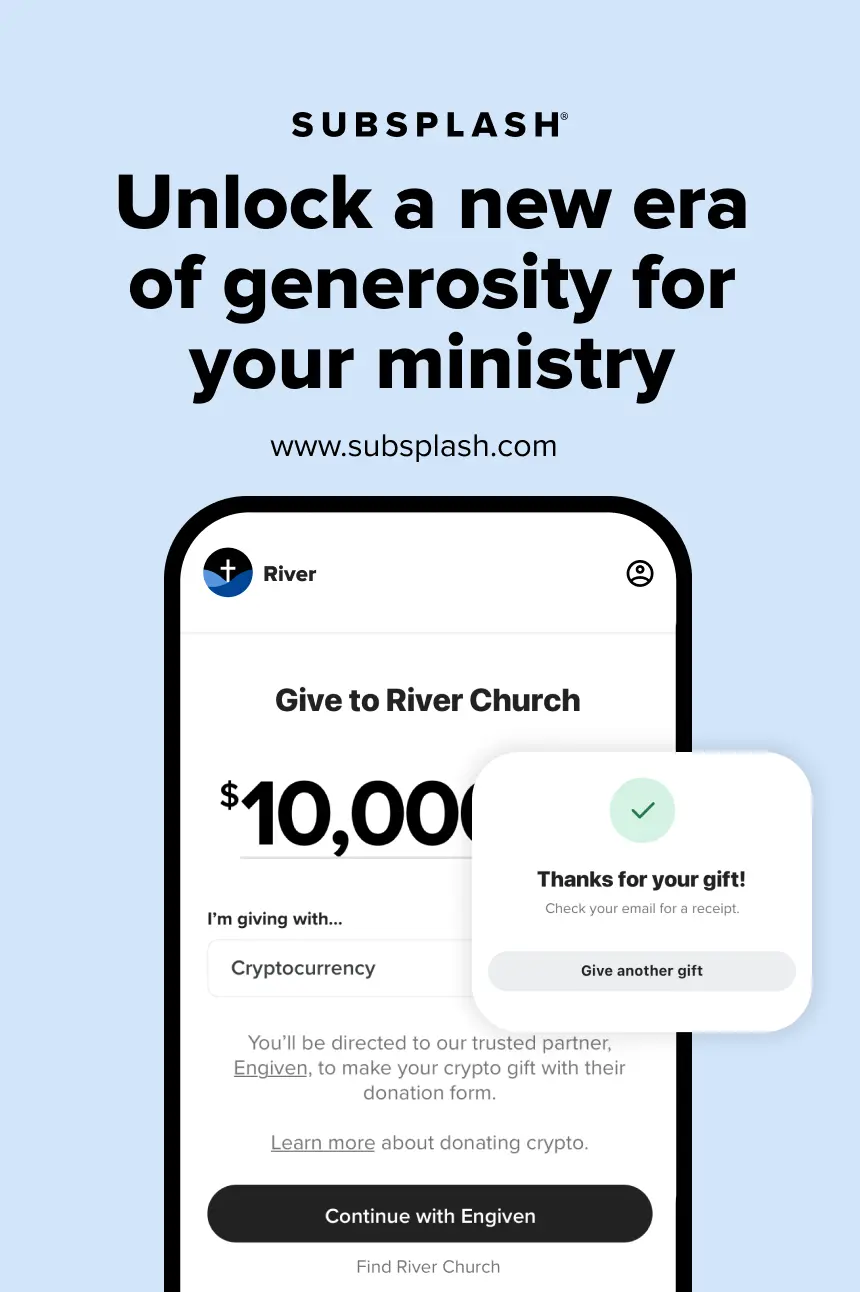
If your church uses Subsplash Giving, it’s easy to enter in-kind donations, DAFs, QCDs, and more through donation entry.
Qualified Charitable Distributions (QCDs) from IRAs
This is a massive but underused opportunity, especially for givers age 70½ and older. Once Required Minimum Distributions RMDs begin at 73, a QCD can also satisfy their required distribution.
A Qualified Charitable Distribution (QCD) allows a donor to transfer up to $111,000 per person in 2026 ($222,000 for married couples) directly from their IRA to a qualified charity tax-free. The amount is excluded from taxable income, which can help lower Medicare premiums and reduce how much Social Security is taxed.
For many retired givers, this is the most tax-efficient way to support their church. Churches that proactively educate their older members about QCDs can unlock a steady stream of larger, tax-smart gifts.
Real estate
Land and property donations can be transformational. A single piece of appreciated real estate can fund entire ministry initiatives.
However, they require more due diligence, including title searches, environmental checks, and valuation. Your church should have a clear policy outlining which types of real estate gifts it will consider.
In many cases, the donor gives the property through a foundation or intermediary that sells it and issues the proceeds as a grant to the church.
Other valuable assets
Beyond stocks and real estate, churches can also receive:
- Vehicles & equipment (with fair market valuation)
- Artwork, jewelry, or collectibles
- Cryptocurrency (via Subsplash Giving, a DAF, or other donation platforms)
- Privately held stock or business interests (for major donors or founders)
These may not be everyday gifts, but for high-capacity givers, they’re often the most meaningful and tax-efficient ways to fund your mission.
The win-win: Benefits of non-cash contributions
Non-cash charitable donations benefit both donors and the church.
Benefits for donors
Here are some of the top benefits for your donors.
- Capital gains avoidance: When donors give appreciated assets directly instead of selling them, they bypass capital gains tax, which can save 15–20% (plus a possible 3.8% surtax) on the gain.
- Income tax deduction: Starting in 2026, itemizers can only deduct gifts above 0.5% of their AGI. Non-itemizers can deduct up to 1,000(2,000 joint), but that only applies to cash gifts, not stock, property or DAF contributions.
- Larger giving potential: Because of those tax advantages, donors often give significantly more. A family that might donate $5,000 in cash could easily give $50,000 in appreciated stock without reducing their after-tax income.
- Estate tax reduction: Gifting assets removes them from the donor’s taxable estate, reducing future estate taxes for high-net-worth families.
- Maximized generosity: It allows donors to give from their wealth, not just their income. That shift expands what’s possible for both them and your ministry.
Benefits for the church
Here are some of the top benefits for your church
- Increased revenue: Accepting non-cash gifts taps into a vastly larger pool of potential giving. These are assets that would never show up in a Sunday offering.
- Diversified funding streams: By combining cash, DAF, stock, and property gifts, your church reduces its dependence on weekly attendance and tithes.
- Deeper donor engagement: Non-cash giving opens doors for more intentional conversations about stewardship, legacy, and long-term generosity. It helps transition donors from casual supporters to partners in your mission.
- Stable growth & financial resilience: Because non-cash assets often fund endowments, building campaigns, or special projects, they strengthen long-term sustainability.

Navigating IRS rules & Form 8283: The legal & financial checklist
This is where many churches get nervous, but it doesn’t have to be complicated.
The key is understanding your role and limits. For example, the church should never provide tax advice or assign value to a gift. Instead, your job is to receive the donation, acknowledge it properly, and guide the donor to their advisors for the rest.
This can be as simple as including acknowledgment letters that are factual and simple. For instance, “We gratefully acknowledge receipt of 50 shares of [Company Name] stock on October 10, 2026. No goods or services were provided in exchange for this gift.”
This documentation satisfies the donor’s IRS requirements and demonstrates transparency.
Valuation & Fair Market Value (FMV)
- The donor is responsible for determining the FMV of their gift.
- For most assets, FMV is the price the item would sell for on the open market.
- Churches must never assign value to non-cash gifts in writing or verbally.
Annual deduction limits
The IRS places percentage-of-income limits on how much donors can deduct each year for charitable contributions. The specific limit depends on what is given and to whom it’s given.
Quick overview
- 60% of AGI limit applies to cash contributions made to 50% limit organizations such as churches.
- 50% of AGI limit applies to most non-cash contributions of ordinary (non-capital-gain) property given to qualified 50% limit organizations.
- 30% of AGI limit applies to gifts of capital-gain property (for example, appreciated stock or real estate held more than one year).
- 20% of AGI limit applies when appreciated property is given to certain private foundations or 30%-limit organizations.
- Qualified conservation contributions have special 100% or 50% AGI limits under IRC §170.
If a donor’s total charitable gifts exceed the applicable limit for the year, the unused portion can be carried forward for up to five additional tax years until fully used..
For example, a donor with $200,000 AGI can deduct up to $60,000 of appreciated stock gifts (30% of AGI) in one year. If they give $80,000, they can carry over the extra $20,000 for future deductions.
Required IRS forms for the donor
- Form 8283 (Noncash Charitable Contributions) is required when total non-cash donations exceed $500 in a year.
- Qualified Appraisal required for any single item or group of similar items valued over $5,000, except publicly traded securities.
- Church responsibility sign Part V of Form 8283 for gifts over $5,000. You’re simply acknowledging receipt, not verifying the value.
Practical steps: How your church can get Non-cash ready
Becoming equipped to receive non-cash charitable donations just takes a little bit of preparation.
Step 1: Create a clear written policy
Define which types of gifts you will and won’t accept (e.g., We do not accept raw land or vehicles requiring restoration.) This policy helps your staff respond quickly and confidently when a donor asks.
Step 2: Establish an internal process & external experts
Appoint a point person to coordinate all non-cash donations. This is normally your CFO, Executive Pastor, or a Major Gifts Director. Then, build relationships with a trusted attorney, CPA, or financial advisor to handle appraisals, transfers, and compliance.
Step 3: Master the acknowledgment process
For every gift of $250 or more, provide a written receipt that includes:
- Donor name
- Date of contribution
- Detailed description of property (no valuation)
- Statement that no goods or services were provided
Be prepared to sign Form 8283, Part V for gifts over $5,000.
Step 4: Communicate the opportunity
Once you're ready, tell your congregation. Add a Non-Cash Giving section on your website. This is easy to do in a church engagement platform, like Subsplash. This section explains that your church welcomes gifts of stock, real estate, crypto, and DAF grants.
Mention it in annual reports, stewardship campaigns, and legacy giving brochures. Normalizing these options turns one-off gifts into a steady stream of generosity.

Ready to simplify all of your giving?
Non-cash charitable donations represent the next evolution in church stewardship. They align donors’ greatest assets with your church’s greatest mission opportunities.
For donors, these gifts unlock smarter, more impactful generosity. For churches, they open doors to funding and resources that would otherwise never be tapped.
Complex assets require financial expertise; however, tracking and managing every gift should be simple.
Subsplash equips churches with the tools to receive, organize, and acknowledge every kind of donation from DAF grants and stock gifts to recurring online giving.
Ready to simplify generosity & fuel your mission? [.blog-contact-cta]Learn more about Subsplash Giving and book a free demo today![.blog-contact-cta]
%20for%20churches.webp)


