




“Where have all the Christians gone?” If you’re a church leader asking yourself this question, you’re not alone. It seems that more and more pastors are looking out at emptier pews on Sunday mornings.
Studies show that the number of Christians in the United States is declining. Part of this stems from the “deconstruction” movement that has taken place among younger generations over the last few decades. This is prominently promoted on social media by Christian authors, celebrities, thought leaders, musicians, and more.
According to Barna, 42% of American adults report that they have deconstructed “the faith of their youth.” But what is deconstructing Christianity? And what do the latest statistics reveal about its impact?
If you’re a pastor, church leader, or theologian, you’re likely already aware of this trend. Let’s take a look at what deconstructing Christianity is, as well as the latest numbers that represent the impact of religious deconstruction on the Church and culture.
What is ‘deconstruction’ in Christianity & why does it matter?
What is the deconstruction of Christianity? While the history of religious deconstruction dates back to a French philosopher named Jacques Derrida in the 1960s, the modern American interpretation is simpler to grasp.
Religious deconstruction primarily refers to the process of reevaluating, or “deconstructing”, one’s religious beliefs from a critical perspective, especially the beliefs imparted in childhood. It’s a process of questioning spiritual authority, beliefs, traditions, and even institutions as a whole, such as the Church or traditions a person grew up in. Religious deconstruction can be experienced by any person from any faith, not just Christianity.
The process of deconstruction can lead to a stronger faith, a reconstructed faith, a whole new faith or set of beliefs, or, more commonly, a loss of the religious traditions and beliefs that were imparted to a person from a young age. Many people use the word “deconstruction” synonymously with “deconversion,” though that is not always accurate.
Some people insist that critically reevaluating one’s faith is a necessary part of growing up and claiming one’s faith for oneself. In support of this perspective, there are many historical saints and figures who experienced a process of critically evaluating their faith before they became some of the most influential Christian figures of all time, such as Martin Luther, Charles Spurgeon, Mother Teresa, and many more.
On the other hand, while a faith crisis is valid and somewhat inevitable, there are many others who insist that the deconstruction movement only leads to a loss of faith, as is evidenced by the numbers below.
Overall, the jury is still out on the total impact religious deconstruction is having on the Church. Nevertheless, as we study the following statistics, we can face the important reality that there are major shifts happening in the Church due to this “movement.”
5 major stats on Christians deconstructing their faith to know in 2025

1. 62% of Americans today identify themselves as Christians
While this percentage may feel strong, only 12 years ago that number was 77%. And of the 62% who do identify themselves as Christians today, only 10-29% have a biblical worldview—meaning most Christians do not view the Bible as authoritative, holy, and the inspired Word of God.
What’s important to note even further here for pastors, theologians, and church leaders is that in just the past 25 years, the percentage of American adults who hold a biblical worldview has declined by half. That means you’ve likely seen some major changes in your pews in just the last few decades regarding the culture, biblical literacy, and even church attendance.
That’s a lot of change in just one generation. This shift reflects a wider pattern of Christians deconstructing their faith, as well as a shrinking biblical worldview, even among Christians.
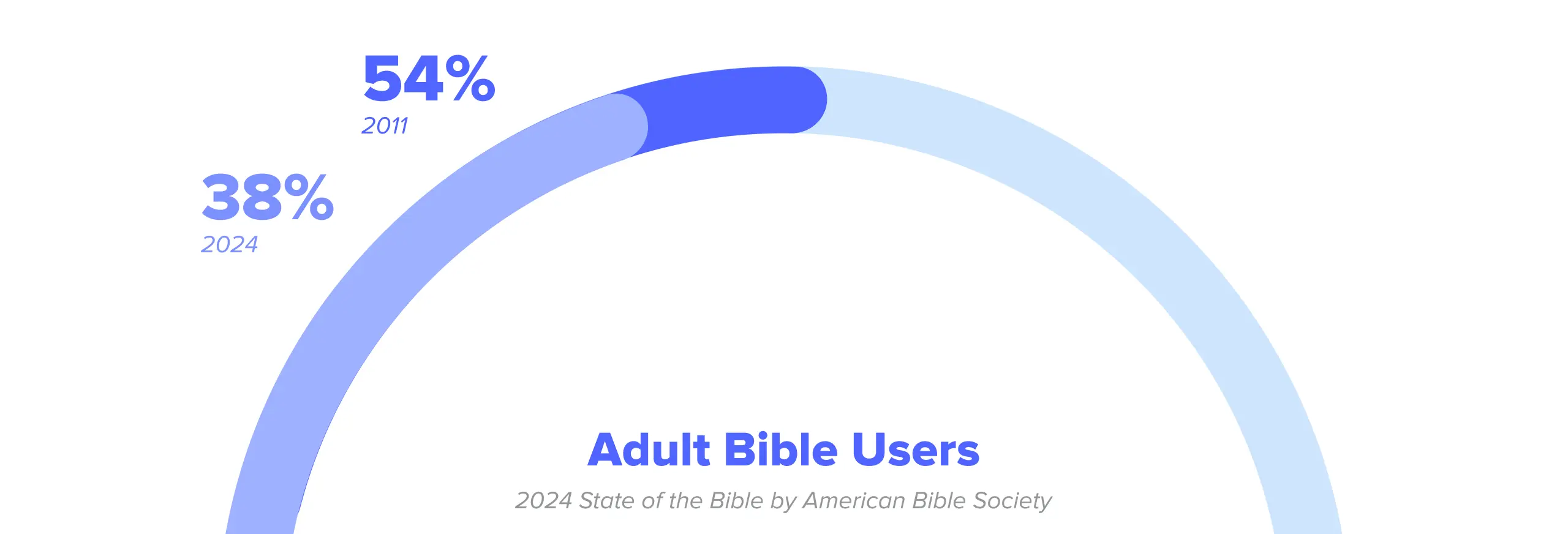
2. Only 38% of American adults engage with their Bible
According to the American Bible Society, over half of Americans were “Bible Users” in 2011, meaning they looked at their Bible daily, weekly, monthly, or at least four times a year. By 2024, that number had dropped significantly, down to 38%.
Scripture engagement has shifted in significant ways. The State of the Bible measures “Scripture Engagement” and “Bible Disengagement” in three areas:
- Impact on one’s relationship with God & others
- Frequency of Bible reading
- Centrality of the Bible in decision-making
The study determined that Scripture Engagement varies widely by demographic:
- 24 million fewer Americans are Scripture Engaged today than in 2020
- 151 million Americans were Bible Disengaged in 2024, reflecting an all-time high in the rate of Bible Disengagement.
- Black Americans lead all other ethnic groups in Scripture Engagement at 28%.
- Evangelical Protestants top the list in Scripture Engagement at 46%, far outpacing any other religious group.
- In the South, 25% of people are Scripture Engaged—nearly double the Northeast and Midwest. In contrast, 67% of the population in the Northwest and West are Bible Disengaged.
- Boomers (24%) and Gen X (21%) are the most Scripture Engaged generations, while Millennials (12%) and Gen Z (11%) are the least.

3. Nearly 30% of American adults qualify as “Nones”
When it comes to religious adherence and Scripture engagement, there are glaring differences between the generations. Nearly 30% of American adults today qualify as “Nones”, those who are religiously unaffiliated—and most of them are young people.
One in six (16%) Boomers qualify as “Nones”, as do 24% of Gen X, 37% of Millennials, and 33% of Gen Z. Nones are more likely to live in large cities rather than the suburbs or rural areas, and more likely to live in the West rather than the South. 64% of Nones say they have no interest in learning about the Bible or Jesus.
Unlike previous generations, Millennials have become less religious as they age, reversing the long-standing trend of people growing more religious over time.
While many of the “Nones” are leaving religious organizations behind entirely, they have yet to walk away from spirituality altogether. In the year 2000, approximately 25% of American adults considered themselves “spiritual but not religious.” Today, that number has grown significantly, with nearly 75% of American adults calling themselves “spiritual,” with or without a religious affiliation.
4. 25 million Americans attend church online
Many people assumed online church services would provide a short-term substitute during the height of the pandemic. Recent data supports this expectation, showing a rebound in in-person attendance.
However, while opinions vary on the theological underpinnings of attending church online, studies show that online church is here to stay. In fact,
- About 25 million Americans attend church online, either primarily online or both online and in person equally.
- Gen X is the most likely to attend church in person (82%), while Millennials and Boomers are the most likely to attend online (both at 15%).
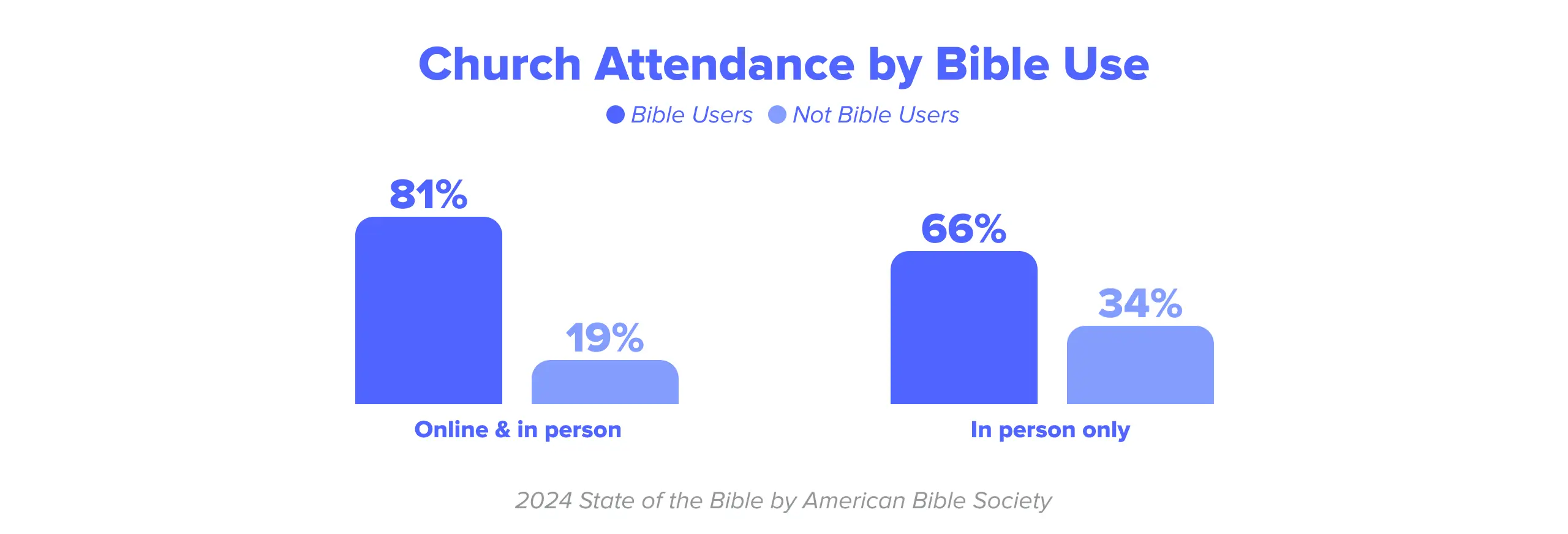
- Over 80% of people who attend both in person and online regularly read their Bibles, compared to 66% of people who primarily attend in person.
These stats represent how online church can be beneficial to many people, including parents with newborns or young children, those who are physically impaired, as well as older generations who may have more physical challenges.
It’s important to note that people often assume that those who attend church online are less engaged with the Bible or their spiritual development. However, the study actually proved the opposite, that those who attend online services—whether exclusively or alongside in-person attendance—are much more likely to read their Bible.
5. 40 million Americans have left the Church in the last 30 years
Over the past few decades, the American religious landscape has experienced significant transformation—marked most clearly by the decline in both the number and size of Protestant congregations.
In the early 2000s, church planting still outpaced closures. However, by 2019, even before the COVID-19 pandemic disrupted religious life, that trend had reversed: only 3,000 new churches were started while 4,500 closed, leading to a net loss of 1,500 congregations in just one year.
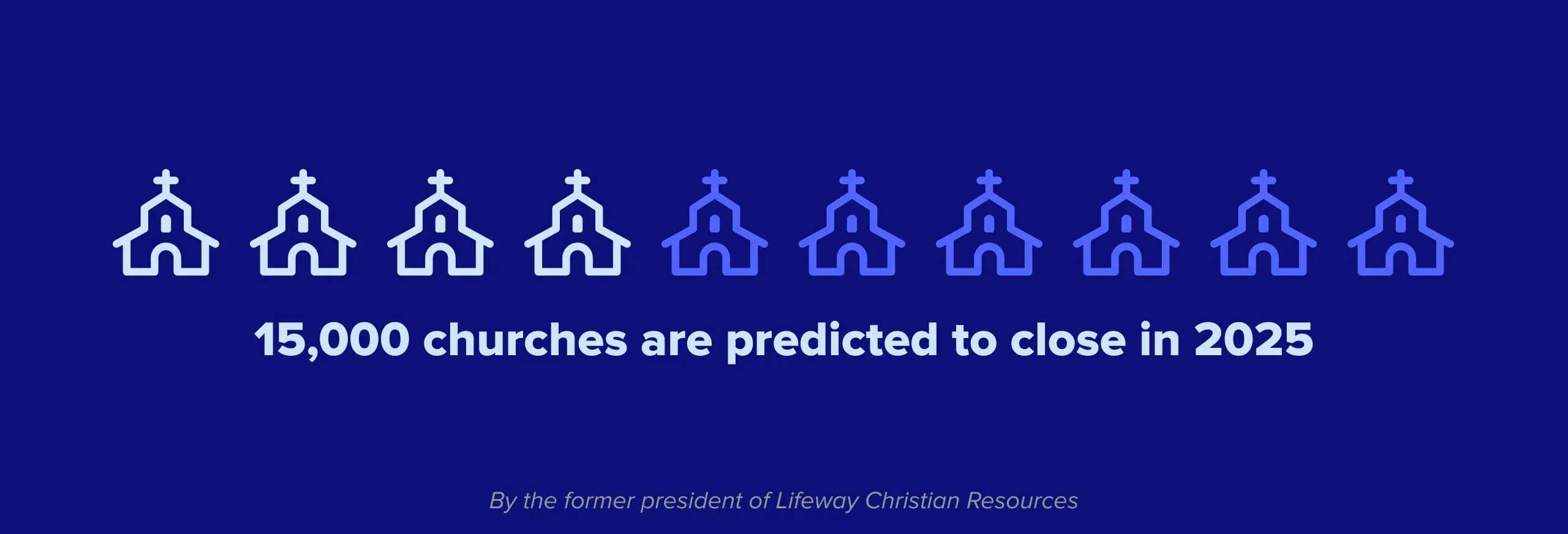
This shift has disproportionately impacted mainline Protestant churches, but White Evangelical and Black Protestant churches have also seen a steady decline in congregational numbers. Some church experts have predicted that 15,000 churches will close in 2025 alone.
Beyond closures, congregations themselves are shrinking. 40 million Americans have left the Church in the last 30 years. The median worship attendance dropped from 137 in 2000 to just 65 by 2020—a 52% decline in two decades. Notably, only one-third of churches are now considered “spiritually vital,” and the majority of growth is occurring in already large churches.
Why there’s hope for the Church today
Even with the rise of religious deconstruction, there’s reason to be encouraged. From 2024-2025, some important stats have seen a major shift or reversal.
According to the 2025 State of the Bible report from the American Bible Society, Bible engagement among Gen Z and Millennials has risen significantly. For the first time since 2021, overall Bible use in America has increased, with 10 million more adults now reading Scripture outside of church.
Studies also show that people are hungry for the Bible. More than half of American adults who are Bible Users (51%) wish they read it more. And 25% of the “Nones” report curiosity about the Bible and/or Jesus.
While church attendance, biblical literacy, and religious affiliation have declined in recent decades, this recent data reveals signs of hope.
As pastors, church leaders, and believers, now is not the time to lose heart—it’s a call to listen to churchgoers and lead with compassion. By embracing dialogue, truth, and community, we remind others that even when everything feels uncertain, God is not finished writing their story.
.webp)

.webp)