.webp)


.webp)


Picture this: It’s early morning during the week after a beautiful, packed Easter or Christmas service. Your church staff and elders are gathered around the office table, fueled by coffee and good intentions, ready to process the weekend’s generosity.
But instead of celebrating, they are staring at a logistical nightmare.
On the table sits a traditional velvet offering plate holding a few crumpled checks. On the laptop screen is a chaotic spreadsheet trying to track dozens of micro-donations from random apps. One person texted a gift to a random church number, three people Venmoed a staff member's personal account, and a handful used an unverified Cash App tag.
What should be a moment of gratitude turns into a grueling multi-hour scavenger hunt of cross-referencing isolated app alerts, tracking down missing donor names, and dreading the upcoming tax season. On top of that, staff are needing immediate numbers to start planning next year’s budget.
Sound familiar?
In a world where over half of all church donations are now completely digital, simply giving your congregation "a way to pay online" isn’t enough anymore. The tools you choose behind the scenes can either fuel your ministry’s vision or completely bury your staff in administrative chaos.
Some online giving platforms are far better than others, especially when it comes to accepting donations for churches and faith-based organizations.
Let’s take a closer look at popular online platforms to discover which ones actually protect your ministry, free up your staff, and offer the best way to collect online donations for your church.
Note: For any questions regarding IRS regulations, please contact the IRS or a tax professional. PayPal, CashApp, Venmo, and GoFundMe may change their terms and conditions at any time. Please consult their website for updated information.
1. PayPal
PayPal is one of the best known online payment processing systems. They offer a secure, simple-to-use solution for receiving and making payments, as well as for receiving donations. It’s possible to add a PayPal button on a website, making it a tempting solution for churches and nonprofit organizations. Additionally, PayPal remains a widely recognized name for standard digital transactions. Many organizations use it because dropping a payment button onto a website is relatively straightforward.
Despite this familiarity, this is not a tool that’s specifically built for churches. Its widespread commercial use demonstrates that while it is excellent for e-commerce, it lacks the pastoral and theological nuance required for ministry stewardship.
Because PayPal treats tithes exactly like retail purchases, your administration team is left with a fragmented workflow. The platform does not natively integrate with Church Management Systems (ChMS) to track member attendance alongside giving trends, nor does it allow a donor to direct their funds toward specific church goals—like a building fund, youth ministry, or a sudden global missions push.
Furthermore, PayPal’s discounted nonprofit rate (1.99% + $0.49 per transaction) features a high flat fee that heavily penalizes smaller gifts, like a recurring $10 or $20 weekly tithe. Without specialized church features like a "donor-covered fees" checkbox or automated, end-of-year IRS-compliant giving statements, your administrative staff will ultimately lose hours every January manually merging PayPal CSV spreadsheets into member profiles.
2. Subsplash
We built Subsplash Giving to offer the absolute best way to accept online donations for ministries of all sizes—from church plants to multi-site congregations.
For too long, church leaders have been forced to stitch together a frustrating patchwork of disconnected financial tools, generic apps, and isolated merchant accounts. We believe your administrative team deserves better.
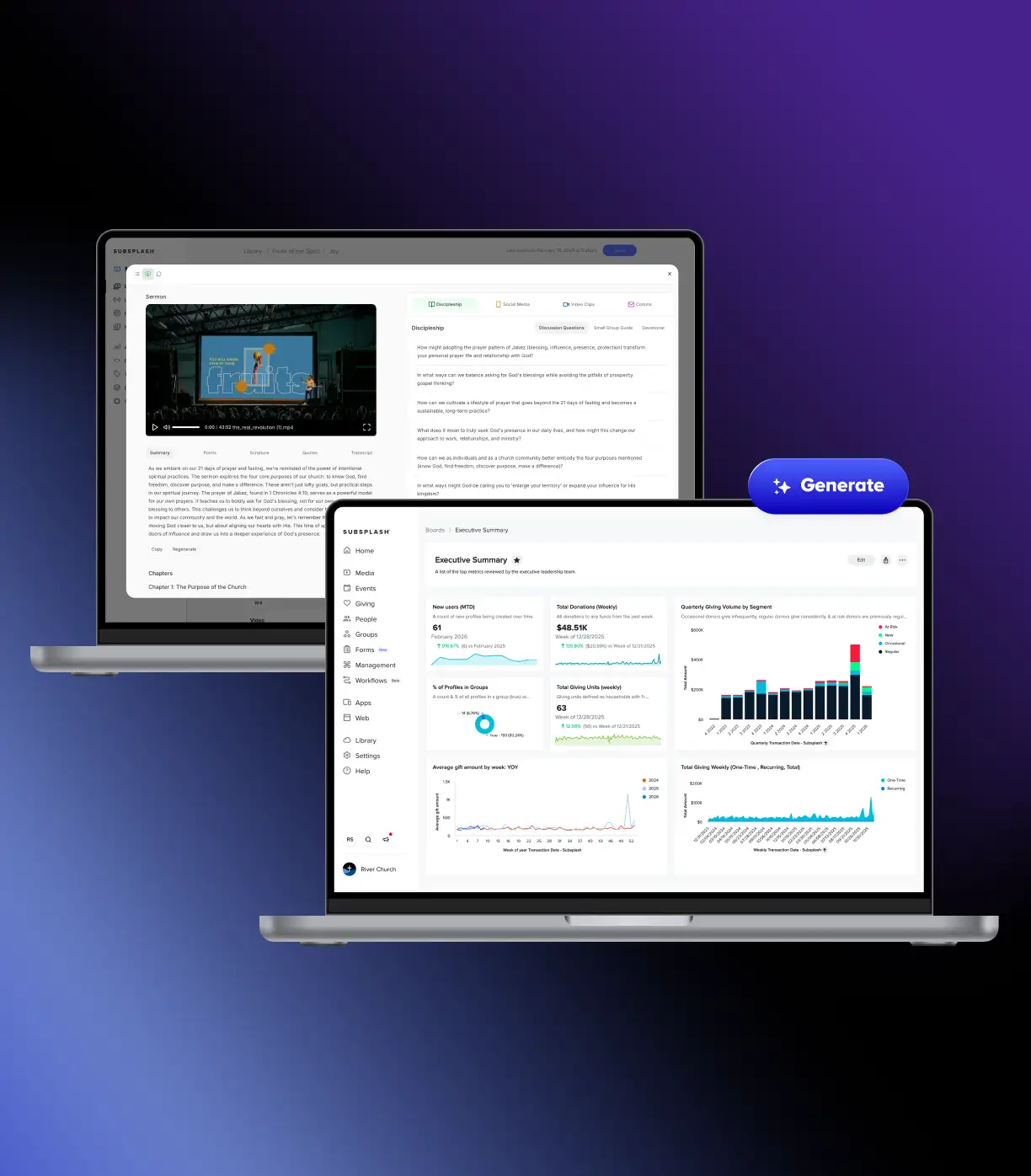
With Subsplash, your staff gains access to a fully unified, church-first ecosystem where giving, media, messaging, and administration all live under one roof. By eliminating fragmented systems, Subsplash acts as a true force multiplier for your mission—slashing your administrative burden, protecting your Kingdom resources, and making digital generosity effortless for your people.
Subsplash is the platform built for churches. Our platform addresses the unique needs of churches and ministries with several practical and imperative features, including:
- Guest giving: Donors can choose not to create an account, streamlining their giving experience
- Recurring giving: Donors can easily schedule their gifts in advance
- Donor-covered fees: Donors can cover any processing fees, which ensures your organization keeps 100% of their donations
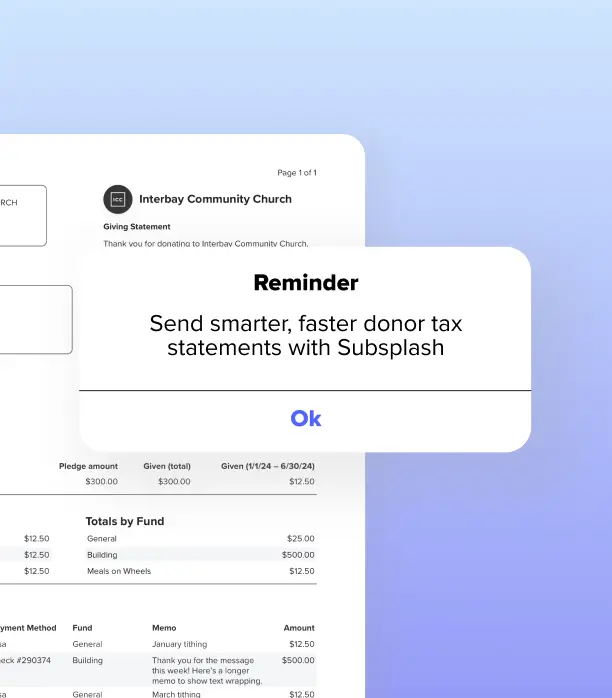
- End-of-year tax statements: Easily send donors their tax deductible contribution statements with a click of a button
- Campaign fundraisers: A powerful, built-in tool that makes running major building initiatives, short-term mission trips, or emergency funds completely seamless.* Unlike complex systems that require hours of staff training, leaders can launch and manage intuitive pledge campaigns in under 30 minutes
- No monthly fees or hidden fees: Simple pricing with no tricks or gimmicks
Evaluating the best online donation platforms for churches requires looking at long-term freedom and security. Subsplash also respects and supports religious freedom with no subjective community guidelines or terms of service, and content policies built to amplify the message of the gospel.
*Check out how Citizens Church successfully used Subsplash to fully digitize their capital campaign, raising $3.5 million in just two months!
3. CashApp
Cash App is a peer-to-peer mobile payment platform that allows users to send, receive, and store money digitally. And while many ministries accept peer-to-peer online donations for churches, they often don’t realize the legal and tax limitations of consumer applications.
Cash App does not have the administrative feature to automatically generate IRS-compliant tax receipts, which they state in their terms to protect themselves. However, if a donor sends money to a verified church or registered 501(c)(3) via Cash App (specifically using a Cash for Business account), the church is required to manually issue the tax receipt.
This creates a major administrative headache. Because Cash App operates outside of your standard church management software, your team must cross-reference isolated app alerts with bank deposits, track down missing donor contact details, and manually type up individual, IRS-compliant giving statements for every single person who gave via their "$cashtag."
This fragmented process drastically increases the window for data entry errors, which can inadvertently jeopardize a donor’s tax deduction or complicate your church’s internal financial auditing. For growing ministries, the hours wasted reconciling these peer-to-peer micro-transactions quickly outweigh any initial convenience the app offered.
Next, while modern church giving platforms like Subsplash allow you to automatically generate unified household tax statements for couples filing jointly, Cash App completely lacks this context. Spouses giving from separate apps remain disconnected, doubling the manual data entry required for your staff to merge, verify, and format cohesive family records.
CashApp transactions also do not offer a “guest giving” option and require creating a CashApp account, meaning every contributor must download the app and register a personal profile. This requirement limits your ability to receive spontaneous gifts from holiday visitors or external supporters.
4. Venmo
Venmo is a mobile payment application owned by PayPal that recently introduced charity profiles for 501(c)(3) organizations. While researching the best online donation platforms for churches, there are a few things to be aware of when it comes to Venmo.
While Venmo offers official charity profiles for 501(c)(3) organizations, it carries many of the same systemic drawbacks as other consumer apps that were just not built with churches in mind.
Importantly, because it shares compliance frameworks with its parent company, ministries face the same subjective "acceptable use" restrictions that can unexpectedly threaten religious organizations over social and political stances. That means when a church signs up for a Venmo Charity Profile, the backend verification process literally forces the ministry to link or create a PayPal Business Account.
Free speech and religious liberty organizations have repeatedly documented cases where traditional financial tech and peer-to-peer processors have frozen accounts or denied service to religious or conservative groups. Because terms like "intolerance" or "discrimination" are defined entirely at the corporate platform’s sole, subjective discretion, traditional religious stances on social or political issues can easily trigger automated compliance flags or sudden account suspensions.
From a functional standpoint, Venmo severely limits a church’s administrative control. The platform requires all profile customization and settings to be managed strictly through a mobile app rather than a robust web-based dashboard. Furthermore, Venmo lacks a "guest giving" option, meaning holiday visitors or external supporters cannot give unless they download the app and create a personal account.
While Venmo does waive its standard 3% credit card fee for donors giving to verified charities, the church itself is still hit with a 1.9% + $0.10 processing fee per transaction, all while your staff is left to manually track and reconcile fragmented records outside of your primary database.
5. GoFundMe
GoFundMe is a popular crowdfunding platform designed primarily for short-term community projects, disaster relief, or sudden emergencies. Unlike other consumer apps, GoFundMe does offer a frictionless "guest giving" option, allowing supporters to donate via a web link without creating an account.
However, GoFundMe poses a major risk for ministries due to its highly subjective Terms of Service. The platform explicitly reserves the right to cancel a fundraiser at its "sole discretion" if it determines an organization promotes what it deems to be ‘discrimination’ or ‘intolerance.’ GoFundMe has routinely made national headlines for freezing accounts and canceling fundraisers due to sudden disagreements with a user’s social, traditional, or religious beliefs—making it a highly unstable environment for long-term ministry funding.
Navigating online donations for churches without the complexity
When navigating online donations for churches, you should start by gathering your official non-profit determination letters and church bank records. Choosing an integrated system avoids the total cost of ownership trap, where teams waste valuable time managing a scattered stack of rigid software tools.
Understanding how to set up online donations for churches ensures that your giving data syncs naturally to member profiles. When you connect your giving platform to your website, live streams, and communication hubs, your staff can automate follow-up workflows. This step keeps your team focused on pastoring people rather than manually entering data into computer screens.
Knowing the best way to accept donations online saves your staff hours of manual entry. Once your system is active, add direct giving links to your digital front doors, including your custom mobile app and online video players. Learning how to set up online donations for churches is simple when you partner with onboarding specialists and the best online donation platforms who understand church operations and were built with churches in mind.
Experience the best way to collect donations online
Choosing the best way to accept donations online isn’t just a financial decision—it’s a ministry decision. Because digital avenue collection continues to expand, your ministry needs an integrated ecosystem rather than isolated payment links.
The best online donation platforms for churches come down to finding a true partner that values partnership over profit. Commercial big tech applications work well for retail businesses, but they lack the discipleship tools needed to nurture a generous culture.
As we’ve seen, relying on "Big Tech" consumer apps might feel convenient at first glance, but they ultimately leave your church vulnerable to subjective policy shifts and saddle your team with a mountain of manual admin work. On the flip side, many generic, secular giving processors sneak in hidden fees, lock you into expensive monthly subscriptions, or even raise your rates as your congregation grows.
Your ministry shouldn’t be penalized for its impact.
Subsplash Giving was built with partnership over profit in mind. We believe that as your ministry grows, your processing fees should shrink. That’s why we created GrowCurve™—a built-in feature that automatically lowers your processing rates as your total donation volume increases, ensuring more money stays where it belongs: working for your church and in your community.
Even better, Subsplash goes far beyond simple transaction processing. It seamlessly integrates your giving platform with your custom mobile app, website, media streams, and Church Management Software (ChMS)—creating a unified digital ecosystem that fosters deeper engagement and makes generosity effortless.
Stop wrestling with fragmented apps and hidden fees. Let us handle the heavy lifting so you can focus on what matters most.
[.blog-contact-cta] Book a free demo today [.blog-contact-cta]to discover how Subsplash Giving can help you encourage generosity and Fuel Your Mission™!