
Download the The ultimate guide to Donor Advised Funds (DAF) for churches
Tools & resources to make disciples in a digital age, straight to your inbox.
Fill out the form below to schedule a demo or call our sales team at
469-564-3922
%20for%20churches.webp)
Most churches rely almost entirely on Sunday giving, online tithes, and the occasional capital campaign. It works until it doesn’t.
What many church leaders don’t realize is that a growing number of faithful, high-capacity givers no longer write checks or swipe cards when they give. They give through Donor Advised Funds (DAFs), which are charitable investment accounts. In fact, according to the National Philanthropic Trust (NPT) 2024 DAF Report, total charitable assets held in DAFs reached $251.52 billion in 2023.
That means billions of dollars are already set aside for giving and just waiting for donors to recommend where it should go.
The big problem is most churches don’t even mention DAFs on their giving page. As a result, those gifts often flow to large nonprofits and universities instead of local congregations.
When your church understands and communicates about DAFs, you can unlock a new stream of generosity. One that’s often larger, more consistent, and more tax-efficient for your donors.
In this guide, we’ll demystify Donor Advised Funds, explain how they work, and show practical ways your church can make them a key part of your digital giving strategy.
Quick editor’s note: Before we dive in, this guide is provided for educational purposes only and should not be considered legal or tax advice. Donors should consult their financial or tax advisor when making charitable contributions.
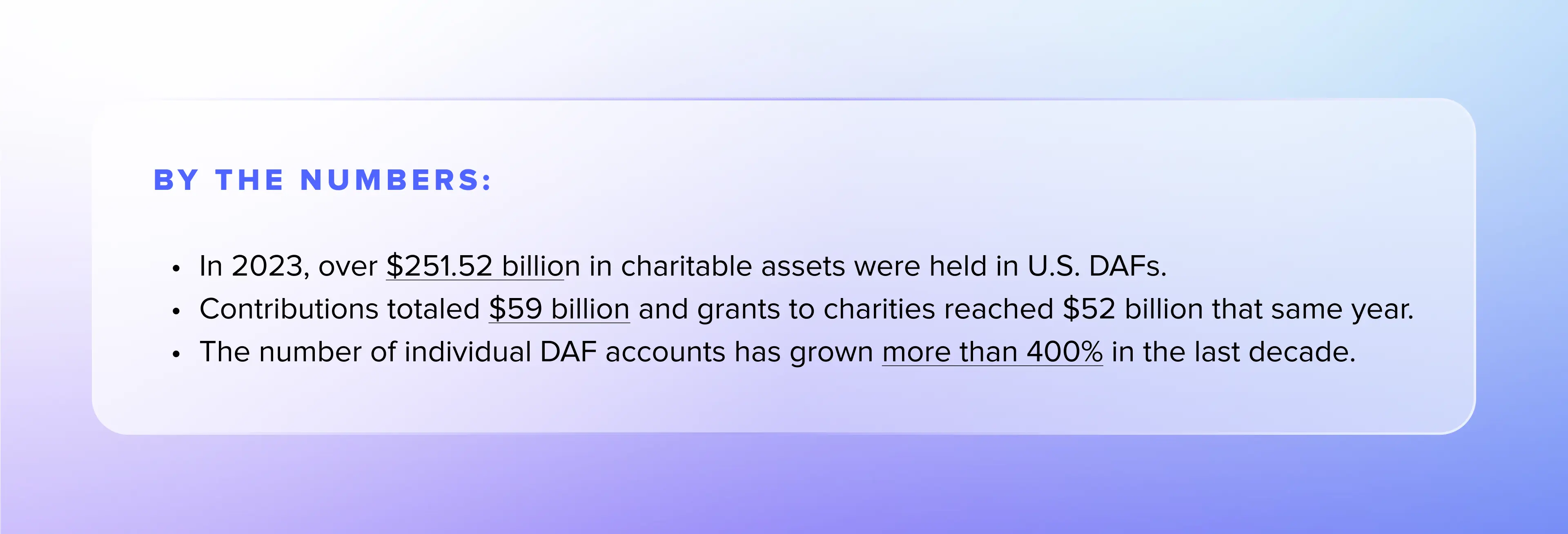
By the numbers:
A Donor Advised Fund (DAF) is like a charitable savings account. Donors contribute money or assets into the account, receive an immediate tax deduction, and then recommend grants to their favorite ministries or nonprofits like your church over time.
The fund is managed by a sponsoring organization, such as:
Think of it as a simple way for donors to set aside money for giving without the complexity of creating a private foundation.
Plus, it follows a straightforward, three-step process:
The sponsoring organization handles the administrative side: processing donations, investment management, and sending out the checks or electronic transfers to ministries.
From a donor’s perspective, setting up a DAF is simple:
It can be done online in minutes, and donors can manage everything digitally.
Then, when a donor contributes to their DAF, they receive an immediate tax deduction in that same tax year, even if they wait to recommend a grant to your church later.
That’s a major incentive. For example, if someone contributes $25,000 in appreciated stock to their DAF in December, they can deduct that amount on that year’s taxes even if they don’t make a grant to your church until next summer.
The most overlooked part of DAFs it is easy for people to give non-cash assets, like stocks, mutual funds, real estate, or cryptocurrency.
Most churches can’t directly accept these complex gifts. But with a DAF, the sponsoring organization handles all the logistics. The donor simply transfers the asset, it’s liquidated by the sponsor, and the proceeds become available for grants to the church.
That means your donors can give far more than they could from their checking account.
In fact, from the Fidelity Charitable 2024 Giving Report, in 2023 over 322,000 donors made grants through their DAFs, totaling $11.8 billion with average grant size over $4,600 and 88% of their accounts recommending at least one grant in the year.
For example, when donors contribute appreciated stock to a DAF, they get a double win:
Let’s say a donor bought $10,000 of Apple stock years ago that’s now worth $40,000. Selling it outright would trigger capital gains taxes on the $30,000 profit. Donating it to a DAF eliminates those taxes entirely, which frees up more money for ministry.
The same principles apply to:
For churches, that means fewer barriers and more opportunity to receive major gifts that might otherwise be impossible to process directly.
Funds inside a DAF can be invested and grow tax-free. Over time, that can increase the total amount available for grants.
So when a donor puts $50,000 into a DAF today, that balance could grow to $60,000 or $70,000 in a few years. All of which can eventually support your church’s mission.
Understanding the why behind why donors love DAFs helps you communicate their value and get more donations.
DAFs allow donors to bundle charitable giving into a single year. For example, a business owner anticipating a large tax year might contribute $100,000 to a DAF in December. They receive the full deduction that year and then recommend $20,000 in grants to your church annually over the next five years.
It’s flexible, tax-smart, and deeply appealing to high-capacity givers.
Instead of collecting dozens of donation receipts from different charities, DAF donors receive one single receipt from their DAF sponsor. That makes year-end tax prep simple and stress-free.
Some donors want to give quietly. DAFs allow for anonymous giving, meaning the donor’s name isn’t shared with the church if they prefer. The sponsoring organization simply sends a grant check on their behalf.
DAFs make it easy for families to pass on a legacy of generosity. Donors can name a successor advisor like a spouse or child, so the next generation continues recommending grants long after the original donor has passed.
This transforms generosity from a one-time act into a multigenerational habit.
Now that you understand what DAFs are and how they work, here’s how to turn that knowledge into growth.
As we alluded to earlier in this post, most churches never mention DAFs. That silence costs them major gifts and donations.
Make it easy and visible, including:
Use your regular stewardship communications, including emails, videos, or giving series, to teach about modern giving tools like DAFs.
Pastors don’t need to turn into financial advisors. Nor, do you need to dive into tax code details, but a brief mention during a generosity series can go a long way.
Focus on clarity and stories like:
Even one sentence like that normalizes DAF giving for your congregation.
When donors understand that your church can receive complex gifts easily, it changes how they think about generosity.
If your church has a stewardship director, business administrator, or major gifts volunteer, train them to ask one simple question during donor meetings, “Do you have a Donor Advised Fund?”
Many donors already do, but have never thought to include their church.
Editor’s tip: Subsplash’s platform makes it easy for your staff to track all forms of generosity in one place so you can identify trends, track donations from all sources including DAFs, and follow up with gratitude when DAF grants come in.
DAF grants often come from the sponsoring organization, not directly from the donor. For example, a check might arrive from “Fidelity Charitable” instead of “John and Mary Smith.”
To maintain strong relationships:
Consistent acknowledgment builds trust and encourages future grants. Plus, once you build a simple system to log DAF gifts and send personal thank-yous, those donors started giving more regularly.
Encourage donors to name your church as a beneficiary of their DAF when they pass.
That means when their DAF is closed, any remaining balance goes directly to your ministry. It’s one of the easiest forms of legacy giving and doesn’t require any lawyers or complex estate planning.
DAFs can smooth out giving patterns. Many donors make a large one-time contribution to their DAF, then distribute smaller recurring grants throughout the year.
That means your church may see steadier giving even when attendance dips or members travel.
For instance, using Subsplash Giving, your team can track those DAF grants alongside online and recurring donations, giving your finance team better visibility into long-term trends.
Even seasoned finance teams can misunderstand how DAFs work. Here are key clarifications to keep you compliant and confident.
Here’s a small but important distinction that your church must communicate clearly if you want to stay compliant. A DAF grant cannot be used to pay off a formal pledge or commitment contract. However, donors can recommend grants toward the same campaign or project, just not as a legally binding pledge fulfillment.
Donors can’t use a DAF to buy anything of value, like event tickets, auction items, or tuition. DAFs are strictly for charitable purposes, not exchanges.
If you host fundraising events, make sure your staff knows to keep DAF contributions separate from ticketed or benefit-related payments.
DAFs typically charge small administrative fees that are often around 0.5–1% of assets annually.That’s usually far less than the 2–3% processing fee on credit card donations.
For high-capacity donors, that’s another reason to favor DAF giving. It’s efficient, secure, and often cheaper than traditional online gifts.
Churches don’t need to open or manage DAFs themselves. All you need to do is:
That’s it! You don’t handle the tax documentation or compliance burden. That’s all managed by the DAF sponsor.

Donor Advised Funds are reshaping how generosity happens in the U.S. Millions of believers now give from their investment accounts, not just their wallets.
For churches willing to adapt, DAFs represent one of the most significant opportunities in modern stewardship by unlocking larger gifts, smoother giving cycles, and long-term legacy support.
When you understand and tap into the power of DAFs, this unlocks a ton of benefits for your church including:
With charitable donations evolving, the tools your donors use are evolving, too. Your mission deserves to keep pace.
Subsplash’s mission is to simplify digital generosity—this includes everything from recurring tithes to non-cash gifts and Donor Advised Funds.
With powerful digital tools including websites, apps, live streaming, giving, church management, and messaging all in one unified dashboard, your church can confidently manage every stream of generosity in one place.
Ready to learn how Subsplash can help your church optimize all your giving streams, from mobile to planned gifts? [.blog-contact-cta]Book your demo here[.blog-contact-cta].
More resources you may find helpful


© 2025 Subsplash


%20for%20churches.webp)
%20for%20churches.webp)


